

Your Complete PTE Test Format Breakdown (2026 Updated)

TL;DR:
-
This blog is aimed at students, professionals, and immigration aspirants who plan to take the PTE Academic exam and want a thorough understanding of the PTE exam format, test structure, and scoring system for effective preparation.
-
The PTE Academic exam consists of three main sections—Speaking & Writing, Reading, and Listening—covering 20+ question types to assess comprehensive English proficiency in approximately two hours.
-
Speaking & Writing lasts 54–67 minutes with tasks like essay writing and describe image; Reading takes 29–40 minutes with multiple-choice and reorder paragraphs; Listening lasts 30–57 minutes including summarizing spoken text and highlight incorrect words.
-
The exam evaluates academic English skills, including reading comprehension, listening, writing, grammar, vocabulary, pronunciation, and the ability to understand and use idiomatic expressions in academic contexts.
-
Minor updates include timing adjustments in Speaking & Writing, tweaks to question types in Reading and Listening, improved guidance on test navigation, and emphasis on academic English, while the scoring system remains unchanged.
Know more about the PTE Exam:
Introduction
Preparing for the PTE Academic exam requires understanding its PTE exam format, PTE test structure, and scoring system. The PTE is a computer-based test lasting approximately two hours, designed to evaluate English proficiency in reading, writing, listening, and speaking.
Recognized by over 3,000 institutions worldwide, including Canada, Australia, the UK, the USA, and New Zealand, the PTE is a trusted pathway for students, professionals, and immigration aspirants. Familiarity with the PTE test format and PTE question types ensures better preparation and improves the chances of achieving a high score
Overview of the PTE Exam Pattern 2025
Preparing for success in the PTE exam? Here’s what you need to know: The PTE exam format 2025 is a computer-based assessment lasting approximately two hours, conducted in a secure Pearson test center environment.
This examination comprises four distinct sections, each designed to evaluate different language skills: reading, writing, listening, and speaking. Within these sections, you will encounter a total of 20 unique PTE question types that assess various aspects of English proficiency.
The Speaking and Writing section together requires approximately 54–67 minutes, while the Reading section lasts around 29–30 minutes, and the Listening portion ranges from 30–43 minutes.
Your performance on the PTE test is graded on a scale from 10 to 90. Therefore, it’s essential to prepare thoroughly to tackle the challenges and demonstrate your proficiency in different language skills. This guide will also help you understand the PTE test structure, syllabus, and section-wise breakdown.
PTE Test Format 2025
A One Australia presents a digital assessment to evaluate your reading, writing, listening, and speaking abilities. The PTE test format 2025 is designed to provide a comprehensive assessment of your English proficiency.
The PTE Academic test session lasts approximately two hours, enabling a thorough evaluation of your answers and helping you identify areas for improvement before your final exam.
When you arrive at the secure Pearson test center, you will be provided with a computer and headset. The Reading, Writing, Speaking, and Listening components make up the PTE Academic exam structure.
- Speaking & Writing modules are assessed together, while Listening and Reading are evaluated separately.
- The exam includes 20+ PTE question types across all sections, such as multiple-choice questions, essay writing, sentence reading, and selecting the correct answers.
- The PTE test is non-stop and generally comprises 50–55 questions in total.
The PTE exam pattern reflects real-life academic and general English content, including graphs, summaries, excerpts, and other materials you might encounter in everyday academic or professional settings.
It also incorporates both native and non-native accents, mirroring the English you hear in movies, TV shows, lectures, and conversations.
Thinking about studying abroad? The Pearson Test of English (PTE) is widely recognized by over 3,000 institutions worldwide, including in Canada, the UK, the USA, Australia, and New Zealand. The PTE is known for its speedy results and reliability in assessing English proficiency.
In 2025, the PTE exam format consists of three main sections: Reading, Listening, and Speaking & Writing. If you are planning to take the PTE Academic test for international studies, understanding the PTE test structure and syllabus is essential. This guide will provide a clear breakdown of the PTE exam pattern and helpful preparation tips for success.
PTE Exam Pattern & Structure 2025
When preparing for studying overseas, it becomes necessary to exhibit English language test scores to validate your linguistic proficiency. These scores assure educational institutions that you possess the capability to pursue courses conducted in English.
The Pearson Test of English (PTE) Academic, one of the most recognized exams, assesses applicants’ reading, speaking, listening, and writing skills. Understanding the PTE exam pattern 2025 is essential for effective preparation.
The purpose of the PTE exam structure is to evaluate if applicants can thrive in international academic settings. Students’ abilities to comprehend, read, listen, speak, and write in English when immersed in a foreign environment are reflected in their PTE Academic results.
The PTE exam pattern has three major sections: Reading, Listening, and Speaking & Writing, similar to other English proficiency tests. Familiarity with the PTE test format helps candidates approach each section strategically and improve their scores.
PTE Exam Syllabus 2025
The PTE exam syllabus covers various academic English topics. It assesses your ability to comprehend, interpret, and apply academic vocabulary, grammar, and sentence structures effectively in academic settings.
The syllabus includes the following key areas:
- Reading and writing academic texts
- Listening to academic lectures and discussions
- Writing summaries and essays
- Understanding academic vocabulary
- Using grammar and syntax confidently
- Comprehending idiomatic expressions
Mastering these topics is essential for demonstrating your proficiency in academic English. The PTE exam evaluates how well you can interact and communicate within academic environments.
For detailed reference, you can also consult the PTE exam syllabus PDF, which provides a comprehensive breakdown of each section and task type.
PTE Exam Pattern Comparison Table
|
Feature / PTE Structure |
Old PTE Format |
New PTE Format 2025 |
|
PTE Speaking tasks |
5 tasks |
7 tasks |
|
New PTE question types added |
— |
Summarise Group Discussion, Respond to a Situation |
|
PTE Scoring system |
AI-based evaluation only |
Hybrid scoring: AI + human raters |
|
PTE Exam Duration |
~2 hours |
2 hours 15–20 minutes |
|
Template usage |
Templates widely used and accepted |
Template-style responses downgraded; natural speaking required |
|
Task weightage |
Standard weight distribution |
Higher weight for Describe Image & Summarise Written Text |
|
Focus of PTE test format |
Speed and structured responses |
Spontaneous communication, natural speaking, note-taking, real-world language use |
The updated PTE syllabus format is designed to reward genuine English skills and real-time communication instead of memorized templates and repetitive patterns.
Types of PTE Tests and Their Uses
Different categories of PTE tests serve specific purposes. These include PTE Academic and UK Government Tests, formerly referred to as PTE.
PTE Academic is commonly taken by individuals for academic intentions and holds substantial recognition in English-speaking countries like Australia, the United States, the United Kingdom, and New Zealand. Understanding the PTE test format is essential for effective preparation and helps candidates approach each section strategically.
Furthermore, individuals seeking employment or immigration visas from the Australian and New Zealand governments are also required to complete this particular examination. For detailed reference, candidates can consult the PTE test format PDF, which provides a complete overview of sections, question types, and timing.
PTE Exam Pattern, Format, and Vital Aspects 2025
The PTE exam format 2025 is the same in all countries that accept PTE Academic results, although the cutoff scores may vary depending on the institution or immigration requirement.
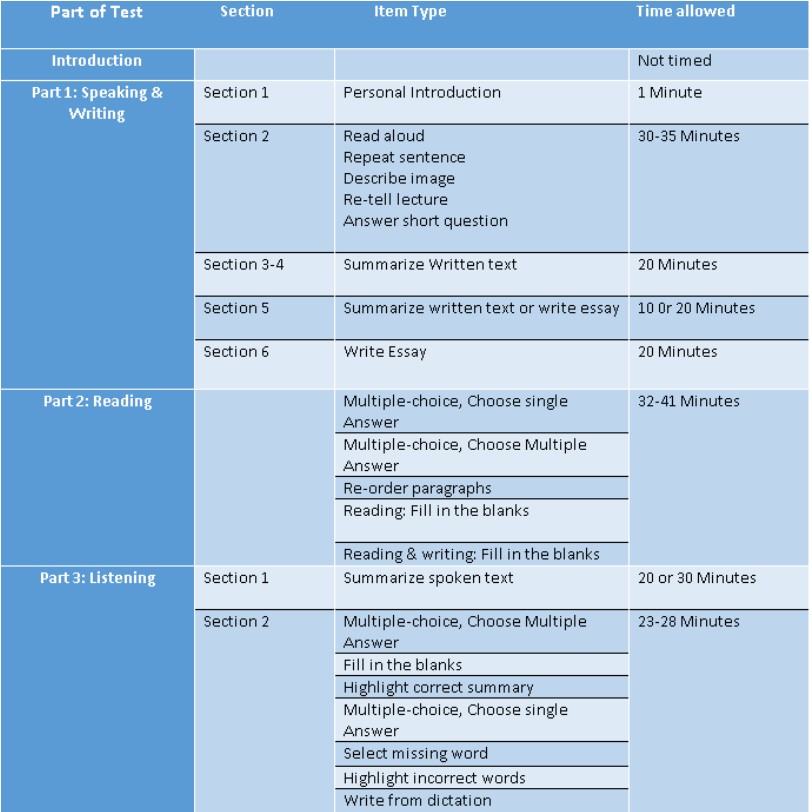
Consult the provided table to get a thorough understanding of the PTE test structure, including PTE sections, PTE modules, and PTE question types. Familiarity with the PTE exam pattern helps candidates plan their preparation effectively and manage time efficiently during the test.
For detailed reference, candidates can also download the PTE test format PDF, which provides a complete overview of section-wise durations, question types, and scoring criteria.
The PTE Exam Result 2025
Typically, candidates require approximately two hours to complete the PTE Academic exam. Upon finishing the test, they receive their PTE exam results, which reflect performance across Speaking & Writing, Reading, and Listening sections.
It is important to note that PTE exam scores are valid for two years, similar to TOEFL and IELTS. Candidates can send their PTE marks to an unlimited number of universities and institutions worldwide.
Understanding the PTE exam pattern, PTE test structure, and PTE modules chart allows candidates to approach the test strategically and maximize their scores. Familiarity with the PTE Academic exam format ensures better time management and performance in all PTE sections.
Now that you have a comprehensive understanding of the PTE exam pattern 2025, PTE test format, and scoring system, you can confidently begin your PTE Academic preparation. Remember, your PTE scores remain valid for two years, giving you ample time to explore academic and professional opportunities without any restrictions on score submissions.
PTE Exam Structure: Section-wise Details 2025
Speaking & Writing
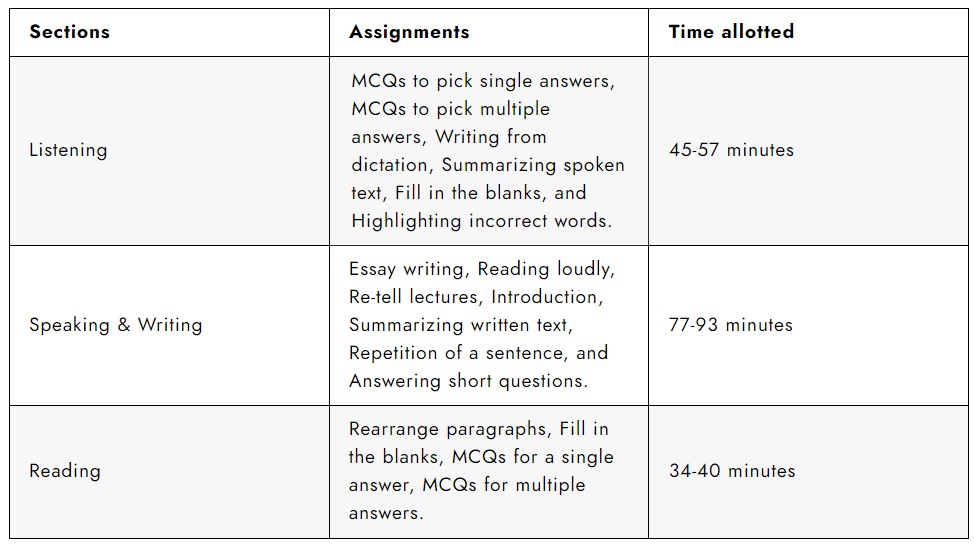
The PTE exam format 2025 is structured into three main sections: Speaking & Writing, Reading, and Listening. The Speaking and Writing section evaluates the speaking and writing proficiency of candidates. It typically lasts 77–93 minutes and encompasses six tasks or sub-sections, covering essay writing, describe image, read aloud, and repeat sentence. Understanding the PTE test structure helps candidates manage their time effectively in this section.
Reading
The Reading section assesses candidates’ ability to comprehend academic and general English texts. It consists of five segments, with a recommended completion time of 32–40 minutes. Key PTE question types in this section include multiple-choice questions, reorder paragraphs, and fill in the blanks.
Listening
The Listening section, lasting 45–57 minutes, evaluates candidates’ ability to understand spoken English in lectures, conversations, and academic contexts. Students should carefully listen to audio materials and retain the information. This section comprises eight sub-segments, including summarize spoken text, multiple-choice, and highlight incorrect words.
A detailed overview of the PTE exam pattern, PTE modules, and section-wise durations can be found in the PTE test format PDF, which serves as a comprehensive guide for candidates preparing for the PTE Academic exam 2025.
PTE Academic Exam Pattern and Format 2025
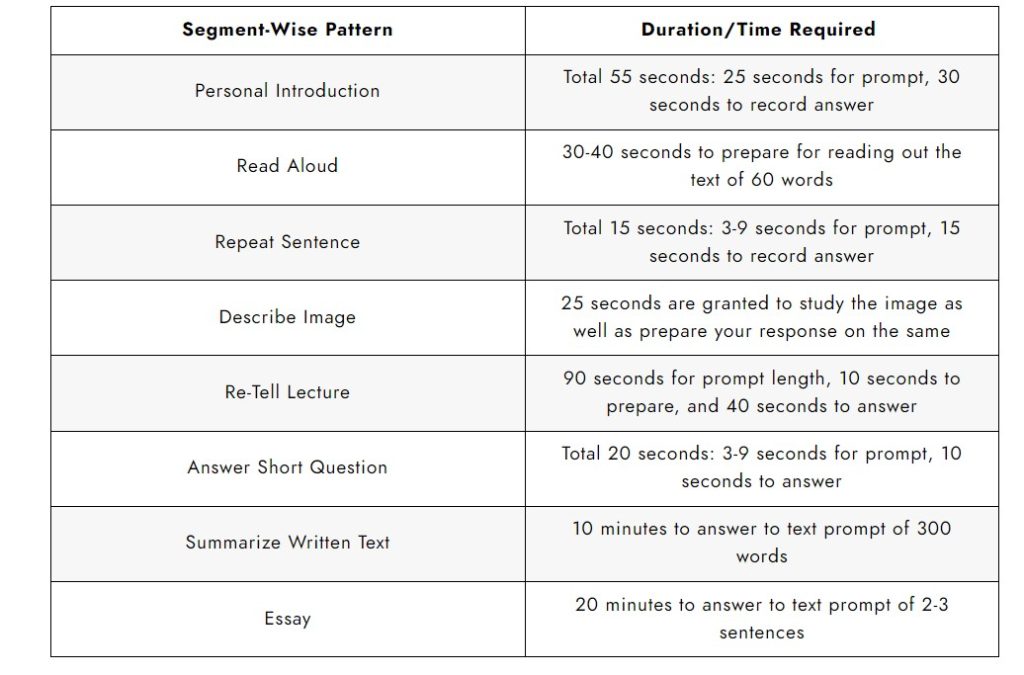
Similar to other language proficiency exams, the PTE Academic exam evaluates students’ speaking, listening, writing, and reading abilities. Understanding the PTE exam pattern 2025 and PTE test structure is essential for effective preparation.
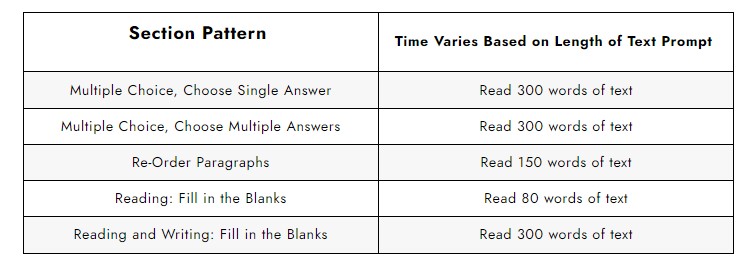
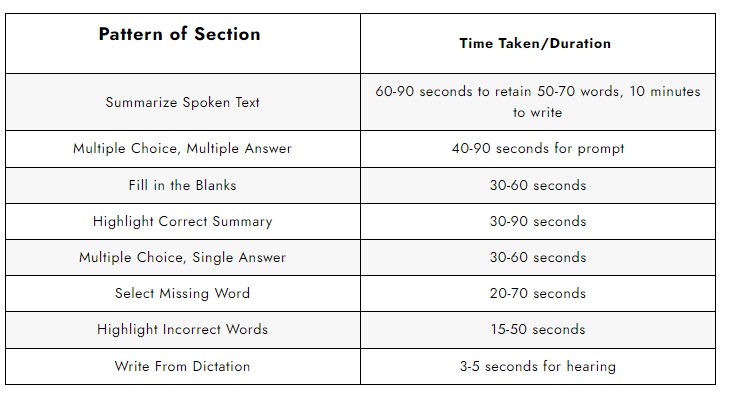
The following table provides a detailed explanation of the PTE Academic exam format, including PTE sections, PTE modules, PTE question types, and section-wise durations. Candidates can also refer to the PTE test format PDF for a comprehensive guide on tasks, scoring, and exam structure.
The PTE Exam Result 2025
Typically, candidates require approximately two hours to complete the PTE Academic exam. Upon finishing the test, they receive their PTE exam results, which reflect performance across Speaking & Writing, Reading, and Listening sections.
It is important to note that PTE exam scores are valid for two years, similar to TOEFL and IELTS. Candidates can send their PTE marks to an unlimited number of universities and institutions worldwide.
Understanding the PTE exam pattern, PTE test structure, and PTE modules chart allows candidates to approach the test strategically and maximize their scores. Familiarity with the PTE Academic exam format ensures better time management and performance in all PTE sections.
Now that you have a comprehensive understanding of the PTE exam pattern 2025, PTE test format, and scoring system, you can confidently begin your PTE Academic preparation. Remember, your PTE scores remain valid for two years, giving you ample time to explore academic and professional opportunities without any restrictions on score submissions.
How to Prepare for the New PTE Format (2025 Update)
With the introduction of new speaking tasks and hybrid scoring, your preparation approach must evolve. The following strategies will help you adapt to the latest PTE test format 2025:
Effective Preparation Tips for the Updated PTE Exam
- Prioritize natural speaking over memorized templates
The new PTE scoring system rewards authentic tone, clarity, and spontaneous expression rather than fixed T-templates. - Practice real group discussions
The Summarise Group Discussion task requires engaging, listening, note-taking, and summarizing live speech. Practice with peers or through structured practice groups. - Do spontaneous speaking drills
Practice answering questions with minimal preparation time to build fluency and confidence. This helps prepare for Respond to a Situation tasks. - Use sticky-note note-taking training
Practice writing key points quickly on sticky notes. Focus on keywords, speaker opinions, numbers, and transitions to improve listening + speaking clarity. - Train with modern AI scoring tools aligned with 2025 standards
Use updated PTE mock test platforms (for example, MockMaster or similar tools) that simulate hybrid scoring and reward natural responses. - Improve active listening
Listen to podcasts, debates, and discussions to strengthen comprehension and summarization skills. - Practice timing and pressure management
The exam is now longer, and. speaking has more tasks. Build stamina and pacing through full-length mock exams
Updates in PTE 2025 – Minor Rule Changes and Format Updates
The PTE exam 2025 continues to follow the PTE Academic test format while introducing minor updates to improve candidate experience and assessment accuracy.
Key PTE exam updates include:
- Timing adjustments for certain tasks in the Speaking & Writing section to better reflect real-life academic scenarios.
- Minor tweaks in PTE question types to enhance clarity and consistency across the Reading and Listening sections.
- Updated PTE test structure guidance for candidates, ensuring easier navigation and understanding of section-wise tasks.
- Emphasis on academic English proficiency, including comprehension, grammar, vocabulary, and written communication.
- Availability of an updated PTE test format PDF for candidates to download, showing sections, question types, durations, and scoring criteria.
These PTE 2025 updates do not change the overall scoring system but ensure that the PTE exam pattern remains aligned with international academic standards. Candidates are encouraged to review the PTE syllabus and familiarize themselves with the latest PTE test format before taking the exam.
FAQs:
1.Why is spontaneous speaking important in PTE practice?
Spontaneous speaking helps you respond quickly and confidently, just like in the actual PTE exam environment. It builds real fluency, improves tone variation, and strengthens on-the-spot language skills, which are now vital for high PTE scores.
2.What is the sticky-note technique for PTE note-taking?
The sticky-note technique involves jotting down keywords, connectors, and phrases on small notes while practicing listening and speaking tasks. This builds quick notepad usage habits that improve efficiency during the actual PTE Academic test.
3.Should I use AI-based PTE scoring tools?
Yes, practicing with AI-based PTE mock tests helps you understand your fluency, pronunciation, and content accuracy. Tools like MockMaster provide modern scoring aligned with the updated PTE exam pattern, making preparation more realistic and effective.
4.What is the PTE exam format 2025?
The PTE Academic exam 2025 consists of three main sections: Speaking & Writing, Reading, and Listening, with a total of 20+ PTE question types.
5.How long is the PTE test duration?
The PTE exam duration is approximately 2 hours, with Speaking & Writing lasting 54–67 minutes, Reading 29–30 minutes, and Listening 30–43 minutes.
6.What are the PTE question types?
The exam includes essay writing, describe image, multiple-choice, reorder paragraphs, summarize spoken text, and fill in the blanks, among others.
7.What is included in the PTE exam syllabus 2025?
The PTE syllabus evaluates academic English skills, including reading comprehension, listening, writing summaries, grammar, vocabulary, and pronunciation. Candidates can also refer to the PTE exam syllabus PDF for detailed guidance.
8.Are there any updates in PTE 2025?
Yes, minor updates include timing adjustments, tweaks to question types, and updated PTE test structFAQs About Preparing for the New PTE Format
9.How can I prepare effectively for the new PTE format?
To prepare effectively for the new PTE format, focus on developing natural speaking skills instead of relying on memorized templates. Engage in real group discussions, practice spontaneous speaking responses, and use structured note-taking strategies like the sticky-note technique.
10.Is memorizing templates still useful for PTE preparation?
Templates are not as effective anymore due to updated PTE scoring criteria. The new format rewards natural tone, contextual fluency, and authentic communication. It’s better to practice real-time speaking, active listening, and natural sentence flow.