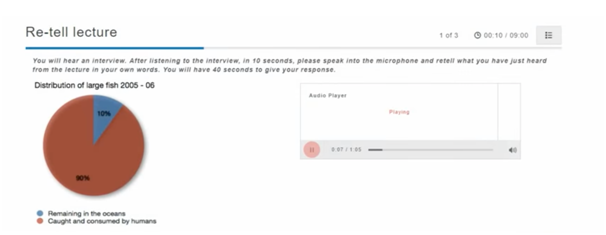
In the re-tell lecture PTE task, after you listen to or watch a lecture, you must re-tell the lecture. However, you must not repeat the exact lecture, you have to re-tell it in your own words.
You will get 40 seconds to watch or listen to a lecture and then you must provide your response.
Remember:
Speak clearly in your normal tone.
Say your entire response before the progress bar is completed.
You can only record your response once, so be as accurate as you can.
✅ Re-tell lecture tips and strategies to follow
In order to make sure you don’t miss the initial start of the recording, remember to start speaking in the first 3 seconds of your total allotted time. Use the time before the recording start to check your notes and get ready to start your response.
Do not speak too fast that you lose your fluency and clarity. However, if you speak too slow then you might run out of time, so speaking naturally is key. Practicing PTE re-tell lecture templates could help you practice your pace and fluency.
Stress words that require emphasis and pause whenever the sentence ends. Listen to the lecture carefully to remember the tones and pauses as much as possible. Keep speaking without any hesitation even if you make a mistake. Stopping will only make you lose time.
When taking notes for the lecture, write as little as three words per line so you don’t get confused due of sloppy handwriting when your giving your response.
You should not be re-telling the exact lecture, but remember to use around 25-30 words from the real recording to make sure you don’t go off track in your response.
✅ Scoring
Re-tell lecture scores are based on 3 factors:
✅ Content
The accuracy and thoroughness with which you express the context, characters, elements, actions, and developments provided in the lecture determines your content score.
The best response you can offer is to include all the main ideas of the lecture and include potential outcomes, conclusions and consequences. If you do not connect all the ideas you speak about, then it could lead to a lower score.
✅ Oral fluency
Your response must be smooth, fluent and natural.
Your tone, rhythm, accuracy, pauses and stresses are going to determine your score on this standard.
✅ Pronunciation
Your speech must be similar to the natural way English speakers sound.
Pronunciation scores will be determined by observing if what you’re saying will be understood by the majority of the regular English speakers.
✅ Notes
No credit is granted for no response or a response that is irrelevant. Listening, speaking, oral fluency, and pronunciation are all scored differently depending on the response.
Your writing and reading skills are not tested by this question type.
This blog is aimed at PTE Academic aspirants, students, and professionals who want to improve their performance in the PTE Read Aloud task by learning strategies, sample questions, and scoring tips.
The PTE Read Aloud task tests reading accuracy, oral fluency, and pronunciation. Candidates get 30–40 seconds to prepare and must read the text aloud clearly in one attempt.
Daily practice using sample texts, recording responses, starting with shorter passages, simulating exam conditions, and focusing on natural tone and stress are crucial for improvement.
Use pauses effectively, chunk the text, emphasize keywords, start speaking promptly, and practice consistently to build confidence and accuracy.
Avoid skipping words, rushing, monotone speech, or incorrect pausing. Scores are based on content accuracy, oral fluency, and pronunciation, so targeted practice is essential to maximize results.
The PTE Read Aloud task is a key part of the PTE Academic Speaking and Reading section. It evaluates how accurately and fluently you can read a given text aloud. In this guide, we cover PTE Read Aloud strategies, PTE Read Aloud sample questions, scoring tips, and best practices to help you maximize your score.
You will have 30–40 seconds to prepare your response for the PTE Read Aloud task. During this time, get ready and organize your answer. A short tone will signal the start of your speaking time, and that is your cue to start speaking immediately.
This task is part of the Reading and Speaking section of the PTE Academic test, which assesses both your reading and speaking skills.
Remember:
Speak clearly in your natural tone.
Complete your entire response before the progress bar ends.
You can record your response only once, so accuracy is crucial.
How to Prepare for PTE Read Aloud
To excel in the PTE Read Aloud task, consistent practice and focused strategies are essential. Here’s how you can prepare effectively:
Practice daily: Regularly attempt PTE Read Aloud sample texts to improve pronunciation, fluency, and confidence.
Focus on natural tone and stress: Emphasize important keywords and maintain a conversational rhythm while reading.
Simulate exam conditions: Use mock tests and timed exercises to get comfortable with the real PTE environment.
Start with shorter passages: Begin with short texts, gradually progressing to longer paragraphs to build endurance and accuracy.
Record and review: Record your responses and compare them with model PTE Read Aloud samples to identify mistakes and improve.
Strategies for PTE Read Aloud Success
Use Pauses Effectively: Pauses are crucial between sentences. Use full stops and commas as indicators to pause briefly, ensuring your speech sounds natural and clear.
Chunk the Text: During your preparation time, divide the text into smaller chunks. Focus on speaking each chunk separately rather than reading the entire paragraph at once.
Stress and Emphasis: Highlight important keywords while speaking to convey meaning clearly and improve pronunciation.
Start Promptly: Begin speaking within the first 3 seconds of your allotted time to maximize your response window.
Daily Practice: Practice PTE Read Aloud questions consistently using PTE Read Aloud sample texts. Aim for 20 questions per day, a few weeks before your exam, and record yourself to track improvement.
Common Mistakes to Avoid in PTE Read Aloud
To achieve a high score in the PTE Read Aloud task, it’s important to be aware of common errors that can reduce your marks:
Skipping or Mispronouncing Words: Missing or incorrectly pronouncing words directly affects your content and pronunciation scores. Practice with PTE Read Aloud sample texts to improve accuracy.
Reading Too Fast: Rushing through the text can cause mistakes and make your speech sound unnatural. Pay attention to punctuation and maintain a steady pace.
Monotone Speech: Speaking without proper stress or intonation can make your response sound flat. Emphasize key words to convey meaning effectively.
Incorrect Pausing: Pausing at the wrong places or not pausing at all can disrupt fluency. Use full stops, commas, and sentence structure as cues for natural pauses.
Tip: Regularly recording and reviewing your PTE Read Aloud practice will help you identify and correct these mistakes.
PTE Read Aloud Scoring Criteria
The PTE Read Aloud task is scored based on three main factors:
Content:
Your response must include all the words from the given text and should not contain extra words.
Points are awarded for each correct word. Missing, changing, or adding words can reduce your score.
Oral Fluency:
Your speech should be smooth, natural, and fluent.
Scores consider your tone, rhythm, pauses, stress, and overall flow of speech.
Pronunciation:
Speak in a way that is understandable and close to natural English pronunciation.
Pronunciation is evaluated on whether native English speakers can clearly understand your response.
Practice Tip: Improve your score by practicing PTE Read Aloud questions and PTE Read Aloud sample texts through mock tests. For example, you can try One Australia PTE Mock Tests to simulate real exam conditions.
PTE Read Aloud Practice Plan / Daily Routine
A structured practice plan can significantly improve your PTE Read Aloud score. Here’s a recommended routine:
Week 1–2:
Focus on pronunciation, stress, and intonation.
Practice 10–15 short PTE Read Aloud sample texts daily to build confidence and accuracy.
Week 3–4:
Attempt full-length passages similar to real exam texts.
Record your responses and listen carefully to identify mistakes and areas for improvement.
Daily Practice:
Review your recordings and correct errors in pronunciation, pauses, and fluency.
Time yourself to simulate real exam conditions and gradually increase reading speed while maintaining accuracy.
Tip: Regularly usingPTE Read Aloud sample questions will help you get accustomed to different text types and difficulty levels.
FAQs – PTE Read Aloud
Q1: What is the PTE Read Aloud task?
The PTE Read Aloud task requires you to read a given text aloud clearly and naturally. It assesses both your reading and speaking skills.
Q2: How long do I have to prepare for the PTE Read Aloud text?
You get 30–40 seconds to prepare before a tone signals you to start speaking. Use this time to quickly review and plan your response.
Q3: Can I practice with PTE Read Aloud samples?
Yes, practicing with PTE Read Aloud sample texts helps improve pronunciation, fluency, and confidence. Regular practice familiarizes you with different text types and sentence structures.
Q4: What is the best strategy to improve my PTE Read Aloud score?
Focus on chunking the text, using proper pauses, emphasizing keywords, and practicing daily with PTE Read Aloud sample questions. Recording and reviewing your practice also helps.
Q5: How is the PTE Read Aloud task scored?
Scores are based on three factors: Content (accuracy of words), Oral Fluency (smoothness and rhythm), and Pronunciation (clarity and natural English pronunciation). Practicing with PTE Read Aloud samples can help maximize your score.