
pte marks distribution

PTE Marks Distribution Explained -Complete Score Breakdown Guide
pte marks distribution

TL;DR

  • This blog is designed for PTE Academic aspirants, students, and professionals who want to understand how their performance in different tasks contributes to their overall score. It explains the PTE marks distribution in a clear, structured way to help candidates plan their preparation strategically.
  • Provides a detailed explanation of PTE marks distribution across all modules,Speaking, Writing, Reading, and Listening,and highlights how each question type impacts the overall score.
  • Explains how the AI-based scoring system evaluates integrated skills, meaning some tasks affect multiple modules simultaneously, making the final score calculation different from simple addition of marks.
  • Identifies high, medium, and low impact tasks like Repeat Sentence, Write From Dictation, and Reading Fill in the Blanks, helping candidates focus on tasks that can significantly boost their score.
  • Offers actionable preparation tips and examples of how individual task performance translates to module and overall scores, allowing candidates to set realistic goals and improve their PTE performance efficiently.

Related Blog

Understanding PTE marks distribution is essential for anyone preparing for the Pearson Test of English Academic exam. Many test-takers want to know how their performance in different tasks contributes to their final score. In simple terms, PTE marks distribution refers to how scores are calculated and allocated across various question types and skills in the exam. Since the test measures multiple language abilities at the same time, the scoring system can sometimes seem complex for new candidates.

Students often search for information about the score distribution in PTE to understand which tasks have the greatest impact on their overall result. Knowing this helps candidates focus on high-weight questions and improve their preparation strategy. However, confusion arises because the PTE exam uses an AI-based scoring system where some tasks contribute to more than one skill at the same time.

The exam evaluates four main language modules: Speaking, Writing, Reading, and Listening. Each section contributes to the overall result, and scores are reported on a scale from 10 to 90. A clear PTE marks chart helps candidates understand how their performance across different tasks affects their final score and where they should focus their preparation efforts to achieve a higher band.

What is PTE Marks Distribution?

PTE marks distribution explains how scores are allocated across different question types and skills in the PTE Academic exam. Unlike traditional tests where marks are simply added together, the marks distribution in PTE is based on a more advanced scoring system that evaluates multiple language abilities at the same time.

The PTE exam uses a scoring scale from 10 to 90, where candidates receive individual scores for Speaking, Writing, Reading, and Listening, along with an overall score. Each task in the exam contributes differently to these skill scores depending on the type of question and the language abilities it measures.

Another key feature of the PTE marking distribution is that the exam uses an AI-based scoring algorithm. This automated system evaluates responses based on several criteria such as pronunciation, fluency, grammar, vocabulary, and comprehension. Because of this technology, scoring is consistent and objective across all test-takers.

Additionally, the PTE exam follows an integrated skills scoring model. This means many question types assess more than one skill simultaneously. For example, some tasks test both speaking and listening or reading and writing at the same time. As a result, the final score is not calculated by simply adding marks from each section, but by analyzing performance across all tasks and skills collectively.

PTE Exam Sections and Score Distribution

The PTE Academic exam is divided into three main sections, each designed to evaluate different language abilities. Understanding the score distribution in PTE across these sections helps candidates see how various question types contribute to their overall performance. Each section focuses on specific skills, but many tasks also test integrated language abilities, meaning a single question can influence more than one score.

The exam measures performance in four core skills: Speaking, Writing, Reading, and Listening. These skills are assessed through multiple question formats across the three sections. Reviewing a PTE marks chart can help candidates understand how different tasks are distributed within the test and how they impact their scores.

Below is an overview of the PTE exam sections and their score distribution:

SectionSkills TestedQuestion Types
Speaking & WritingSpeaking + WritingRead Aloud, Repeat Sentence, Describe Image
ReadingReadingFill in the Blanks, Reorder Paragraphs
ListeningListeningSummarize Spoken Text, Write From Dictation

Each section plays an important role in the overall score distribution in PTE, so candidates should prepare strategically for all question types to achieve a balanced and competitive score.

PTE Marks Distribution Chart (Overall Score Structure)

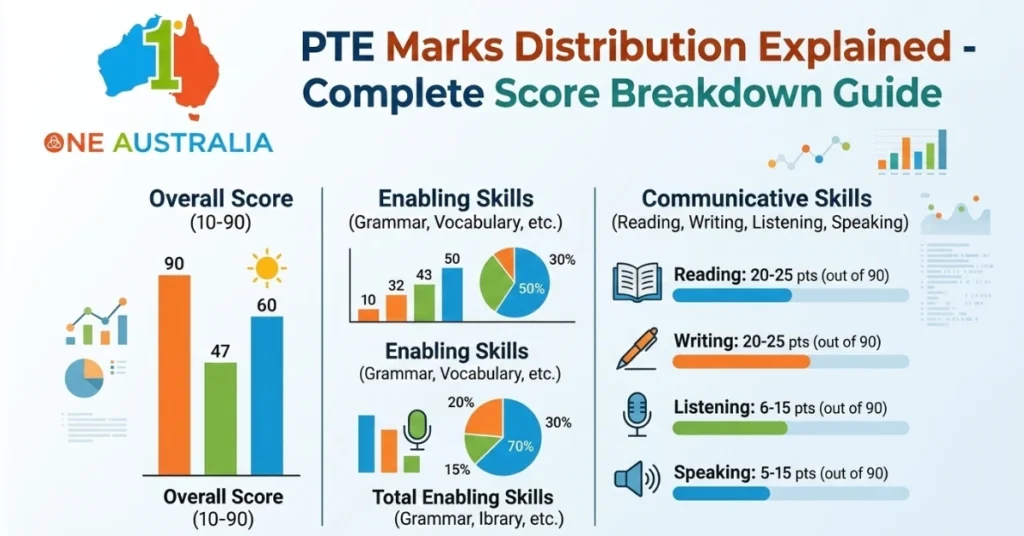
The PTE marks distribution chart helps candidates understand how scores are categorized within the PTE Academic exam. The test uses a score scale from 10 to 90, where higher scores represent stronger English language proficiency. This scoring system allows universities, employers, and immigration authorities to evaluate a candidate’s language ability accurately.

Each test-taker receives an overall score along with individual scores for Speaking, Writing, Reading, and Listening. These scores are determined based on performance across different question types and tasks throughout the exam. Reviewing the PTE marks chart can give students a clear idea of how their score reflects their English proficiency level.

Below is a simplified PTE marks distribution chart showing how score ranges correspond to language proficiency levels:

Score RangeLevel
85–90Expert
76–84Very Good
59–75Competent
43–58Limited
10–42Basic

Understanding this PTE marks distribution chart can help candidates set realistic score targets and measure their progress during preparation. It also helps test-takers identify the score range required by universities, visa programs, or professional organizations.

PTE Speaking Marks Distribution

The PTE speaking marks distribution is based on several question types that assess a candidate’s ability to speak clearly, accurately, and fluently in English. In the PTE Academic exam, the speaking score is not determined by just one task. Instead, multiple tasks contribute to the final speaking score, and some of them also affect other modules such as reading or listening.

An important aspect of the PTE marking distribution is that several speaking tasks use integrated skills scoring. This means a single response may influence more than one skill score. For example, tasks like Repeat Sentence and Retell Lecture evaluate both listening comprehension and speaking ability at the same time.

Because of this integrated scoring system, some tasks have a higher impact on the speaking score than others. Understanding which tasks carry greater weight can help candidates prioritize their preparation and improve their speaking performance more effectively.

Below is a simplified overview of the PTE speaking marks distribution by question type:

Question TypeSkills ImpactedImportance
Read AloudReading + SpeakingHigh
Repeat SentenceListening + SpeakingVery High
Describe ImageSpeakingMedium
Retell LectureListening + SpeakingHigh
Answer Short QuestionListening + SpeakingLow

Among these tasks, Repeat Sentence and Read Aloud generally have a strong influence on the speaking score because they test pronunciation, fluency, and comprehension simultaneously. Candidates who perform well in these tasks can significantly improve their overall speaking score in the PTE exam.

PTE Writing Marks Distribution

The PTE writing marks distribution is determined by several question types that evaluate a candidate’s ability to organize ideas, use correct grammar, and communicate clearly in written English. In the PTE Academic exam, writing tasks assess skills such as sentence structure, vocabulary, spelling, and coherence.

An important feature of the marks distribution in PTE is that some writing tasks also measure other language skills. This means a single response can contribute to multiple modules. For example, Summarize Written Text evaluates both reading comprehension and writing ability, while Write From Dictation measures listening accuracy along with writing skills.

Because of this integrated scoring system, certain tasks have a greater influence on the writing score than others. Understanding the PTE writing marks distribution helps candidates focus on tasks that carry higher importance and can significantly impact their final writing score.

Below is an overview of the main tasks contributing to the writing score in PTE:

Question TypeSkills ImpactedImportance
Summarize Written TextReading + WritingMedium
Essay WritingWritingHigh
Write From DictationListening + WritingVery High

Among these tasks, Write From Dictation is often considered one of the most important because it requires strong listening comprehension and accurate writing. Performing well in this task can significantly improve both writing and listening scores in the PTE exam.

PTE Reading Score Distribution

The PTE reading score distribution is based on how well candidates understand written English passages and respond to different reading tasks. In the PTE Academic exam, the reading section measures skills such as vocabulary knowledge, comprehension, sentence structure, and the ability to identify logical connections between ideas.

The PTE marks distribution for reading is determined by performance across multiple question types. Each question carries a different level of importance, meaning some tasks contribute more significantly to the final reading score. Candidates who understand the score distribution in PTE can focus their preparation on the question types that have the greatest impact on their results.

Below is an overview of the main question types that influence the reading score:

Question TypeImportance
Reading Fill in the BlanksHigh
Reorder ParagraphsMedium
Multiple ChoiceLow

Among these tasks, Reading Fill in the Blanks usually has the highest impact because it tests vocabulary, grammar, and contextual understanding at the same time. Reorder Paragraphs evaluates logical thinking and the ability to identify the correct sequence of ideas, while Multiple Choice questions generally contribute less to the overall reading score.

Understanding this PTE reading score distribution allows candidates to prioritize high-impact tasks and develop a more effective preparation strategy for the exam.

PTE Listening Score Distribution

The PTE listening score distribution is based on how well candidates understand spoken English and respond to different audio-based tasks in the exam. In the listening section, test-takers hear recordings such as lectures, conversations, and instructions, and must answer questions that measure their ability to identify key information, understand meaning, and follow spoken language accurately.

Within the PTE marks distribution, several listening tasks contribute to the final listening score. Some of these tasks also influence other modules because PTE uses an integrated scoring system. This means a single task can impact both listening and another skill, such as writing or reading. Understanding the PTE listening score distribution helps candidates focus on tasks that have the greatest effect on their overall performance.

Below is a simplified breakdown of important listening question types:

Question TypeSkills ImpactedImportance
Summarize Spoken TextListening + WritingMedium
Multiple ChoiceListeningLow
Highlight Incorrect WordsListening + ReadingMedium
Write From DictationListening + WritingVery High

Among these tasks, Write From Dictation is considered one of the most important because it requires candidates to accurately hear and write the spoken sentence. Strong performance in this task can significantly improve scores due to its high impact within the PTE marks distribution. Other tasks like Summarize Spoken Text and Highlight Incorrect Words also contribute to the listening score while testing additional language skills.

Most Important Questions in PTE Marks Distribution

Understanding which tasks carry the highest weight is essential when preparing for the exam. The PTE marking distribution is not equal across all question types. Some tasks contribute significantly to multiple skills, while others have a smaller effect on the overall score. Because the marks distribution in PTE is based on an integrated scoring system, focusing on high-impact questions can help candidates improve their scores more efficiently.

Certain tasks influence more than one module, such as speaking, listening, reading, or writing. These integrated tasks typically carry greater importance because they test multiple language abilities at the same time.

High Impact Tasks

These question types usually have the greatest influence on the overall score:

  • Repeat Sentence – Tests listening and speaking skills and strongly affects both modules.
  • Write From Dictation – Evaluates listening accuracy and writing ability, making it one of the most important tasks in the exam.
  • Read Aloud – Measures pronunciation, fluency, and reading ability, contributing to both speaking and reading scores.
  • Reading Fill in the Blanks – Tests vocabulary and grammar understanding within context.

Medium Impact Tasks

These tasks contribute moderately to the overall score:

  • Retell Lecture – Assesses listening comprehension and speaking skills.
  • Summarize Spoken Text – Measures the ability to understand spoken information and summarize it in writing.

Low Impact Tasks

These question types generally have a smaller influence on the final score:

  • Multiple Choice Questions – Although they test comprehension, they typically contribute less compared to integrated tasks.

By understanding the PTE marking distribution, candidates can prioritize high-impact questions during preparation. Focusing on these tasks allows test-takers to maximize their performance and improve their scores more effectively across the different modules of the PTE exam.

How PTE Score Is Calculated Example?

Understanding how scores are calculated helps candidates better interpret the score distribution in PTE. The PTE exam does not calculate the final score by simply adding marks from each question. Instead, the scoring system evaluates performance across multiple tasks and skills using an automated algorithm. Many question types contribute to more than one skill, which means a single response can influence several module scores at the same time.

To understand this better, consider the following simplified example of how individual task performance may contribute to the final score.

Example Task Scores

TaskScore
Repeat Sentence85
Write from Dictation80
Read Aloud75

These scores represent strong performance in tasks that influence multiple modules such as speaking, listening, reading, and writing. Because these tasks carry higher weight, they can significantly improve the overall result.

Example Final Skill Scores

SkillScore
Speaking78
Writing74
Reading70
Listening82
Overall79

In this example, the candidate achieves an overall score of 79, even though individual task scores and module scores vary. This demonstrates how the score distribution in PTE works across different skills. Strong performance in high-impact tasks can raise multiple skill scores simultaneously, leading to a higher overall

PTE Marks Distribution Strategy (For 65+, 79+, 90 Scores)

Understanding the PTE marks distribution can help candidates plan their preparation more effectively. Since some tasks carry more weight than others, focusing on high-impact questions can significantly improve the overall score. Instead of spending equal time on every question type, students should prioritize tasks that influence multiple skills such as speaking, listening, reading, and writing.

A strategic approach to preparation also depends on the target score. For example, candidates aiming for a moderate score may focus on mastering a few key tasks, while those targeting higher scores must perform consistently across multiple high-impact questions. This is especially important for improving the PTE speaking marks distribution, where fluency, pronunciation, and accuracy play a major role.

Strategy for a 65+ Score

Candidates aiming for a 65+ score should focus on building accuracy and consistency in the most important question types. Key tasks to prioritize include:

  • Read Aloud – Helps improve pronunciation, fluency, and reading comprehension.
  • Reading Fill in the Blanks (FIB) – Strengthens vocabulary and grammar in context.
  • Write From Dictation – Improves listening accuracy and writing skills.

Strong performance in these tasks can contribute significantly to multiple modules and help candidates achieve a solid overall score.

Strategy for a 79+ Score

For candidates targeting a 79+ score, preparation needs to be more advanced and focused on high-impact integrated tasks. Important areas to concentrate on include:

  • Repeat Sentence Accuracy – One of the most influential tasks affecting both listening and speaking scores.
  • Retell Lecture – Tests the ability to understand and summarize spoken information clearly.
  • Listening Dictation Practice – Improves accuracy for Write From Dictation, which carries very high weight.

By understanding the PTE marks distribution and focusing on these key tasks, candidates can maximize their performance across modules and improve their chances of achieving higher scores in the PTE exam.

Common Myths About PTE Marks Distribution

Many candidates misunderstand how the PTE exam is scored. These misconceptions can lead to ineffective PTE preparation strategies and confusion about final results. Understanding the actual PTE marking distribution helps test-takers focus on the right tasks and prepare more efficiently. Below are some common myths about PTE scoring and the reality behind them.

Myth 1: All Questions Carry Equal Marks

Reality: Not all questions have the same impact on the final score. In the PTE exam, some tasks contribute more heavily because they test multiple skills at the same time. For example, tasks like Repeat Sentence and Write From Dictation influence more than one module, which means they have a stronger effect on the overall score.

Myth 2: Overall Score Is the Average of Module Scores

Reality: The overall PTE score is not simply the average of speaking, writing, reading, and listening scores. Instead, the exam uses an automated scoring system that calculates results based on performance across all tasks and skills using a weighted model.

Myth 3: Only Speaking Tasks Affect the Speaking Score

Reality: Some tasks in other sections can also impact the speaking score because the PTE exam uses an integrated skills approach. For example, tasks that combine listening and speaking may contribute to both module scores.

Myth 4: Multiple Choice Questions Are the Most Important

Reality: Multiple choice questions usually carry less weight compared to integrated tasks such as Repeat Sentence, Read Aloud, and Write From Dictation, which have a stronger influence within the PTE marking distribution.

By understanding these common myths, candidates can focus on the most impactful question types and prepare more strategically for the PTE exam.

Tips to Improve Your PTE Score Faster

Improving your PTE score requires a focused preparation strategy that targets the most important question types. Since the PTE marks distribution is based on an integrated scoring system, performing well in high-impact tasks can significantly improve multiple skill scores at the same time. Many students choose PTE coaching classes, or practice through PTE Academic online platforms to better understand the exam format and improve their performance. Candidates who understand which tasks carry greater weight can prepare more efficiently and achieve faster score improvements.

Below are some practical tips that can help you improve your performance across the different modules, especially in areas that influence the PTE speaking marks distribution and overall results.

1. Master Repeat Sentence

Repeat Sentence is one of the most important tasks in the exam because it affects both listening and speaking scores. Practice listening carefully and repeating sentences with correct pronunciation and fluency. Regular practice can greatly improve your speaking score.

2. Practice Dictation Daily

Write From Dictation carries very high weight in the PTE exam. Practicing dictation exercises daily can help improve listening accuracy, spelling, and writing skills. Many PTE Academic onlin emphasize this task because even small improvements can significantly increase your overall score.

3. Improve Reading Fill in the Blanks

Reading Fill in the Blanks tests vocabulary and grammar within context. To perform well, focus on learning common collocations, grammar patterns, and contextual meaning while reading English passages.

4. Work on Fluency for Speaking

Fluency and pronunciation are key factors in the PTE speaking marks distribution. Practice speaking regularly, record your responses, and work on maintaining a steady pace without long pauses. Clear and confident speech can help improve your speaking score.

By focusing on these strategies and understanding the PTE marks distribution, candidates can improve their performance more effectively and achieve higher scores in the PTE Academic exam.

Conclusion

Understanding the PTE marks distribution is one of the most important steps in preparing effectively for the PTE Academic . Since the test uses an advanced AI-based scoring system, the final score is determined by performance across multiple question types rather than a simple addition of marks. This means that some tasks carry more weight and can influence more than one skill score at the same time.

Throughout the exam, candidates are evaluated across four core modules,Speaking, Writing, Reading, and Listening. Each section contains different question types that contribute to the overall score distribution in PTE, and integrated tasks such as Repeat Sentence, Read Aloud, Reading Fill in the Blanks, and Write From Dictation often have the greatest impact on the final result.

By understanding how the PTE marking distribution works, test-takers can develop a smarter preparation strategy. Instead of treating every question equally, focusing on high-impact tasks and practicing regularly can significantly improve performance across multiple modules.

Ultimately, a clear understanding of the PTE marks chart, combined with targeted practice and consistent preparation, can help candidates achieve their desired score and succeed in their academic, professional, or immigration goals.

FAQs

1. Is PTE marks distribution the same for every test attempt?

Yes, the PTE marks distribution follows the same scoring framework for all test-takers. However, the difficulty level of questions may vary between different test versions. The AI scoring system evaluates responses consistently regardless of the test date or location.

2. Do all sections contribute equally to the overall PTE score?

No, the overall score is not simply an equal combination of all sections. The score distribution in PTE depends on how well you perform across different question types. Some tasks influence multiple modules, which means their impact on the final score can be higher than others.

3. Can strong performance in one section increase scores in another section?

Yes. Because PTE uses integrated skills scoring, a strong performance in certain tasks can improve multiple skill scores. For example, Write From Dictation can boost both listening and writing scores within the PTE marking distribution.

4. Does skipping a question affect the PTE marks distribution?

Yes, skipping a question can reduce your score because many tasks contribute to the overall marks distribution in PTE. Attempting every question,even if you are unsure,can help maintain a better overall performance across modules.

5. How do integrated tasks influence PTE scores?

Integrated tasks test more than one language skill at the same time. For example, Read Aloud measures both reading and speaking abilities, while Repeat Sentence tests listening and speaking. These tasks often have a stronger influence in the PTE marks distribution.
IELTS to PTE Conversion Chart

IELTS to PTE Conversion Chart – Band Score Equivalent Guide

TL;DR

  • This blog is designed for students, test takers, and immigration applicants who want to understand IELTS to PTE score conversion, compare test formats, or estimate their IELTS equivalent to PTE score when switching exams for university admission, study visas, or immigration programs.
  • The guide provides a clear IELTS to PTE conversion chart, helping readers quickly compare common scores such as IELTS 5, 6, 6.5, 7, and 8 with their corresponding PTE score ranges.
  • It explains the difference between IELTS and PTE scoring systems, including IELTS band scores (0–9) and PTE score scale (10–90), along with the impact of human scoring in IELTS vs AI scoring in PTE.
  • The blog includes practical examples and real score profiles, showing how IELTS section scores may translate into estimated PTE scores to help students interpret their results more accurately.
  • It also offers useful preparation tips for students switching from IELTS to PTE, including strategies for key PTE tasks like Repeat Sentence, Read Aloud, and Write From Dictation, along with guidance on choosing the right exam based on personal strengths.

Related Blog

Many students preparing for English proficiency tests often search for IELTS to PTE score conversion to understand how their band score compares across different exams. Since both tests are widely accepted by universities, employers, and immigration authorities, knowing the IELTS PTE equivalent helps students decide whether they should switch exams or estimate their expected score in another test format.

Although both exams assess similar English skills,speaking, listening, reading, and writing,the scoring systems are very different. The International English Language Testing System uses a band scale from 0 to 9, while the Pearson Test of English uses a score scale from 10 to 90 with AI-based evaluation. Because of these differences, many test takers look for a reliable IELTS equivalent to PTE chart to understand how scores align between the two exams.

A clear conversion table helps students interpret their results more accurately, compare the IELTS vs PTE score, and determine the target score required for university admission, work visas, or immigration programs. In this guide, we provide a detailed IELTS to PTE score comparison, including conversion tables and explanations for common scores like IELTS 6, 6.5, 7, and 8.

IELTS to PTE Score Converter

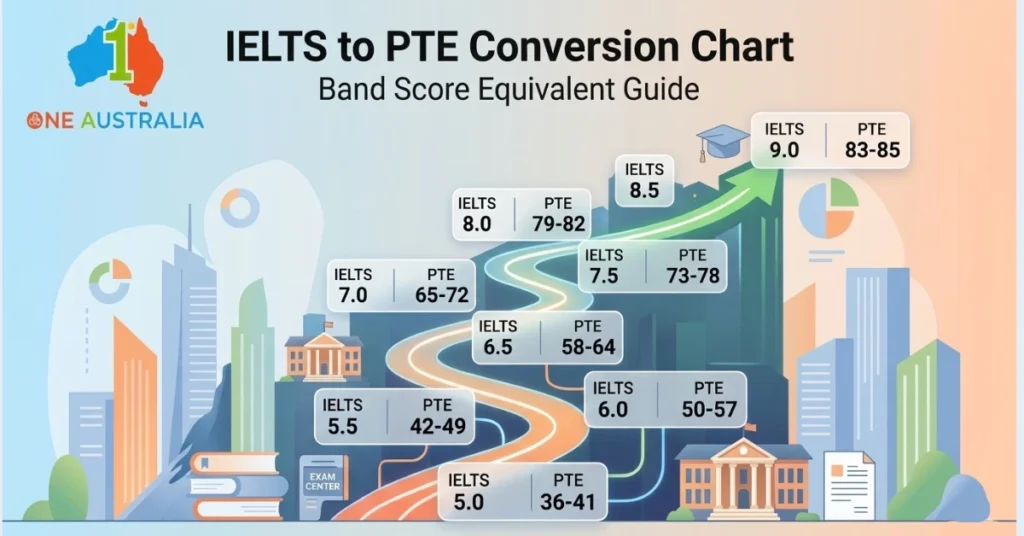
If you want a quick IELTS to PTE score comparison, the table below shows the commonly accepted IELTS equivalent to PTE scores based on official concordance studies. This simple chart helps students quickly understand the approximate IELTS to PTE conversion and estimate how their IELTS band score translates into a PTE score.

IELTS ScorePTE Equivalent
IELTS 5PTE 35–38
IELTS 5.5PTE 42–46
IELTS 6PTE 50–54
IELTS 6.5PTE 58–62
IELTS 7PTE 65–70
IELTS 7.5PTE 73–78
IELTS 8PTE 79–85

These ranges represent the approximate IELTS to PTE score equivalence between the International English Language Testing System and the Pearson Test of English. Because the two exams use different scoring systems,IELTS uses a 0–9 band scale while PTE uses a 10–90 score scale,a direct one-to-one comparison is not always possible.

This IELTS to PTE conversion table is useful for students planning to switch exams, apply to universities, or meet immigration requirements. For example, if you previously scored IELTS 6.5, your expected IELTS to PTE score would typically fall around 58–62 in PTE. In the sections below, we explain detailed conversions for common scores such as IELTS 6, 6.5, 7, and 8, along with examples to help you interpret the IELTS equivalent to PTE more accurately.

Complete IELTS to PTE Conversion Table 2026 Updated

Understanding the IELTS to PTE score comparison is important for students who want to switch exams or estimate their results across different English proficiency tests. Since the International English Language Testing System and the Pearson Test of English use different scoring systems, many students look for a reliable IELTS PTE equivalent chart.

The IELTS exam uses a band score scale from 0 to 9, while the PTE exam uses a score scale from 10 to 90. Because of this difference, students often need a clear IELTS equivalent to PTE table to understand how their IELTS band translates into a PTE score.

The table below provides a detailed IELTS to PTE conversion from IELTS 4.5 to IELTS 9, helping you estimate your approximate IELTS to PTE score.

IELTS Band ScorePTE Equivalent Score
IELTS 4.5PTE 28–30
IELTS 5PTE 35–38
IELTS 5.5PTE 42–46
IELTS 6PTE 50–54
IELTS 6.5PTE 58–62
IELTS 7PTE 65–70
IELTS 7.5PTE 73–78
IELTS 8PTE 79–85
IELTS 8.5PTE 86–89
IELTS 9PTE 90

This IELTS to PTE score table is widely used by universities and immigration authorities when comparing English test results. However, it is important to remember that these scores represent approximate equivalence, not an exact conversion. The reason is that IELTS evaluates candidates using a band-based scoring method, while PTE relies on AI-driven scoring and integrated tasks across speaking, listening, reading, and writing.

For example, if a student scores IELTS 6.5, the typical IELTS PTE equivalent would fall around PTE 58–62. Similarly, an IELTS 7 equivalent to PTE is generally around PTE 65–70, which is often required for university admissions and immigration programs.

In the following sections, we will break down specific conversions such as IELTS 6 to PTE, IELTS 6.5 to PTE, and IELTS 7 to PTE, along with practical examples to help you understand the IELTS equivalent to PTE more clearly.

IELTS 6 to PTE: What Score Does It Equal?

Many students who are planning to switch exams often ask what IELTS 6 to PTE conversion looks like. Understanding this comparison helps test takers estimate their expected performance when moving from IELTS to PTE or when applying to universities that accept both tests.

IELTS 6.0 to PTE

An IELTS 6.0 to PTE conversion typically falls in the range of PTE 50–54. This level represents a competent user of English, meaning the candidate can generally understand and communicate in familiar situations, although some inaccuracies and misunderstandings may still occur.

IELTS ScorePTE Equivalent
IELTS 6.0PTE 50–54

This IELTS to PTE score range is commonly accepted by many universities and immigration programs as a minimum English proficiency requirement.

Why IELTS 6 Does Not Convert to an Exact PTE Score?

Although the table provides a reliable estimate, the IELTS 6 to PTE conversion is not always exact. The two exams use different scoring systems and evaluation methods.

1. Differences in Listening and Reading Assessment
In IELTS, listening and reading sections are scored based on the number of correct answers in separate tasks. In contrast, PTE uses integrated tasks, meaning listening and reading skills may be evaluated together in some question types. This difference can slightly influence the final score.

2. AI vs Human Scoring
IELTS speaking and writing tasks are evaluated by trained examiners, while PTE uses AI-based scoring technology. Because of this difference, some students may perform slightly better or worse depending on the exam format.

3. Integrated Skill Evaluation in PTE
Another reason the IELTS 6.0 to PTE conversion can vary is that PTE tasks often measure multiple skills at the same time. For example, a speaking task may also contribute to listening or reading scores, which can affect the overall PTE result.

For most candidates, scoring IELTS 6 means their expected IELTS to PTE score will fall around PTE 50–54, though the exact result may vary depending on strengths in specific sections like speaking or listening.

IELTS 6.5 to PTE Equivalent Score

Many students preparing for English proficiency exams often want to know the IELTS 6.5 to PTE equivalent score. This comparison is especially useful for students applying to universities or immigration programs that accept both IELTS and PTE results.

IELTS 6.5 to PTE

In most official comparison charts, IELTS 6.5 usually equals PTE 58–62. This score level indicates that the test taker has a competent to upper-intermediate level of English proficiency, meaning they can communicate effectively in academic and professional environments with occasional mistakes.

IELTS ScorePTE Equivalent
IELTS 6.5PTE 58–62

So if a student previously achieved 6.5 IELTS to PTE conversion, their expected IELTS 6.5 in PTE score would generally fall within this range.

Why IELTS 6.5 to PTE Scores May Vary?

Although 6.5 IELTS to PTE typically converts to around 58–62, the exact score can vary slightly because the two tests evaluate English skills differently. IELTS uses a band score based on individual modules, while PTE uses AI scoring and integrated tasks where multiple skills are assessed at the same time.

For example, strong speaking performance in PTE tasks like Read Aloud or Repeat Sentence may increase the overall score even if other sections are slightly weaker.

Example Score Profile

Below is an example of how an IELTS 6.5 score profile might translate into a PTE score:

IELTS Result

  • Listening: 7
  • Reading: 6.5
  • Writing: 6
  • Speaking: 6.5
  • Overall Band: 6.5

Estimated PTE Result

  • Listening: 60
  • Reading: 58
  • Writing: 56
  • Speaking: 63
  • Overall PTE Score: ~59–61

This example shows how an IELTS 6.5 to PTE conversion generally results in a score around PTE 58–62, depending on strengths in individual sections.

IELTS 7 to PTE Equivalent Score

Many students aiming for higher education or immigration often want to understand the IELTS 7 to PTE conversion. This score level is important because it is commonly required by universities, professional registrations, and immigration programs in countries like Australia, Canada, and the UK.

IELTS 7 to PTE

In most official comparison charts, IELTS 7.0 generally equals PTE 65–70. This means that if you scored band 7 in IELTS, your expected IELTS 7 equivalent to PTE would typically fall within this range.

IELTS ScorePTE Equivalent
IELTS 7.0PTE 65–70

So when students ask “IELTS 7 equal to PTE?”, the closest equivalent score is usually around PTE 65 to 70, depending on performance in individual sections like speaking, listening, reading, and writing.

Competent vs Proficient English Levels

Understanding the difference between competent and proficient English levels can also help explain this conversion.

  • Competent English usually refers to IELTS 6.0 or PTE 50, which is the minimum level required for many university programs or immigration applications.
  • Proficient English generally refers to IELTS 7.0 or PTE 65, which indicates a stronger command of English and may provide additional immigration points in some countries.

At the IELTS 7 level, candidates demonstrate a good operational command of English, meaning they can communicate effectively in academic or professional environments with only occasional inaccuracies. Similarly, a PTE score of around 65–70 reflects a strong ability to understand complex texts, participate in discussions, and produce clear written responses.

Although the IELTS 7 to PTE conversion provides a reliable estimate, the exact score may vary slightly because the two exams use different scoring methods,IELTS uses human examiners for speaking and writing, while PTE relies on AI-based scoring across integrated tasks.

IELTS 5 and 5.5 to PTE Conversion

Students who are at the intermediate stage of English proficiency often want to understand the IELTS 5 to PTE and IELTS 5.5 to PTE conversion. These scores are commonly required for foundation programs, diploma courses, or entry-level university pathways.

IELTS 5 to PTE

In most score comparison charts, IELTS 5 ≈ PTE 35–38. This level indicates that the candidate has a modest user level of English, meaning they can handle basic communication in familiar situations but may struggle with complex language or academic tasks.

IELTS ScorePTE Equivalent
IELTS 5PTE 35–38

Students with IELTS 5 to PTE conversion in this range may need additional preparation if they plan to apply for degree programs or immigration pathways that require higher English proficiency.

IELTS 5.5 to PTE

Similarly, IELTS 5.5 ≈ PTE 42–46 according to most official comparison charts. This level represents an upper-intermediate beginner level, where the candidate can understand and use English in everyday contexts with some limitations.

IELTS ScorePTE Equivalent
IELTS 5.5PTE 42–46

When students search for 5.5 IELTS to PTE, they are usually trying to estimate their expected PTE score before switching exams. In most cases, someone who scored IELTS 5.5 to PTE would likely achieve a score in the 42–46 range, depending on their strengths in listening, reading, speaking, and writing.

Although these conversions provide a helpful guideline, the final PTE score can vary slightly because PTE uses AI-based scoring and integrated tasks, while IELTS evaluates skills separately using band scores.

IELTS 8 to PTE Conversion

Students aiming for top universities or immigration pathways often want to know the IELTS 8 to PTE equivalent score. Achieving this level indicates a very strong command of English, with the ability to understand complex language, communicate fluently, and produce well-structured written responses.

IELTS 8 to PTE

In most official concordance charts, IELTS 8.0 equals PTE 79–85. This means that candidates who score band 8 in IELTS typically achieve a PTE score within this range.

IELTS ScorePTE Equivalent
IELTS 8.0PTE 79–85

This high-level IELTS to PTE conversion reflects advanced English proficiency across all four skills: listening, reading, writing, and speaking.

Importance for Australia PR

An IELTS 8 to PTE equivalent score is particularly important for applicants pursuing immigration through Australia’s skilled migration programs. In many cases, IELTS 8 or PTE 79 is considered “Superior English”, which can provide additional immigration points under the Australian points-based visa system.

Importance for University Admission

Many top universities also accept this level as proof of strong English proficiency. Students who achieve IELTS 8 or the equivalent PTE 79–85 demonstrate the ability to succeed in demanding academic environments, including postgraduate and research programs.

Although the IELTS 8 to PTE conversion provides a reliable estimate, the final PTE score can vary slightly depending on performance in individual tasks, since PTE uses AI-based scoring and integrated skill assessment, while IELTS relies on human examiners for speaking and writing evaluation.

IELTS vs PTE Score Comparison

Many students compare the IELTS vs PTE score systems to decide which English proficiency test suits them best. Both exams assess the same four core skills,listening, reading, writing, and speaking,but they differ significantly in scoring methods, test format, and result time.

The International English Language Testing System uses a band score system from 0 to 9, while the Pearson Test of English uses a score scale from 10 to 90 and relies on AI-based evaluation. Understanding these differences can help students choose the test that aligns with their strengths.

IELTS vs PTE Score Comparison Table

FeatureIELTSPTE
Score Scale0–9 band score10–90 score scale
Speaking TestHuman examiner interviewAI computer scoring
Result Time2–13 days24–48 hours
Test FormatPaper or computer-basedFully computer-based
Scoring MethodHuman + structured markingAI-driven scoring

Who Should Choose IELTS?

IELTS may be a better option for students who:

  • Prefer speaking face-to-face with a human examiner
  • Are comfortable with traditional exam formats
  • Want the option of paper-based tests
  • Feel more confident explaining answers in a conversational setting

Many candidates find that interacting with an examiner allows them to demonstrate their speaking ability more naturally.

Who Should Choose PTE?

PTE can be a good choice for students who:

  • Prefer a fully computer-based test
  • Want faster results (usually within 48 hours)
  • Are comfortable speaking into a microphone
  • Prefer AI scoring, which removes human subjectivity

Because PTE evaluates multiple skills in integrated tasks, candidates who are strong in quick thinking, pronunciation, and typing may perform particularly well. Many students also choose PTE coaching classes to improve their strategies, practice with expert guidance, and better understand the exam format.

Overall, understanding the IELTS vs PTE score comparison helps students decide which exam format matches their learning style and preparation strategy. Both tests are widely accepted by universities and immigration authorities worldwide, so the best choice often depends on the candidate’s personal strengths and preferences.

Why IELTS and PTE Scores Are Different?

Many students wonder why the IELTS equivalent to PTE is not always an exact conversion. Although both exams assess listening, reading, writing, and speaking skills, they use different scoring systems. IELTS relies on trained human examiners, while PTE uses AI-based automated scoring. PTE also includes integrated tasks where multiple skills are evaluated in one question, whereas IELTS scores each section separately using a band scale from 0 to 9. Because of these differences, IELTS to PTE comparisons are usually shown as an approximate score range rather than an exact match.

AspectIELTS (International English Language Testing System)PTE (Pearson Test of English)
Scoring MethodUses human examiners to evaluate speaking and writing responses.Uses AI-based automated scoring technology.
Speaking TestCandidates participate in a live interview with an examiner who evaluates fluency, pronunciation, vocabulary, and grammar.Speaking responses are recorded and analyzed by AI, focusing on pronunciation, fluency, grammar, and content accuracy.
Scoring ConsistencyHuman evaluation may include some level of subjectivity depending on the examiner.AI evaluates responses consistently using algorithms, which many students find more predictable.
Task StructureEach section mainly evaluates one specific skill at a time.Includes integrated tasks where multiple skills are assessed simultaneously.
Example of Integrated TaskListening, reading, writing, and speaking are generally tested separately.A candidate may listen to a lecture and summarize it in writing, contributing to both listening and writing scores.
Score SystemUses a band score from 0–9 for each section and calculates the overall score as the average.Uses a score range from 10–90, calculated through automated analysis across tasks.
Score ComparisonIELTS band scores are fixed and structured.PTE scores are calculated through integrated scoring across multiple skills.

Understanding these scoring differences helps students interpret the IELTS equivalent to PTE more accurately and choose the test format that best matches their strengths.

Real Examples of IELTS to PTE Score Conversion

To better understand how IELTS to PTE score conversion works in real situations, it helps to look at practical examples. Since the International English Language Testing System and the Pearson Test of English use different scoring systems, the IELTS PTE equivalent is usually estimated based on performance across individual sections.

Below is an example of how an IELTS score profile may translate into a PTE result.

Example Student Profile

A student who has taken IELTS and is planning to switch to PTE might have the following score profile.

IELTS Result

  • Listening: 7
  • Reading: 6.5
  • Writing: 6
  • Speaking: 7
  • Overall IELTS Band: 6.5

Based on typical IELTS equivalent to PTE conversion charts, this performance could translate to the following estimated PTE scores.

Estimated PTE Score

  • Listening: 62
  • Reading: 58
  • Writing: 55
  • Speaking: 75
  • Overall PTE Score: 63–66

This example shows that a student with an overall IELTS band of around 6.5 can expect a PTE score in the mid-60 range, depending on performance in individual tasks.

It is important to remember that the final IELTS to PTE score may vary slightly because PTE evaluates multiple skills within integrated tasks and uses AI-based scoring, while IELTS evaluates each section separately using band scores.

IELTS to PTE Conversion for Australia PR and Student Visa

For many international students and skilled professionals, understanding IELTS to PTE conversion is important when applying for visas or immigration programs. Countries like Australia accept both IELTS and PTE as proof of English proficiency, but they define specific score levels that correspond to different English language requirements.

These English levels are commonly used by the Australian Department of Home Affairs when assessing visa applications. Knowing the IELTS equivalent to PTE helps applicants determine which score they need to achieve for student visas, skilled migration programs, or permanent residency (PR).

Common English Language Requirements

English LevelIELTS ScorePTE Equivalent
Competent EnglishIELTS 6PTE 50
Proficient EnglishIELTS 7PTE 65
Superior EnglishIELTS 8PTE 79

Why This Conversion Matters for Immigration

Understanding the IELTS PTE equivalent is particularly important for candidates applying for Australia PR or skilled migration visas. Each English level can affect eligibility and points in the immigration system.

  • Competent English (IELTS 6 or PTE 50) is often the minimum requirement for many visa categories.
  • Proficient English (IELTS 7 or PTE 65) may provide additional immigration points, improving the chances of receiving an invitation to apply.
  • Superior English (IELTS 8 or PTE 79) can provide the highest number of English language points for immigration pathways.

Similarly, many universities and student visa programs also accept these IELTS to PTE score equivalents when evaluating international applicants. Understanding this conversion helps students set the right score targets when preparing for their English language test.

Which Test Is Easier: IELTS or PTE?

The answer depends largely on your personal strengths, test-taking style, and familiarity with computers. While both exams measure the same English skills, the format and scoring methods are quite different, which can influence your final IELTS vs PTE score.

The International English Language Testing System follows a more traditional exam format, while the Pearson Test of English is fully computer-based and uses AI scoring.

Speaking Format

One of the biggest differences between the tests is the speaking section.

  • IELTS: Candidates speak directly with a human examiner in a face-to-face interview. Many students prefer this format because it feels like a natural conversation.
  • PTE: The speaking section is done on a computer using a microphone. Responses are recorded and evaluated using AI.

Students who feel confident in conversations often prefer IELTS, while those comfortable speaking to a microphone may find PTE easier.

Typing vs Handwriting

Another key difference is how the writing section is completed.

  • IELTS: In the paper-based version, writing answers must be handwritten. Even in the computer-based version, the exam structure follows traditional essay writing.
  • PTE: All responses are typed on a computer. This can be easier for candidates who type quickly.

Students who have strong typing skills often find PTE more comfortable.

AI Scoring vs Human Evaluation

Scoring methods also affect the difficulty level.

  • IELTS: Writing and speaking are evaluated by trained examiners.
  • PTE: Uses AI-based scoring, which evaluates pronunciation, fluency, grammar, and vocabulary using algorithms.

Some students prefer PTE because AI scoring removes human subjectivity, while others feel that human examiners in IELTS better understand natural communication.

Final Verdict

There is no universally easier test when comparing IELTS vs PTE score results.

  • Choose IELTS if you prefer human interaction and traditional exam formats.
  • Choose PTE if you are comfortable with computers, typing quickly, and completing integrated tasks.

Ultimately, the easier test is the one that best matches your skills, preparation style, and confidence level.

Tips for Switching from IELTS to PTE

Many students decide to switch exams after checking their IELTS equivalent to PTE score or realizing that the test format suits them better. However, moving from IELTS to PTE requires a different preparation strategy because the test structure, scoring system, and task types are very different.

The Pearson Test of English uses integrated tasks and AI scoring, which means candidates must adapt their approach compared to the International English Language Testing System. Below are some practical tips that can help IELTS candidates perform better when preparing for PTE.

1. Practice Repeat Sentence Daily

One of the most important tasks in PTE is Repeat Sentence, which tests both listening and speaking skills at the same time. Unlike IELTS, where listening and speaking are separate sections, this task requires you to listen carefully and repeat the sentence exactly as you hear it.

Improving short-term memory and practicing sentence repetition daily can significantly boost both speaking and listening scores in PTE.

2. Improve Your Read Aloud Skills

Another high-scoring PTE task is Read Aloud. In this task, you must read a short passage clearly and fluently into a microphone.

Focus on:

  • Clear pronunciation
  • Natural pacing
  • Avoiding unnecessary pauses

Strong performance in this task can positively impact both speaking and reading scores.

3. Focus on Write From Dictation

Write From Dictation is one of the most scoring question types in PTE because it contributes to both listening and writing scores.

To improve:

  • Practice listening to sentences and writing them exactly
  • Pay attention to spelling, grammar, and punctuation
  • Train your ability to remember the full sentence before typing

Many students who switch from IELTS underestimate this task, but mastering it can significantly increase your overall PTE score.

4. Learn the Microphone Speaking Technique

Unlike IELTS, where you speak directly to an examiner, PTE requires speaking into a microphone. This can feel unusual for first-time test takers.

Important tips include:

  • Speak clearly and confidently
  • Maintain a consistent volume
  • Avoid speaking too fast
  • Start speaking immediately when recording begins

Practicing with a microphone helps reduce hesitation and improves fluency scores in AI evaluation.

5. Get Comfortable with Integrated Tasks

Another adjustment when switching from IELTS to PTE is learning integrated skill tasks. For example, you might listen to a lecture and then summarize it in writing or speak about a graph.

Practicing these tasks helps you manage time effectively and perform well across multiple skill areas in the same question.

By focusing on these strategies, students transitioning from IELTS can adapt quickly to the PTE format and improve their chances of achieving their target IELTS to PTE score equivalent.

Final Summary: IELTS to PTE Conversion

Understanding IELTS to PTE score comparison is important for students and professionals who plan to study, work, or migrate to English-speaking countries. Since both tests measure the same four language skills,listening, reading, writing, and speaking,many universities and immigration authorities accept them interchangeably.fully computer-based PTE Academic online exam format.

However, the IELTS to PTE conversion is not a direct one-to-one match because the exams use different scoring systems. IELTS follows a 0–9 band scale, while PTE uses a 10–90 score range with AI-based evaluation. Because of this difference, the IELTS equivalent to PTE is usually expressed as a score range rather than a single number.

For example:

  • IELTS 6 typically equals PTE 50–54
  • IELTS 6.5 usually equals PTE 58–62
  • IELTS 7 generally equals PTE 65–70
  • IELTS 8 corresponds to PTE 79–85

When comparing IELTS vs PTE score systems, the best test for you depends on your personal strengths. IELTS uses human examiners for speaking and writing, while PTE relies on AI scoring and integrated tasks. Some students prefer the conversational format of IELTS often taught in IELTS coaching, while others perform better with the fully computer-based PTE Academic online exam format.

If you are planning to switch tests or estimate your score, the most effective strategy is to practice with realistic mock tests. Mock exams help you understand the format, identify weak areas, and achieve your target IELTS to PTE score more confidently. Regular practice, especially with exam-style questions, can significantly improve your performance in both exams.

Frequently Asked Questions

1.Is IELTS 6 equal to PTE 50?

Yes, IELTS 6.0 usually equals PTE 50–54 according to most official concordance charts. This level is often considered Competent English for many university programs and immigration pathways.

2. What is IELTS 7 in PTE?

IELTS 7 generally equals PTE 65–70. This level indicates a strong command of English and is often categorized as Proficient English, which may provide additional immigration points in some countries.

3. What is IELTS 6.5 in PTE?

In most conversion charts, IELTS 6.5 usually equals PTE 58–62. This score level is commonly required by universities for undergraduate and postgraduate programs.

4. Is PTE easier than IELTS?

It depends on the student’s strengths and preferences. The Pearson Test of English uses AI-based scoring and a fully computer-based format, while the International English Language Testing System includes a face-to-face speaking interview with a human examiner. Some students find PTE easier because of faster results and typing-based responses, while others prefer the traditional IELTS format.

5. Which test is better for studying abroad: IELTS or PTE? 

Both tests are widely accepted by universities and immigration authorities worldwide. The choice depends on your comfort with the exam format. IELTS includes a face-to-face speaking interview and paper-based options, while PTE Academic is fully computer-based with AI scoring and usually delivers results faster. Many students choose PTE because of its quick results and integrated scoring system, but both tests are equally valid for studying abroad.