CELPIP Test Format 2026: Complete Section Breakdown, Timing & Scoring Guide
TL;DR
- This comprehensive guide is designed for Canada PR applicants, international students, skilled workers, and citizenship candidates who want to understand the complete CELPIP test format, section structure, timing, scoring system, and exam-day experience before taking the test.
- The blog explains the latest CELPIP General and CELPIP General LS formats, including Listening, Reading, Writing, and Speaking sections, along with detailed task types, timing breakdowns, and scoring criteria based on the Canadian Language Benchmark (CLB) system.
- Readers will learn what the CELPIP exam actually feels like in real test conditions, including the fully computer-based environment, microphone speaking setup, timer pressure, typing requirements, and common challenges students face during the exam.
- The guide also includes expert preparation strategies such as mock test practice, time management techniques, speaking fluency improvement, vocabulary building, typing practice, and section-wise tips to help candidates achieve higher CELPIP scores.
- In addition to exam structure and preparation, the blog covers important CELPIP test day rules, ID requirements, break policies, scoring requirements for Canada PR, and FAQs to help candidates feel fully prepared and confident before their exam day.
Also Read,
- CELPIP General vs LS: Best for Canada or Australia PR
- CELPIP Exam Guide: Format, Key Benefits & Preparation
- CELPIP Easier Than IELTS?: Which Is Easier for You?
Introduction
The CELPIP test is one of the most widely accepted English language exams for individuals planning to immigrate, work, or apply for citizenship in Canada. The exam evaluates a candidate’s real-life English communication skills through practical tasks in Listening, Reading, Writing, and Speaking. Understanding the latest CELPIP test format is extremely important because the exam is fully computer-based and follows a unique structure that is very different from traditional English tests.
Many test takers lose valuable marks not because their English is weak, but because they are unfamiliar with the CELPIP exam format, section timing, task flow, and computer-based environment. By understanding the format in advance, students can manage time better, avoid common mistakes, and improve their confidence during the actual exam.
The CELPIP exam is available in two versions: CELPIP General and CELPIP General LS. The CELPIP General test format includes four sections Listening, Reading, Writing, and Speaking and is mainly used for Canada Permanent Residency (PR), work permits, and professional designation requirements. On the other hand, CELPIP General LS only assesses Listening and Speaking skills and is commonly required for Canadian citizenship applications.
One of the biggest advantages of the CELPIP General exam format is that it is entirely computer-delivered. From reading passages to typing essays and recording speaking responses through a microphone, every part of the exam is completed on a computer in a single sitting. Unlike some other English tests, there is no face-to-face speaking interview, which many students find more comfortable and less stressful.
Today, the CELPIP test is officially accepted by the Canadian government for immigration and citizenship purposes, making it a popular choice among international students, skilled workers, and PR applicants worldwide. In this complete guide, you will learn the latest CELPIP test structure, section-wise breakdown, timing, question types, scoring system, and expert strategies to help you prepare effectively and achieve your target score.
CELPIP General Test Format: Quick Overview
Understanding the CELPIP general test format is essential before starting your preparation. The exam is designed to assess real-life English communication skills through a fully computer-based testing system. Below is a quick overview of the latest CELPIP format for Canada PR and immigration applicants.
| Feature | CELPIP General |
| Test Type | Computer-Based |
| Duration | About 3 Hours |
| Sections | Listening, Reading, Writing, Speaking |
| Scoring | CLB 1–12 |
| Speaking Format | Microphone Recording |
| Test Mode | Single Sitting |
| Accepted For | Canada PR & Immigration |
| Result Availability | Usually Within 3–4 Business Days |
| Note-Taking | Allowed During the Test |
| Accent Focus | Canadian & North American English |
The CELPIP exam is completely conducted on a computer, including the Speaking section where responses are recorded through a headset microphone. Unlike traditional face-to-face interviews, the CELPIP format provides a more practical and modern testing experience that reflects real-life communication situations commonly used in Canada.
What Is the CELPIP Test?
The CELPIP test, short for the Canadian English Language Proficiency Index Program, is a widely recognized English language proficiency exam designed to evaluate a person’s ability to communicate effectively in everyday Canadian English. The test measures four core language skills Listening, Reading, Writing, and Speaking and is officially accepted by the Canadian government for immigration, citizenship, and professional purposes.
The CELPIP exam is especially popular among individuals applying for Canada Permanent Residency (PR), work permits, and citizenship because it focuses on real-life communication scenarios rather than purely academic English. Unlike many traditional English exams, the CELPIP test is fully computer-based and completed in a single sitting, making it a convenient option for many test takers.
Types of CELPIP Tests
There are two versions of the CELPIP exam available:
1. CELPIP General
The CELPIP General test evaluates all four English skills:
- Listening
- Reading
- Writing
- Speaking
This version is mainly required for:
- Canada PR applications
- Express Entry
- Provincial Nominee Programs (PNP)
- Professional designations
- Employment purposes
The CELPIP General test is ideal for students, skilled workers, and immigrants who need to prove complete English proficiency for Canadian immigration pathways.
2. CELPIP General LS
The CELPIP General LS test only assesses:
- Listening
- Speaking
This version is specifically designed for:
- Canadian citizenship applications
Since citizenship applicants only need to demonstrate listening and speaking ability, the General LS version is shorter and simpler compared to the full CELPIP General exam.
Who Should Take CELPIP General vs General LS?
| Test Version | Best For |
| CELPIP General | Canada PR, Work Permits, Professional Licensing |
| CELPIP General LS | Canadian Citizenship Applications |
Choosing the correct version is important because Canadian immigration authorities have different language requirements depending on the type of application you are submitting.
Why Is CELPIP Important for Canada Immigration?
The CELPIP exam is officially approved by the Canadian government and accepted by:
- Immigration, Refugees and Citizenship Canada (IRCC)
- Professional organizations
- Employers across Canada
One major reason many applicants choose CELPIP is that the exam uses Canadian accents and practical everyday situations, making it highly relevant for people planning to live and work in Canada. Additionally, the fully computer-based format and integrated scoring system provide faster results and a modern testing experience.
Understanding the CELPIP test structure and choosing the right exam version can help candidates prepare more effectively and improve their chances of achieving the required Canadian Language Benchmark (CLB) score for immigration success.
CELPIP General Test Format Overview
Understanding the CELPIP General test format is one of the most important steps before starting your preparation. The exam is designed to evaluate practical English communication skills used in everyday Canadian life, workplace situations, and immigration environments. Unlike many traditional English tests, the CELPIP exam is fully computer-based and completed in a single sitting, making it faster, more modern, and highly structured.
The CELPIP General exam assesses four language skills:
- Listening
- Reading
- Writing
- Speaking
All sections are completed on a computer at an official CELPIP test centre using headphones, a keyboard, and a microphone headset. Because the test is fully digital, candidates should also be comfortable with typing and navigating computer-based questions efficiently.
Total CELPIP Exam Duration
The complete CELPIP General test takes approximately 3 hours to finish without any separate speaking interview or multiple test-day sessions. Everything is completed in one continuous sitting, which many students find more convenient compared to other English proficiency exams.
Approximate Duration by Section
| Section | Duration |
| Listening | 47–55 Minutes |
| Reading | 55–60 Minutes |
| Writing | 53–60 Minutes |
| Speaking | 15–20 Minutes |
The exact timing may vary slightly depending on the test version and unscored items included in the exam.
CELPIP Section Order
The CELPIP exam always follows the same section order:
- Listening
- Reading
- Writing
- Speaking
Since the exam is conducted in one sitting, candidates move directly from one section to the next through the computer system without changing rooms or meeting a speaking examiner.
Understanding the section sequence is important because time management and concentration play a major role in achieving a high score.
Fully Computer-Based Testing Environment
One of the biggest features of the CELPIP exam format is that the entire test is completed on a computer. This includes:
- Reading passages on screen
- Listening through headphones
- Typing written responses
- Recording speaking answers using a microphone
Unlike face-to-face speaking interviews, the Speaking section is recorded digitally, which many test takers find less stressful. The computer system also includes:
- On-screen timers
- Word counters
- Progress indicators
- Easy navigation tools
Because of this format, candidates should practice using computer-based mock tests before the actual exam.
One-Sitting Exam Experience
The CELPIP General exam is designed as a single-sitting test, meaning candidates complete all four sections in one continuous session at the test centre. There is no separate speaking appointment on another day.
This one-sitting structure provides:
- Faster completion
- Better convenience
- Less scheduling stress
- Quicker overall testing experience
However, it also means students must maintain focus and energy for nearly three hours. Proper preparation, time management, and familiarity with the CELPIP General test format can significantly improve performance on exam day.
CELPIP General Test Structure
To understand the complete CELPIP General test format, it is important to know how each section is structured, how much time is provided, and how many tasks are included. The CELPIP exam format is designed to assess practical English communication skills through multiple real-life tasks completed in one sitting.
Below is the latest overview of the CELPIP format general structure:
| Section | Duration | Tasks |
| Listening | 47–55 Minutes | 6 Parts |
| Reading | 55–60 Minutes | 4 Parts |
| Writing | 53–60 Minutes | 2 Tasks |
| Speaking | 15–20 Minutes | 8 Tasks |
The CELPIP General exam begins with the Listening section, followed by Reading, Writing, and finally Speaking. Each section evaluates different communication skills commonly used in everyday Canadian environments such as workplaces, social situations, and community interactions.
The Listening and Reading sections mainly contain multiple-choice and comprehension-based questions, while the Writing and Speaking sections test a candidate’s ability to communicate ideas clearly and effectively in written and spoken English.
Since the exam is fully computer-based, candidates must also manage time efficiently while typing responses, reading instructions on screen, and speaking into a microphone headset. Understanding this structure in advance can help students prepare strategically and reduce stress on the actual test day.
CELPIP Listening Format
The Listening section is the first part of the CELPIP exam and is designed to evaluate how well candidates understand spoken English used in real-life Canadian situations. The CELPIP listening format includes conversations, discussions, news reports, and opinion-based audio clips that test a candidate’s ability to identify details, understand context, and interpret meaning accurately.
Many students find the Listening section challenging because the audio is played only once, and answers must be selected while listening carefully under time pressure. Understanding the complete CELPIP test format listening section can help candidates improve concentration, note-taking, and response accuracy.
Listening Section Overview
The CELPIP Listening section takes approximately 47–55 minutes and contains multiple task types based on practical everyday communication scenarios. Candidates listen to audio recordings through headphones and answer questions directly on the computer screen.
The Listening section mainly tests:
- Understanding key ideas
- Identifying specific details
- Recognizing opinions and attitudes
- Interpreting conversations
- Following spoken instructions
Unlike some traditional English exams, the CELPIP listening tasks use Canadian and North American accents, making the test highly relevant for people planning to study, work, or settle in Canada.
CELPIP Listening Question Types
The CELPIP listening format consists of several question categories that simulate real-life situations commonly experienced in Canada.
1. Listening to Problem Solving
In this task, candidates listen to a conversation where people discuss a problem and possible solutions. Questions test understanding of decisions, suggestions, and outcomes.
Skills Tested:
- Understanding solutions
- Identifying speaker intentions
- Following discussions logically
2. Listening to a Daily Life Conversation
This section focuses on casual everyday conversations between two or more speakers.
Skills Tested:
- Understanding informal communication
- Identifying key details
- Recognizing context and relationships
3. Listening to a News Item
Candidates listen to a short news report or informational broadcast.
Skills Tested:
- Identifying important facts
- Understanding summaries
- Following structured information
4. Listening to a Discussion
This task includes longer conversations or group discussions involving multiple viewpoints.
Skills Tested:
- Tracking multiple speakers
- Identifying opinions
- Understanding arguments and agreements
5. Listening to Viewpoints
Candidates hear different opinions on a topic and answer questions based on perspectives, attitudes, and supporting ideas.
Skills Tested:
- Comparing opinions
- Understanding viewpoints
- Recognizing speaker tone and attitude
CELPIP Listening Timing Breakdown
Below is the approximate timing structure for the Listening section:
| Listening Task | Approximate Time |
| Problem Solving | 8–10 Minutes |
| Daily Life Conversation | 5–7 Minutes |
| News Item | 4–6 Minutes |
| Discussion | 8–10 Minutes |
| Viewpoints | 8–10 Minutes |
| Additional Questions & Instructions | Remaining Time |
The exact timing may vary slightly during the actual exam, but candidates must stay focused throughout because recordings are generally played only once.
Common Listening Challenges
Many students struggle in the Listening section because of:
- Fast-paced audio recordings
- Limited time to read questions
- Similar answer choices
- Losing concentration during long discussions
- Difficulty understanding multiple speakers
- Missing keywords while taking notes
Another major challenge is multitasking. Candidates must listen, read questions, take notes, and select answers simultaneously within strict time limits.
Best Tips to Score High in Listening
1. Practice Active Listening
Focus on understanding the overall meaning instead of translating every word.
2. Improve Note-Taking Skills
Write short keywords, names, numbers, and important ideas while listening.
3. Read Questions Quickly
Use the preparation time to preview questions before the recording starts.
4. Learn Common Canadian Vocabulary
The CELPIP exam uses Canadian English expressions and real-life situations.
5. Practice With Timed Mock Tests
Timed practice helps improve concentration and familiarity with the CELPIP listening format.
6. Stay Focused Until the End
Many students lose marks by missing important details in the final part of the recording.
7. Avoid Overthinking Answers
Your first understanding is often correct if you listened carefully.
By understanding the complete CELPIP test format listening section and practicing consistently, candidates can improve confidence, accuracy, and overall listening performance on exam day.
CELPIP Reading Format
The Reading section is one of the most important parts of the CELPIP exam because it evaluates how effectively candidates can understand written English used in everyday Canadian situations. The CELPIP reading format includes emails, advertisements, articles, opinion pieces, and informational texts that test comprehension, vocabulary, interpretation, and analytical skills.
Many students underestimate the Reading section because the passages may appear simple at first glance. However, the real challenge lies in understanding paraphrased information, identifying hidden meanings, and managing time efficiently. Understanding the complete CELPIP exam format reading section can significantly improve both accuracy and confidence on test day.
Reading Section Overview
The CELPIP Reading section takes approximately 55–60 minutes and contains several task types designed to assess real-life reading ability. Candidates read passages directly on the computer screen and answer multiple-choice questions based on the information provided.
The Reading section mainly evaluates:
- Understanding main ideas
- Identifying specific details
- Interpreting opinions and viewpoints
- Understanding vocabulary in context
- Analyzing written information quickly
Since the test is fully computer-based, candidates must also be comfortable scrolling through passages, switching between questions, and managing on-screen time limits efficiently.
CELPIP Reading Question Types
The CELPIP reading format includes four major task categories that reflect practical reading situations commonly experienced in Canada.
1. Reading Correspondence
In this task, candidates read emails, letters, messages, or workplace communication and answer related questions.
Skills Tested:
- Understanding purpose and tone
- Identifying important details
- Following instructions and requests
2. Reading to Apply a Diagram
This task combines written information with diagrams, schedules, charts, maps, or visual data.
Skills Tested:
- Interpreting visual information
- Connecting text with diagrams
- Locating specific details quickly
Many students find this section tricky because they must switch between written content and visual information under time pressure.
3. Reading for Information
Candidates read informational articles or short passages based on practical topics.
Skills Tested:
- Understanding facts and details
- Identifying key information
- Recognizing paraphrased ideas
This section often includes vocabulary and synonym-based traps designed to test deeper comprehension.
4. Reading for Viewpoints
This section includes opinion-based articles or discussions presenting multiple perspectives on a topic.
Skills Tested:
- Understanding viewpoints and arguments
- Comparing opinions
- Identifying supporting evidence
- Recognizing writer attitude and tone
This is often considered one of the most difficult parts of the CELPIP exam format reading section because answer choices can appear very similar.
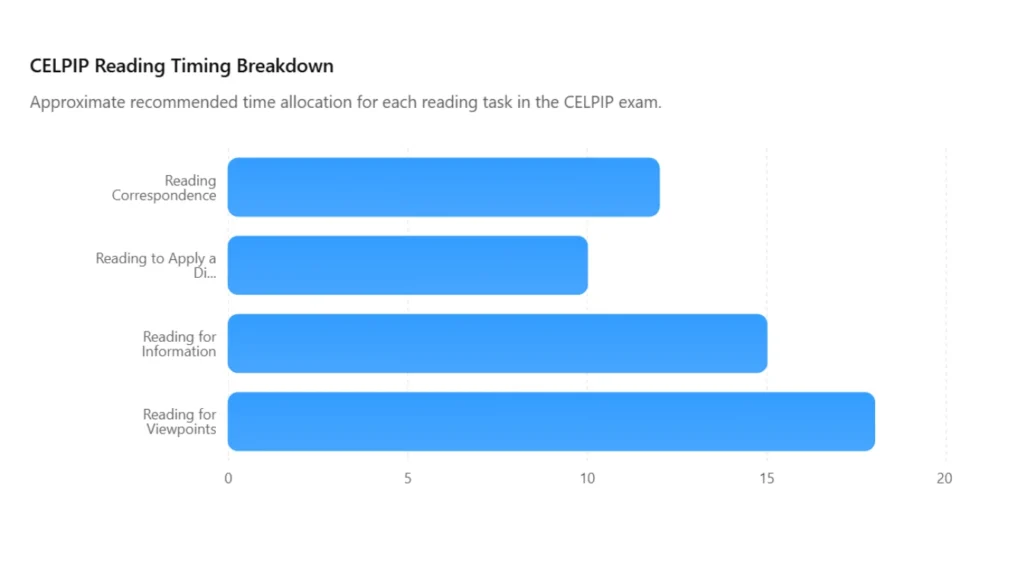
Reading Timing Strategy
Time management is critical in the Reading section because candidates must read passages, analyze questions, and choose answers within limited time.
| Reading Task | Approximate Time |
| Reading Correspondence | 10–12 Minutes |
| Reading to Apply a Diagram | 8–10 Minutes |
| Reading for Information | 12–15 Minutes |
| Reading for Viewpoints | 15–18 Minutes |
Candidates should avoid spending too much time on difficult questions early in the section because this can reduce performance later.
Common Reading Mistakes
Many test takers lose marks in the Reading section because of avoidable mistakes such as:
- Reading too slowly
- Ignoring keywords in questions
- Falling for paraphrased answer traps
- Overthinking similar answer choices
- Misunderstanding writer opinions
- Spending too much time on one passage
- Not scanning for key information efficiently
Another common issue is focusing only on vocabulary instead of understanding the overall meaning of the passage.
Best Reading Tips for CLB 9+
1. Learn Skimming and Scanning Techniques
Practice identifying keywords, names, dates, and main ideas quickly without reading every word.
2. Focus on Context, Not Individual Words
You do not need to understand every vocabulary word to answer correctly.
3. Watch for Paraphrasing
CELPIP frequently rewrites ideas using synonyms instead of exact words from the passage.
4. Improve Time Management
Set personal time limits during practice tests to simulate real exam conditions.
5. Read Questions Carefully
Small wording differences can completely change the correct answer.
6. Practice With Computer-Based Mock Tests
Familiarity with the digital format improves reading speed and navigation skills.
7. Strengthen Vocabulary Naturally
Read news articles, blogs, advertisements, and opinion pieces regularly to improve comprehension.
By understanding the complete CELPIP reading format and practicing strategically, candidates can improve reading accuracy, reduce time pressure, and increase their chances of achieving CLB 9 or higher in the CELPIP exam.
CELPIP Writing Format
The Writing section evaluates a candidate’s ability to communicate clearly, professionally, and effectively in written English. The CELPIP writing format focuses on practical real-life communication tasks commonly used in Canadian workplaces, communities, and daily situations. Candidates must type their responses on a computer within strict time limits, making both writing ability and typing speed important for success.
Many students struggle in the Writing section not because they lack ideas, but because they do not fully understand the task structure, scoring criteria, or time management strategies. Understanding the complete CELPIP general writing format can help candidates write more organized, accurate, and high-scoring responses.
Writing Section Overview
The CELPIP Writing section takes approximately 53–60 minutes and consists of two tasks:
- Writing an Email
- Responding to Survey Questions
Both tasks are completed on a computer, and candidates must type their answers directly into the exam interface.
The Writing section mainly evaluates:
- Grammar accuracy
- Vocabulary usage
- Organization and coherence
- Task fulfillment
- Clarity of communication
- Tone and style
Since the exam is fully computer-based, typing efficiently and managing time carefully are essential skills for achieving a high score.
CELPIP Writing Tasks Explained
The CELPIP writing format includes two practical communication tasks designed to reflect real-life situations in Canada.
1. Writing an Email
In this task, candidates must write a formal or semi-formal email based on a given situation. The task may involve:
- Making a request
- Giving information
- Explaining a problem
- Responding to a situation
- Providing suggestions or complaints
Candidates are expected to organize ideas clearly using:
- Introduction
- Supporting details
- Proper tone
- Logical conclusion
Skills Tested:
- Professional communication
- Grammar and sentence structure
- Clarity and organization
- Appropriate tone
2. Responding to Survey Questions
In this task, candidates respond to survey-style questions by choosing an opinion or preference and explaining their reasons.
Candidates may need to:
- Compare two options
- Defend an opinion
- Explain preferences
- Persuade readers logically
Skills Tested:
- Opinion development
- Idea organization
- Supporting arguments
- Coherence and vocabulary
This task requires candidates to write persuasively while maintaining clarity and logical flow.
CELPIP Writing Scoring Criteria
The CELPIP Writing section is evaluated based on several important factors.
| Scoring Area | What Examiners Look For |
| Content & Coherence | Clear ideas and logical organization |
| Vocabulary | Appropriate and varied word usage |
| Readability | Easy-to-understand writing |
| Task Fulfillment | Properly answering all parts of the question |
| Grammar & Syntax | Correct sentence structure and grammar |
| Tone | Suitable formal or semi-formal style |
Examiners focus heavily on communication effectiveness rather than perfect academic writing.
Common Writing Mistakes
Many students lose marks in the Writing section because of:
- Weak organization
- Grammar errors
- Repetitive vocabulary
- Ignoring task instructions
- Writing off-topic responses
- Poor paragraph structure
- Inappropriate tone
- Spelling and punctuation mistakes
- Running out of time
Another common issue is writing overly complex sentences that reduce clarity and increase grammatical mistakes.
Best Writing Strategies
1. Understand the Task Clearly
Read the question carefully and identify exactly what the task is asking.
2. Use a Simple Structure
Organize your response into:
- Introduction
- Main body
- Conclusion
A clear structure improves readability and coherence.
3. Manage Time Properly
Do not spend too much time planning. Leave a few minutes at the end for proofreading.
4. Focus on Clarity Over Complexity
Simple, clear sentences are often more effective than overly complicated grammar.
5. Practice Typing Speed
Since the test is computer-based, faster typing can help you write more detailed responses comfortably.
6. Use Real-Life Examples
Practical examples make arguments stronger and more natural.
7. Proofread Before Submission
Check grammar, spelling, punctuation, and sentence flow before finishing the task.
8. Learn Formal and Semi-Formal Tone
The CELPIP general writing format often requires professional communication, especially in the email task.
By understanding the complete CELPIP writing format and practicing regularly with timed tasks, candidates can improve organization, confidence, and writing accuracy to achieve higher CELPIP scores.
CELPIP Speaking Format
The Speaking section is one of the most unique parts of the CELPIP exam because candidates do not speak to a human examiner. Instead, all responses are recorded through a computer headset microphone. The CELPIP speaking format is designed to assess real-life communication skills used in everyday Canadian situations such as giving advice, explaining experiences, expressing opinions, and handling practical problems.
Many students find the Speaking section stressful because they must think quickly, organize ideas under time pressure, and speak clearly while surrounded by other test takers speaking at the same time. Understanding the complete CELPIP speaking test format can help candidates feel more confident, improve fluency, and avoid common mistakes on exam day.
Speaking Section Overview
The CELPIP Speaking section takes approximately 15–20 minutes and consists of 8 speaking tasks. Candidates wear a headset with a microphone and record their responses directly into the computer system.
The Speaking section mainly evaluates:
- Fluency and pronunciation
- Vocabulary usage
- Grammar accuracy
- Clarity of communication
- Organization of ideas
- Ability to respond naturally
Unlike traditional interviews, there is no face-to-face examiner interaction. This makes the CELPIP speaking environment more technology-driven and fast-paced.
All CELPIP Speaking Tasks
The CELPIP speaking format includes eight different real-life communication tasks.
1. Giving Advice
Candidates provide advice or suggestions for a specific situation.
Skills Tested:
- Problem-solving
- Clear explanations
- Logical communication
2. Talking About a Personal Experience
Candidates describe a past experience or memory in detail.
Skills Tested:
- Storytelling ability
- Fluency
- Use of descriptive language
3. Describing a Scene
Candidates describe an image or situation shown on the screen.
Skills Tested:
- Observation skills
- Vocabulary
- Organization of details
4. Making Predictions
Candidates predict future events or outcomes based on a situation.
Skills Tested:
- Speculation
- Logical reasoning
- Future tense usage
5. Comparing and Persuading
Candidates compare options and convince someone to choose one.
Skills Tested:
- Persuasive communication
- Comparison language
- Supporting arguments
6. Dealing with a Difficult Situation
Candidates respond to a challenging or uncomfortable scenario.
Skills Tested:
- Professional communication
- Problem-solving
- Emotional control in language
7. Expressing Opinions
Candidates share opinions about a topic and explain their reasoning.
Skills Tested:
- Idea development
- Supporting arguments
- Clear communication
8. Describing an Unusual Situation
Candidates explain a strange, surprising, or uncommon situation.
Skills Tested:
- Creativity
- Descriptive vocabulary
- Fluency under pressure
Speaking Preparation Time vs Speaking Time
Each task in the CELPIP speaking test format includes separate preparation and speaking times. Candidates must quickly organize their thoughts before recording begins automatically.
| Speaking Task | Preparation Time | Speaking Time |
| Giving Advice | 30 Seconds | 90 Seconds |
| Personal Experience | 30 Seconds | 60 Seconds |
| Describing a Scene | 30 Seconds | 60 Seconds |
| Making Predictions | 30 Seconds | 60 Seconds |
| Comparing & Persuading | 60 Seconds | 60 Seconds |
| Difficult Situation | 60 Seconds | 60 Seconds |
| Expressing Opinions | 30 Seconds | 90 Seconds |
| Unusual Situation | 30 Seconds | 60 Seconds |
Time management is extremely important because once the timer starts, candidates cannot pause or restart their responses.
Real Test Room Experience
Understanding the real exam environment can help reduce anxiety during the Speaking section.
Headsets and Microphones
All candidates use headsets with built-in microphones to record responses. The microphone captures speech directly into the computer system for evaluation.
Noise From Other Test Takers
One major challenge in the CELPIP speaking format is that many candidates speak simultaneously in the same room. This creates background noise and distractions during recording.
Students who practice only in silent environments often feel uncomfortable during the actual exam.
Microphone Recording Pressure
Since responses are recorded digitally, candidates must speak clearly, confidently, and at a natural pace. Hesitation, mumbling, or speaking too softly can affect clarity.
Timer Pressure
The CELPIP exam uses strict on-screen timers for both preparation and speaking time. Candidates must think quickly and organize ideas rapidly before recording begins automatically.
Many students panic because of the countdown timer, especially if they are unfamiliar with timed speaking practice.
Common Speaking Mistakes
Many candidates lose marks because of:
- Speaking too fast
- Long pauses and hesitation
- Weak organization
- Repeating ideas
- Poor pronunciation clarity
- Running out of ideas
- Ignoring the task question
- Speaking off-topic
- Overusing memorized templates
- Lack of supporting details
Another major issue is focusing too much on grammar perfection instead of natural communication.
Best Speaking Tips for High Scores
1. Practice Speaking Under Timed Conditions
Simulate real CELPIP timing to improve speed and confidence.
2. Use a Simple Speaking Structure
Organize responses with:
- Introduction
- Main points
- Conclusion
This improves clarity and coherence.
3. Speak Clearly and Naturally
Do not rush. Focus on clear pronunciation and steady pacing.
4. Expand Your Answers
Support ideas with examples, explanations, or personal experiences.
5. Practice in Noisy Environments
This helps prepare for the real test room atmosphere.
6. Avoid Memorized Answers
Examiners can recognize unnatural template-based responses.
7. Improve Vocabulary for Everyday Situations
The CELPIP speaking tasks are based on practical real-life communication.
8. Record Yourself Regularly
Listening to recordings helps identify pronunciation, fluency, and grammar issues.
By understanding the complete CELPIP speaking format and practicing consistently, candidates can improve fluency, confidence, and overall speaking performance to achieve higher CELPIP scores.
CELPIP General vs CELPIP General LS Format
Many students get confused when choosing between CELPIP General vs General LS because both tests are designed for different Canadian immigration purposes. Understanding the difference between these two exam formats is important before registering for the test.
The main difference lies in the number of language skills evaluated. The CELPIP format general exam assesses all four English communication skills, while CELPIP General LS focuses only on Listening and Speaking abilities.
Below is a simple comparison of both test versions:
| Feature | CELPIP General | CELPIP General LS |
| Listening | Yes | Yes |
| Reading | Yes | No |
| Writing | Yes | No |
| Speaking | Yes | Yes |
| Purpose | PR & Work | Citizenship |
What Is CELPIP General?
The CELPIP General test is the complete version of the exam and is mainly used for:
- Canada Permanent Residency (PR)
- Express Entry applications
- Provincial Nominee Programs (PNP)
- Professional licensing
- Employment purposes
This version evaluates:
- Listening
- Reading
- Writing
- Speaking
Since Canadian immigration programs often require proof of complete English proficiency, the CELPIP General exam is the most commonly chosen version among PR applicants.
What Is CELPIP General LS?
The CELPIP General LS test is a shorter version that only evaluates:
- Listening
- Speaking
This version is primarily required for:
- Canadian citizenship applications
Because citizenship applications focus mainly on verbal communication ability, Reading and Writing sections are not included in the General LS format.
Which CELPIP Test Should You Take?
Choosing the correct exam depends entirely on your immigration or citizenship goal.
Take CELPIP General If You:
- Are applying for Canada PR
- Need language scores for work or licensing
- Are submitting an Express Entry profile
- Need assessment of all four English skills
Take CELPIP General LS If You:
- Are applying for Canadian citizenship only
- Need Listening and Speaking assessment only
Selecting the wrong version can delay your application process, so it is important to check the exact English language requirements before booking your exam.
Key Difference Between CELPIP General and General LS
The biggest difference between CELPIP General vs General LS is the test structure and purpose. While CELPIP General is a full English proficiency exam for immigration and professional use, General LS is specifically designed for citizenship applicants who only need to demonstrate listening and speaking ability.
Understanding these differences can help candidates prepare more effectively and choose the right CELPIP exam based on their Canadian immigration goals
CELPIP Scoring System Explained
Understanding the CELPIP scoring system is extremely important for candidates applying for Canada PR, work permits, or citizenship. The CELPIP exam uses the Canadian Language Benchmark (CLB) scale to measure English proficiency levels in Listening, Reading, Writing, and Speaking.
Unlike percentage-based exams, the CELPIP test assigns scores from CLB 1 to CLB 12, with higher scores representing stronger English communication ability. Each section receives an individual score, and immigration authorities use these scores to determine eligibility for different Canadian immigration programs.
What Are CLB Levels?
The Canadian Language Benchmark (CLB) is the official national standard used in Canada to assess English language ability for immigration and professional purposes.
The CELPIP exam directly converts test performance into CLB levels, making it easier for Immigration, Refugees and Citizenship Canada (IRCC) to evaluate candidates consistently.
Basic CLB Level Meaning
| CLB Level | English Proficiency |
| CLB 1–3 | Basic English Ability |
| CLB 4–5 | Intermediate Communication |
| CLB 6–8 | Strong Working English |
| CLB 9–12 | Advanced English Proficiency |
Higher CLB scores generally increase eligibility and CRS points for Canada PR applications.
CELPIP Score Conversion Table
Below is the standard CELPIP CLB score conversion chart used for Canadian immigration purposes:
| CELPIP Score | CLB Level |
| 12 | CLB 12 |
| 11 | CLB 11 |
| 10 | CLB 10 |
| 9 | CLB 9 |
| 8 | CLB 8 |
| 7 | CLB 7 |
| 6 | CLB 6 |
| 5 | CLB 5 |
| 4 | CLB 4 |
| M, 3 or Below | CLB 3 or Lower |
This scoring system applies separately to:
- Listening
- Reading
- Writing
- Speaking
Each section can receive a different CLB score depending on performance.
What CELPIP Score Is Needed for Canada PR?
The required CELPIP CLB score depends on the immigration pathway you choose.
Common PR Requirements
| Immigration Program | Minimum CLB Requirement |
| Express Entry (General Eligibility) | CLB 7 |
| Federal Skilled Worker Program | CLB 7 |
| Canadian Experience Class | CLB 5–7 |
| Provincial Nominee Programs (PNP) | Varies by Province |
| High CRS Score Competitiveness | CLB 9+ |
For many candidates, achieving CLB 9 is considered highly valuable because it can significantly increase Comprehensive Ranking System (CRS) points for Express Entry.
How CELPIP Scoring Works
The CELPIP scoring system evaluates how effectively candidates communicate in English rather than simply counting grammar mistakes.
Examiners assess:
- Clarity of communication
- Vocabulary usage
- Grammar accuracy
- Fluency and coherence
- Task completion
- Pronunciation (Speaking)
- Reading and listening comprehension
The Speaking and Writing sections are evaluated by trained raters, while Listening and Reading are computer-scored based on correct answers.
Important Things to Know About CELPIP Scores
1. Each Section Is Scored Separately
You receive individual scores for:
- Listening
- Reading
- Writing
- Speaking
2. There Is No Overall Band Score
Unlike IELTS, CELPIP does not provide an average overall band. Immigration authorities focus on section-wise CLB levels.
3. CLB 9 Is a Major Target for PR Applicants
Many Express Entry candidates aim for CLB 9 because it can provide a significant CRS score boost.
4. Results Are Usually Available Quickly
CELPIP results are typically available within a few business days after the exam.
5. Communication Quality Matters Most
Examiners focus more on effective communication than perfect academic English.
Understanding the complete CELPIP scoring system and knowing your target CELPIP CLB score can help you prepare strategically and focus on the language skills most important for your Canadian immigration goals.
What the CELPIP Test Actually Feels Like
Most websites only explain the structure of the CELPIP exam, but very few explain what the test actually feels like on exam day. This is one of the biggest reasons students feel shocked, nervous, or overwhelmed during the real exam even after weeks of preparation.
Understanding the real CELPIP experience can help you prepare mentally, improve confidence, and avoid common mistakes that many first-time test takers make.
Fully Computer-Based Experience
The CELPIP exam is completely computer-delivered from start to finish. Every section Listening, Reading, Writing, and Speaking is completed on a computer using headphones, a keyboard, and a microphone headset.
During the exam, candidates:
- Read passages on screen
- Listen through headphones
- Type writing responses
- Record speaking answers into a microphone
Unlike paper-based exams, there are no handwritten answers. This means computer familiarity and typing speed become extremely important for success.
Many students who are not comfortable typing quickly often struggle to complete Writing tasks on time.
No Human Examiner
One major difference between CELPIP and other English exams is that there is no face-to-face speaking interview.
In the Speaking section:
- Questions appear on the computer screen
- Preparation time is provided
- Responses are recorded automatically through the headset microphone
For many students, this reduces nervousness because they are not speaking directly to an examiner. However, others find it challenging because there is no human interaction or feedback during the test.
The experience feels more technology-driven and time-sensitive compared to traditional face-to-face speaking interviews.
Time Pressure Feels Very Real
The CELPIP exam moves very quickly. Every section has strict timers, and once time finishes, the exam automatically moves to the next question or task.
One of the most common challenges candidates report is the fast pace of the actual exam.
Common challenges include:
- Limited time to organize speaking ideas
- Reading passages under strict time limits
- Typing essays quickly
- Listening carefully while reading questions simultaneously
Candidates who practice only casually at home often struggle with the actual exam pace.
Fast-Paced Sections Require Constant Focus
Unlike traditional exams where students can pause and think for long periods, the CELPIP exam requires continuous concentration for nearly three hours.
The pace becomes especially intense during:
- Listening tasks with one-time audio playback
- Reading sections with long passages
- Speaking tasks with short preparation time
- Writing tasks under typing pressure
Losing focus even briefly can affect multiple questions.
Typing Speed Is More Important Than Most Students Expect
Because the exam is fully digital, typing speed directly impacts Writing performance.
Students with slow typing skills often:
- Run out of time
- Write incomplete responses
- Make more spelling errors
- Lose coherence while rushing
Practicing typing regularly before the exam can significantly improve writing quality and reduce stress during the actual test.
Headphones and Microphone Environment
Every candidate wears a headset during the exam for:
- Listening audio playback
- Speaking response recording
The microphone records your answers directly into the system for evaluation.
Many students are surprised by how technical the environment feels compared to traditional classroom exams.
It is important to:
- Speak clearly
- Maintain steady volume
- Avoid mumbling
- Stay close to the microphone naturally
Noise From Other Test Takers
One of the biggest real-world challenges in the CELPIP test is background noise during the Speaking section.
Since everyone speaks at the same time in the same room:
- Multiple voices overlap
- The room becomes noisy
- Concentration becomes difficult
Students who only practice in quiet environments may panic during the real exam.
Practicing mock speaking tests with background noise can help improve focus and confidence.
Real Student Challenges Most People Don’t Expect
Many candidates struggle not because of weak English, but because of:
- Stress under timers
- Difficulty multitasking
- Fast transitions between sections
- Nervousness during recording
- Lack of computer-based practice
- Mental fatigue during long sessions
Some students also freeze during Speaking tasks because preparation time feels shorter than expected.
Others lose marks in Writing simply because they cannot organize ideas quickly enough while typing.
What Makes CELPIP Different From Other English Tests?
The CELPIP exam feels more practical and communication-focused compared to many traditional English tests. Instead of academic theory, it tests how well candidates can handle real-life situations commonly experienced in Canada.
This includes:
- Workplace communication
- Everyday conversations
- Problem-solving situations
- Opinion discussions
- Practical reading and listening tasks
Because of this, success in CELPIP depends heavily on:
- Time management
- Familiarity with the format
- Real-life communication ability
- Computer-based practice
Understanding the actual exam experience in advance can give candidates a major advantage and help reduce anxiety on the real test day.
CELPIP Test Day Rules & Requirements
Understanding the official CELPIP test day rules and requirements can help candidates avoid unnecessary stress, delays, or last-minute problems on exam day. Many students prepare for the English sections but forget to prepare for the actual testing process itself.
Since the CELPIP exam is fully computer-based and conducted under strict test centre rules, it is important to know what to bring, when to arrive, and how the testing environment works before your exam date.
ID Requirements
Candidates must bring a valid government-issued identification document that exactly matches the information used during CELPIP registration.
Commonly accepted IDs include:
- Passport
- Permanent Resident Card
- Government-issued photo identification
Important points to remember:
- The name on your ID must match your registration details exactly
- Expired IDs are usually not accepted
- Photocopies or digital copies are not allowed
- Without valid ID, candidates may be refused entry to the exam
Always double-check your identification documents before leaving for the test centre.
Arrival Time
Candidates are strongly advised to arrive at the test centre at least:
- 45–60 minutes before the scheduled exam time
Early arrival is important because candidates must complete:
- Identity verification
- Registration procedures
- Security checks
- Test instructions
Late arrivals may not be permitted to enter the exam room once the test has started.
Note-Taking Rules
The CELPIP exam allows note-taking during the test.
Test centres usually provide:
- Note paper or erasable writing sheets
- Pens or markers
Candidates can use notes during:
- Listening tasks
- Reading sections
- Speaking preparation time
Taking quick notes can help improve concentration and organize ideas more effectively during the exam.
However:
- Personal notebooks are not allowed
- All provided materials must be returned after the test
Break Policy
The CELPIP General exam is completed in one continuous sitting, which means:
- There are usually no long scheduled breaks
- Candidates are expected to remain focused throughout the exam
Some test centres may allow short supervised restroom breaks during certain situations, but the test timer may continue running depending on the section.
Because the exam lasts nearly three hours, candidates should:
- Eat before arriving
- Stay hydrated
- Be mentally prepared for a long testing session
Headphones and Audio Equipment
Every candidate receives:
- Headphones
- A microphone headset
The headset is used for:
- Listening audio playback
- Recording Speaking responses
Before the exam begins, candidates complete an audio check to ensure:
- Sound quality is clear
- Microphone volume works properly
It is important to:
- Speak clearly into the microphone
- Adjust the headset comfortably
- Inform staff immediately if technical issues occur
Typing Requirements
Since the CELPIP exam is fully computer-based, typing skills are extremely important especially in the Writing section.
Candidates must type:
- Emails
- Survey responses
- Navigation inputs
Students with slow typing speed often:
- Run out of time
- Make more spelling mistakes
- Write shorter answers
Practicing computer typing before the exam can significantly improve:
- Writing fluency
- Time management
- Overall confidence
Additional CELPIP Test Day Tips
To reduce stress and improve performance:
- Get proper sleep before the exam
- Practice with computer-based mock tests
- Arrive early and stay calm
- Listen carefully to instructions
- Avoid spending too much time on difficult questions
Being familiar with the CELPIP test day environment can make a major difference in confidence, focus, and overall exam performance.
Best Preparation Tips for the CELPIP Exam
Scoring well in the CELPIP exam is not only about having strong English skills; it also requires smart preparation, time management, and familiarity with the exam format. Many students struggle because they prepare without understanding how the computer-based test actually works.
The best way to improve your CELPIP score is to combine consistent practice with targeted strategies for each section. Below are some of the most effective preparation tips that can help candidates improve confidence, accuracy, and overall performance.
1. Practice With Full-Length Mock Tests
One of the most effective ways to prepare for CELPIP is by taking regular mock tests under timed conditions.
Mock tests help candidates:
- Understand the real exam structure
- Improve time management
- Build concentration for long exam sessions
- Identify weak sections
- Reduce test-day anxiety
Since the CELPIP exam is fully computer-based, practicing with online mock tests is especially important.
2. Improve Time Management Skills
Time pressure is one of the biggest challenges in the CELPIP exam. Every section has strict timers, and candidates must think, read, write, and speak quickly.
To improve time management:
- Use timers during practice sessions
- Avoid spending too much time on one question
- Learn skimming and scanning techniques
- Practice organizing speaking responses quickly
- Leave time for proofreading in Writing tasks
Students who manage time effectively often perform much better even with average English skills.
3. Practice Typing Regularly
Because the exam is fully computer-based, typing speed plays a major role in Writing performance.
Candidates with slow typing skills may:
- Run out of time
- Write incomplete answers
- Make more typing errors
- Lose focus while correcting mistakes
Daily typing practice can improve:
- Writing speed
- Accuracy
- Confidence during the test
It is also helpful to practice writing essays and emails directly on a computer rather than on paper.
4. Build Strong Vocabulary Naturally
A wider vocabulary helps improve:
- Reading comprehension
- Writing quality
- Speaking fluency
- Listening understanding
Instead of memorizing difficult words randomly, focus on:
- Everyday English expressions
- Workplace vocabulary
- Canadian communication style
- Common opinion and discussion phrases
Reading news articles, blogs, and English conversations regularly can improve vocabulary naturally over time.
5. Improve Speaking Fluency
The Speaking section tests real-life communication ability, so fluency is extremely important.
To improve speaking performance:
- Practice speaking daily
- Record your responses
- Use timed speaking exercises
- Focus on clarity and organization
- Avoid memorized robotic answers
Many students understand English well but struggle to express ideas quickly under pressure. Regular speaking practice helps build confidence and natural communication flow.
Related Guide:
- CELPIP Speaking Templates
6. Practice Active Listening
The Listening section requires strong concentration because recordings are usually played only once.
To improve listening skills:
- Listen to podcasts and news regularly
- Practice understanding Canadian accents
- Take quick notes while listening
- Focus on keywords and main ideas
- Train yourself to multitask while listening and reading questions
Consistent listening practice improves both speed and comprehension accuracy.
7. Learn the CELPIP Question Types
Many students lose marks simply because they are unfamiliar with the task structure.
Candidates should clearly understand:
- Speaking task formats
- Writing response expectations
- Reading question patterns
- Listening task flow
The more familiar you are with the exam structure, the less stressful the real exam feels.
8. Review High-Scoring Sample Answers
Studying strong sample responses helps candidates understand:
- Proper structure
- Vocabulary usage
- Grammar style
- Idea organization
- Scoring expectations
Analyzing model answers is especially useful for Writing and Speaking preparation.
Related Guide:
- CELPIP Writing Samples
9. Focus on Communication, Not Perfection
The CELPIP exam evaluates effective communication more than perfect academic English.
Candidates should focus on:
- Clear ideas
- Logical organization
- Natural speaking
- Relevant examples
- Simple but accurate grammar
Trying to sound overly complex often increases mistakes and reduces fluency.
10. Practice Under Real Exam Conditions
Many students prepare in comfortable environments but struggle during the actual exam because of:
- Timers
- Background noise
- Mental pressure
- Fast transitions between sections
Practicing under realistic conditions can improve:
- Confidence
- Concentration
- Stress management
- Overall exam readiness
With the right preparation strategy, regular practice, and familiarity with the exam format, candidates can significantly improve their CELPIP performance and achieve the scores required for Canada PR, work, or citizenship applications.
Final Verdict
The CELPIP exam is more than just an English test; it is a practical assessment designed to measure how effectively candidates can communicate in real-life Canadian situations. Understanding the complete CELPIP test format, including section structure, timing, question types, scoring system, and computer-based environment, is one of the most important steps toward achieving a high score.
Unlike traditional language exams, CELPIP focuses heavily on practical communication, fast decision-making, and real-world English usage. From Listening and Reading to Writing and Speaking, every section requires strong time management, clear communication, and familiarity with the exam structure.
One of the biggest advantages of the CELPIP exam is its fully computer-based format, single-sitting structure, and Canadian-focused communication style, making it a preferred choice for many Canada PR and citizenship applicants. However, candidates who succeed are usually those who prepare strategically rather than relying only on basic English knowledge.
To perform well in the CELPIP exam:
- Practice regularly with mock tests
- Improve typing speed and speaking fluency
- Learn time management strategies
- Understand each question type clearly
- Familiarize yourself with the real test environment
Whether you are applying for Canada PR, citizenship, work opportunities, or professional licensing, understanding the CELPIP format in advance can give you a major advantage on exam day.
With the right preparation, smart practice techniques, and confidence in the exam structure, achieving your target CELPIP score becomes far more realistic and manageable.
FAQs
1.How long is the CELPIP exam?
The CELPIP General exam takes approximately 3 hours to complete in one sitting and includes Listening, Reading, Writing, and Speaking sections. There is no separate speaking interview, as all sections are completed continuously on a computer. The shorter CELPIP General LS exam takes about 1 hour and 10 minutes because it only includes Listening and Speaking tasks.
2.Is CELPIP fully computer-based?
Yes, the CELPIP exam is completely computer-based. Candidates complete all sections on a computer using headphones for Listening, a keyboard for Writing, and a microphone headset for Speaking responses. Unlike some other English proficiency tests, there is no paper-based option or face-to-face speaking interview in CELPIP.
3.Is CELPIP easier than IELTS?
Whether CELPIP is easier than IELTS depends on the candidate’s strengths and comfort level. Many students find CELPIP easier because it is fully computer-based, uses Canadian accents, and does not include a face-to-face speaking interview. However, candidates who prefer traditional speaking interviews or paper-based exams may feel more comfortable with IELTS.
4.How many sections are in CELPIP?
The CELPIP General exam contains four sections: Listening, Reading, Writing, and Speaking. Each section is designed to test practical English communication skills used in real-life Canadian situations. The CELPIP General LS version only includes Listening and Speaking sections for citizenship applicants.
4. What is CELPIP General LS?
CELPIP General LS is a shorter version of the CELPIP exam that only tests Listening and Speaking skills. It is mainly designed for Canadian citizenship applications where applicants are only required to demonstrate verbal English communication ability. Unlike the full CELPIP General exam, it does not include Reading or Writing sections.