
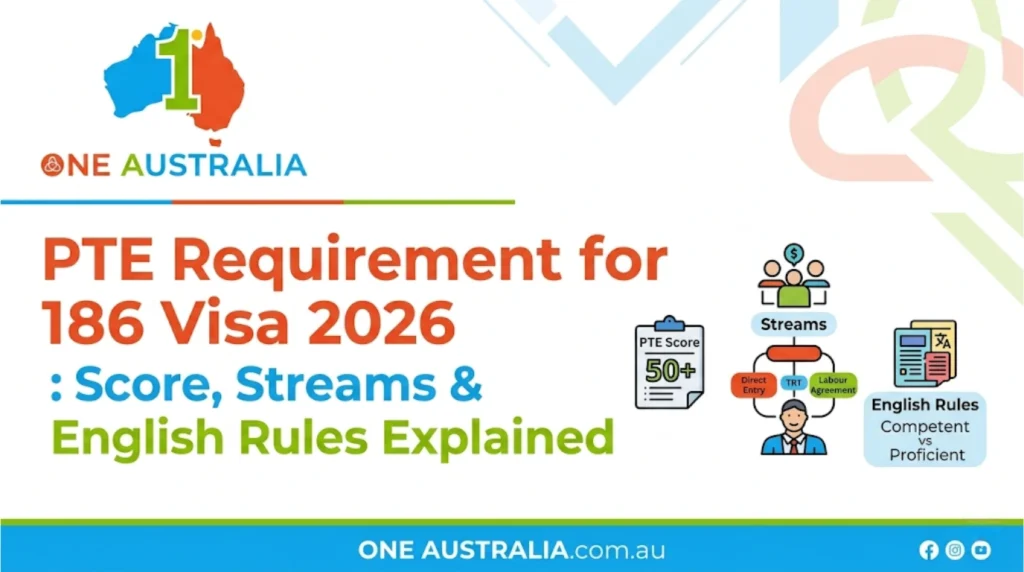
PTE Requirement for 186 Visa 2026 : Score, Streams & English Rules Explained
TL;DR
- This blog targets skilled migrants, 482 visa holders transitioning to PR, offshore applicants, and employer-sponsored workers seeking clarity on the 186 visa English requirement (PTE score, IELTS, and TOEFL rules) and how it impacts Permanent Residency eligibility in Australia.
- The Subclass 186 visa requires Competent English in most cases, meaning a minimum PTE score of 50 in each skill (Listening, Reading, Writing, Speaking) or IELTS 6 in each band. The requirement is strict and based on each skill individually, not overall score, which is a major reason for confusion and visa errors.
- The English requirement varies depending on visa streams such as Direct Entry, Temporary Residence Transition (TRT), and Labour Agreement, where Direct Entry is the strictest and Labour Agreement may have flexible conditions based on employer arrangements.
- The blog clearly explains key distinctions and common misunderstandings, including Functional vs Competent English, partner English requirements, 491 vs 186 comparison, and why overall PTE score is not accepted, helping applicants avoid refusal due to incorrect assumptions.
- It also provides practical guidance including scenario-based clarifications, mistake prevention strategies, retake planning, and preparation tips, making it a complete decision guide to achieve the required pte score for 186 visa successfully and improve approval chances.
Related Blogs
- Graduate Visa PTE Score Requirements in 2026
- PTE Read Aloud Practice: Free Questions, Tips
- PTE New Changes 2026: Complete Guide to Update & New Rules
INTRODUCTION
The Subclass 186 Employer Nomination Scheme (ENS) visa is one of the most direct pathways to Permanent Residency (PR) in Australia for skilled workers who are nominated by an approved Australian employer. It is widely used by professionals already working in Australia on temporary visas, as well as overseas applicants who secure employer sponsorship.
A key eligibility factor for this visa is the English language requirement. While many applicants focus on skills assessment and nomination, the English requirement often becomes a deciding factor in visa approval. Understanding this requirement clearly is essential, as even a small misunderstanding can lead to delays or refusal.
A common area of confusion is whether applicants should take IELTS or PTE Academic for the 186 visa. Both tests are accepted by the Department of Home Affairs, but the requirement is not based on an overall score. Instead, applicants must meet minimum scores in each of the four skills: Listening, Reading, Writing, and Speaking. This is where many applicants make mistakes by assuming that an overall average score is sufficient.
In most cases, applicants are required to demonstrate Competent English, which typically means achieving a PTE Academic score of 50 in each band or an IELTS score of 6 in each component. However, the exact requirement can vary depending on the visa stream, such as Direct Entry, Temporary Residence Transition, or Labour Agreement.
Most applicants need a PTE score of 50 in each band (Competent English) for the Subclass 186 visa, but the requirement may vary depending on the stream and individual circumstances.
WHAT IS THE PTE REQUIREMENT FOR 186 VISA?
The PTE requirement for the Subclass 186 visa is based on demonstrating Competent English, which is the minimum English proficiency level required for most applicants seeking Permanent Residency through the Employer Nomination Scheme (ENS).
Competent English means the applicant must show the ability to communicate effectively in everyday and workplace situations. For the PTE Academic test, this is measured by achieving a minimum score in each of the four skills, not an overall average score.
Competent English definition
Competent English is the standard English requirement set by the Department of Home Affairs for the 186 visa. It confirms that the applicant has sufficient English ability to live and work in Australia without communication barriers. This level is generally required for the main applicant unless an exemption applies based on specific visa conditions.
PTE Academic requirement for 186 visa
To meet Competent English, applicants must achieve:
- A minimum of 50 in each section of the PTE Academic test
- No reliance on overall score averages
- Each skill must individually meet the required benchmark
This is one of the most important rules because even if the overall score is high, failing one section can make the applicant ineligible.
IELTS equivalency
The PTE requirement is also accepted in IELTS format for comparison purposes:
- IELTS 6 in each band (Listening, Reading, Writing, Speaking)
Both PTE and IELTS follow the same principle: each skill must meet the minimum requirement individually.
Why each skill matters (not overall score)
The Department of Home Affairs assesses English ability across all communication areas. This means:
- A strong speaking score cannot compensate for a weak writing score
- An overall average is not considered valid
- Every skill must independently meet the required threshold
This is why many applicants face confusion or rejection when they assume total score is sufficient.
UPDATED PTE SCORE FOR 186 VISA (2025–2026)
The PTE score required for the Subclass 186 visa depends on the level of English proficiency you are required to demonstrate under Australian immigration rules. For most applicants, the minimum requirement is Competent English, but other English levels such as Functional and Vocational English may apply in specific situations, especially for dependents or alternative visa pathways.
Understanding these levels is important because many applicants mistakenly focus only on a single PTE score requirement, while the Department of Home Affairs recognises different English categories depending on the applicant’s role in the visa application.
Below is the updated breakdown of English proficiency levels relevant to the 186 visa English requirements (2025–2026).
English Level Comparison for 186 Visa (PTE & IELTS)
| English Level | PTE Score Requirement | IELTS Equivalent | Purpose / Who It Applies To |
| Functional English | 24 overall | 4.5 average | Dependents or basic eligibility requirement |
| Competent English | 50 each skill | 6 each band | Main 186 visa applicants (standard requirement) |
| Vocational English | 36 each skill | 5 each band | Certain skilled or transitional visa pathways |
Key clarification for applicants
The most important level for the Subclass 186 visa is Competent English, which requires a minimum PTE score of 50 in each section (Listening, Reading, Writing, Speaking). This is the standard requirement for most applicants applying for Permanent Residency through employer sponsorship.
Functional and Vocational English levels are not sufficient for the main applicant in most cases, but they may apply to dependents or specific visa conditions.
STREAM-WISE PTE REQUIREMENT FOR SUBCLASS 186
The 186 visa PTE requirement is not always identical for every applicant. It depends on the specific stream under which you are applying. The Subclass 186 Employer Nomination Scheme (ENS) visa has three main streams, and each stream has different English language expectations based on eligibility and employment pathway.
Understanding your stream is important because it directly determines whether you must meet Competent English (PTE 50 each band) or whether exemptions may apply.
Direct Entry Stream
The Direct Entry stream is the most common pathway for skilled workers applying directly for Permanent Residency without prior long-term work in Australia under a sponsoring employer.
- Requires Competent English
- Minimum PTE 50 in each section (Listening, Reading, Writing, Speaking)
- No flexibility in most cases
- Applicants must meet full English requirement at time of application
This stream has the strictest and most clearly defined 186 visa PTE requirement, making Competent English mandatory for eligibility.
Temporary Residence Transition (TRT) Stream
The TRT stream is designed for applicants who are already working in Australia on a temporary work visa (commonly Subclass 482) and are transitioning to permanent residency with the same employer.
- Generally requires Competent English (PTE 50 each)
- In some cases, exemptions may apply depending on:
- Occupation
- Salary level
- Length of employment with sponsoring employer
- Requirements can be more flexible compared to Direct Entry
While Competent English is still the standard expectation, the TRT stream may offer reduced English requirements in specific scenarios, depending on Department of Home Affairs policies.
Labour Agreement Stream
The Labour Agreement stream applies when an employer has a formal agreement with the Australian Government to sponsor overseas workers under specific terms.
- English requirement is not fixed universally
- May vary based on the labour agreement conditions
- Some agreements may require:
- Competent English (PTE 50 each)
- Lower English levels
- Or alternative evidence of English ability
Because requirements are negotiated between employers and the government, the 186 visa English requirement (PTE score) in this stream can differ significantly from case to case.
PTE VS IELTS VS TOEFL FOR 186 VISA
The 186 visa English requirements are not limited to one English test. The Department of Home Affairs accepts multiple English proficiency tests, including PTE Academic, IELTS, and TOEFL iBT. However, the key rule remains the same across all tests: applicants must meet the minimum score in each individual skill area, not an overall average.
This means your Listening, Reading, Writing, and Speaking scores are assessed separately, and each section must meet the required benchmark for visa eligibility.
English Test Comparison for Subclass 186 Visa
| Test | Required Score | Accepted for 186 Visa |
| PTE Academic | 50 in each skill | Yes |
| IELTS | 6 in each band | Yes |
| TOEFL iBT | Equivalent scores | Yes |
Important clarification for applicants
Although multiple tests are accepted, they all follow the same scoring principle. Applicants often assume that achieving a high overall score is sufficient, but this is incorrect for Australian immigration purposes.
186 VISA PARTNER ENGLISH REQUIREMENT
The 186 visa partner English requirement is an important but often misunderstood part of the Subclass 186 Employer Nomination Scheme visa. While the main applicant must usually meet Competent English, the English requirement for partners or dependents is more flexible and depends on whether they can demonstrate Functional English or choose to pay an additional visa charge.
Understanding this correctly is important because it can directly impact both eligibility conditions and overall visa costs.
Partner / Dependent English Requirement
For the Subclass 186 visa, the partner or secondary applicant is generally not required to meet Competent English. Instead, they must either:
- Demonstrate Functional English, or
- Pay a Second Instalment Visa Application Charge (VAC) if Functional English is not demonstrated
Functional English is a lower English requirement compared to the main applicant’s Competent English level.
Functional English vs Exemption (Fee Option)
A partner or dependent can meet Functional English through:
- PTE Academic: typically lower scores (around 30–36 per skill depending on accepted proof method)
- IELTS: around 4.5–5.0 overall equivalent range (depending on accepted evidence)
If the partner cannot demonstrate Functional English, they are still eligible to be included in the visa application but must pay an additional government fee instead of meeting the English requirement.
When does a partner need to take PTE?
A partner may need to take a PTE Academic test if:
- They want to avoid paying the additional visa charge
- They prefer to meet Functional English requirement through testing
- They are required to provide proof of English ability during processing
In this case, the focus is not on Competent English, but on achieving a Functional English level score.
When is a fee applied instead of English test?
The Australian immigration system allows flexibility for partners who do not wish to provide English test results. In such cases:
- The applicant does not need to sit PTE or IELTS
- A Second Instalment Visa Application Charge is paid instead
- This fee allows inclusion of the partner in the visa grant despite not meeting English requirements
Scenario examples (for clarity)
Scenario 1: No English test submitted
- Partner does not take PTE or IELTS
- Functional English not demonstrated
- Visa granted with additional visa fee surcharge
Scenario 2: Functional English achieved
- Partner scores PTE equivalent of Functional English (approx. 4.5–5 IELTS level)
- No additional visa fee required
- Partner satisfies 186 visa partner English requirement
COMMON MISTAKES THAT LEAD TO VISA REFUSAL
Many applicants underestimate the importance of the PTE score for 186 visa, assuming that meeting a general English level or overall score is sufficient. However, the Subclass 186 visa has strict English requirements, and even small misunderstandings can result in delays or refusal.
Below are the most common mistakes applicants make when meeting the 186 visa English requirements.
Thinking overall score is enough
One of the most frequent mistakes is assuming that an overall high PTE score is enough for visa eligibility.
- The 186 visa requires minimum scores in each skill area
- Listening, Reading, Writing, and Speaking must all meet the requirement individually
- A strong overall score cannot compensate for a weak section
Submitting expired PTE results
Another common error is using test results that are no longer valid for immigration purposes.
- PTE Academic results must be valid at the time of application
- Expired results are not accepted, even if the score meets requirements
- Applicants should always check validity before lodging their visa
Mixing IELTS overall score with band requirements
Many applicants misunderstand how IELTS is assessed for visa purposes.
- IELTS overall score is not considered for eligibility
- Each band must meet the minimum requirement individually (e.g., 6 in each band for Competent English)
- The same rule applies to PTE Academic (minimum 50 in each skill)
Choosing the wrong English category (Functional vs Competent)
Confusion between English levels is another major issue.
- Functional English is not sufficient for most primary 186 visa applicants
- Competent English (PTE 50 each) is generally required
- Incorrect classification can lead to wrong expectations and documentation issues
Applying before meeting English requirement
Some applicants submit their visa application without fully meeting the English requirement.
- English requirement must be met at the correct stage of application
- Submitting without valid test results can delay processing or lead to refusal
- Proper planning of PTE or IELTS testing is essential before lodgement
SCENARIO-BASED CONFUSION CLARIFICATION (HIGH RANKING SECTION)
Many applicants searching for the pte score required for 186 visa are not just looking for definitions, they are trying to understand real-life situations where their results or eligibility may be affected. Below are clear explanations of the most common scenarios that create confusion.
What if one PTE section is below 50?
This is one of the most critical issues for Subclass 186 applicants.
- The requirement for most applicants is Competent English
- This means minimum 50 in each skill area (Listening, Reading, Writing, Speaking)
- If even one section is below 50, the requirement is not met
There is no averaging allowed, and a high score in other sections cannot compensate for a low score in one skill.
Can I combine multiple PTE tests?
In most cases, applicants cannot combine scores from multiple PTE tests to meet the English requirement.
- The Department of Home Affairs generally requires a single test result
- Splitting scores across different test attempts is not accepted for Competent English
- Applicants must achieve all required scores in one valid test sitting
This is an important misunderstanding that often leads to application errors.
Do offshore applicants have different rules?
The English requirement for the Subclass 186 visa is generally the same whether you are applying from inside or outside Australia.
- Offshore applicants must still meet Competent English (PTE 50 each) in most cases
- There is no lower standard simply because the applicant is outside Australia
- The difference is usually in processing and eligibility pathways, not English score requirements
482 → 186 transition English requirement confusion
Many applicants transitioning from a Subclass 482 visa to a 186 visa assume that previous work experience reduces English requirements.
However:
- English requirements may still apply depending on the stream
- In most cases, Competent English is still required
- Some exemptions may exist under specific TRT conditions, but they are not automatic
A common mistake is assuming that long-term work on a 482 visa removes the need for PTE or IELTS entirely, which is not always correct.
491 VISA PTE REQUIREMENT
The 491 visa PTE requirement is often compared with the Subclass 186 visa because both pathways are part of Australia’s skilled migration system. However, it is important to understand that the Subclass 491 visa is a temporary skilled regional visa, while the Subclass 186 visa leads directly to Permanent Residency (PR).
Because of this difference, the English requirements may appear similar in many cases, but the purpose and immigration outcomes are not the same.
491 visa English requirement overview
For the Subclass 491 visa, applicants are generally required to demonstrate at least Competent English in most nomination pathways.
- Typically requires PTE Academic 50 in each skill area
- Equivalent to IELTS 6 in each band
- May vary depending on state nomination criteria or occupation pathway
While the requirement is similar to the 186 visa in many cases, it is applied within a temporary visa framework rather than a direct PR pathway.
Similarities between 491 and 186 visa PTE requirements
In practical terms, both visas often require:
- Competent English level
- PTE Academic score of 50 in each section
- IELTS equivalent of 6 in each band
This creates confusion for applicants, as the English benchmarks appear identical on paper.
Why 186 visa is stricter for PR pathway?
Even though the PTE requirement for 491 visa and 186 visa may look similar, the 186 visa is more stringent overall because:
- It is a direct Permanent Residency visa
- English requirement is tied to long-term settlement eligibility
- Assessment is often stricter across all eligibility factors, not just English
- No transitional PR stage like 491 (which requires a pathway to PR later)
In contrast, the 491 visa is a temporary visa leading to PR through later pathways, which makes its initial requirements slightly more flexible in some cases.
EXPERT TIPS TO ACHIEVE REQUIRED PTE SCORE
Scoring the required PTE score for 186 visa is not just about English ability, it is also about strategy, preparation, and timing. Many applicants fail not because they lack language skills, but because they approach the test without a clear plan aligned with visa requirements.
Below are practical, high-impact strategies to help you achieve the required score efficiently.
Weak module improvement strategy
Most candidates lose marks in one or two specific sections rather than across all skills.
- Identify your weakest module (Listening, Reading, Writing, or Speaking)
- Focus targeted practice on that section instead of general preparation
- Use section-specific practice tests to track improvement
- Prioritise accuracy over speed in weak areas first, then build timing
For example, if Writing is weak, improving structure and grammar will often raise your score faster than overall practice.
Speaking and writing score boosting tips
Speaking and Writing are often the most challenging sections for achieving PTE 50 each, especially for visa purposes.
Speaking tips:
- Focus on fluency rather than complex vocabulary
- Avoid long pauses and self-corrections
- Practice repeat-reading and describe-image tasks daily
- Record and evaluate your responses for clarity
Writing tips:
- Use structured essay formats (introduction, body, conclusion)
- Avoid grammatical complexity if it reduces accuracy
- Focus on coherence and task completion rather than length
- Practice timed essays regularly
These two sections heavily influence whether you meet the 186 visa English requirements PTE benchmark.
Retake strategy before visa lodgement
A smart retake strategy can significantly improve your chances of meeting the required score.
- Do not rush multiple attempts without analysing errors
- Review your previous score report carefully
- Focus only on sections that fall below the required 50 score
- Schedule retakes with enough preparation time between attempts
Many applicants achieve success on their second attempt after targeted improvement rather than repeated testing without strategy.
Timing strategy before application submission
Timing your PTE test correctly is critical for visa success.
- Ensure your test result is valid at the time of visa lodgement
- Do not book the test too early or too late in the application process
- Leave buffer time for retakes if needed
- Align your test schedule with your visa application timeline
Poor timing is one of the most common reasons applicants face delays despite meeting the pte score required for 186 visa.
FINAL SUMMARY
The pte requirement for 186 visa is primarily designed to ensure that applicants can effectively communicate in English in both professional and everyday environments in Australia. For most applicants, the requirement is straightforward but must be met precisely as per immigration guidelines.
A key point many applicants overlook is that the requirement is not based on an overall score but on performance in each individual skill area. This is why understanding the exact benchmark is critical before applying for the Subclass 186 visa.
The 186 visa English requirement is also influenced by visa streams and specific exemptions, particularly for certain TRT or labour agreement cases, as well as partner-related conditions.
FREQUENTLY ASKED QUESTIONS
Is PTE mandatory for 186 visa?
PTE is not mandatory for the Subclass 186 visa. Applicants can choose between PTE Academic, IELTS, or TOEFL iBT as long as they meet the required English proficiency level. The key requirement is not the test type but achieving the minimum score in each skill area based on the visa stream.
What is the minimum PTE score for 186 visa Australia?
The minimum PTE requirement for most Subclass 186 visa applicants is 50 in each skill area, including Listening, Reading, Writing, and Speaking. This level is considered Competent English, which is commonly required for primary applicants applying for permanent residency through employer sponsorship.
Can I apply with overall PTE score?
No, applicants cannot rely on an overall PTE score for the 186 visa. The Department of Home Affairs requires that each individual skill meets the minimum benchmark. Even if the overall score is high, failing to meet the required score in one section can result in not meeting the 186 visa English requirements PTE.
How long is PTE valid for 186 visa?
PTE Academic results are generally valid for Australian visa purposes for up to three years, depending on current immigration rules at the time of application. It is important to ensure that the test is valid both at the time of lodgement and during visa processing.
Is IELTS or PTE better for 186 visa?
Both IELTS and PTE are equally accepted for the Subclass 186 visa, and neither is preferred by the immigration authority. The choice depends on the applicant’s comfort with the test format. However, both tests require meeting minimum per-skill scores rather than an overall average.