PTE to IELTS Score Conversion 2026 – Official Chart, Skill-Wise Comparison & Real Examples
TL;DR
- This blog is designed for students, skilled migrants, and professionals who need to understand PTE to IELTS score conversion for university admission, PR applications, or professional registration. It explains official 2026 concordance tables and practical examples to help readers plan their preparation.
- Provides an updated PTE score to IELTS table with overall and skill-wise equivalents, including examples like PTE 55 to IELTS, PTE 65 to IELTS, and PTE 79 to IELTS, ensuring readers can accurately convert their scores.
- Breaks down Listening, Reading, Speaking, and Writing conversions, showing how AI-based PTE scoring compares to human-assessed IELTS bands, helping readers understand section-specific differences for migration or university eligibility.
- Covers Australian and Canadian migration English levels, undergraduate and postgraduate admission thresholds, and professional licensing requirements, showing how PTE equivalent to IELTS determines eligibility for various programs.
- Highlights strategic preparation, frequent conversion errors, and key considerations for setting realistic target scores. Includes links IELTS preparation guides, and official migration resources to ensure informed decision-making.
Related blog
- Compare PTE and IELTS, differences in scoring, and which test suits you best.
- Detailed skill-wise PTE score breakdown and conversion to IELTS bands.
- Master the PTE Listening module to achieve higher conversion scores.
Introduction
The demand for pte to ielts score conversion has increased significantly in recent years. Thousands of students and skilled migrants now take PTE Academic instead of IELTS, but universities, immigration departments, and licensing bodies often mention requirements in IELTS bands. This creates confusion and that’s exactly why understanding your pte to ielts score equivalent is essential.
Whether you are applying for study abroad, permanent residency (PR), or professional registration, knowing how to convert PTE to IELTS correctly can determine if you meet the required English level.
Growing Demand for PTE to IELTS Score Conversion
With more test-takers choosing PTE Academic for its faster results and fully computer-based format, institutions still frequently reference IELTS band scores in their admission criteria. As a result, searches for:
Immigration, PR, and University Admission Requirements
Many immigration systems especially Australia and Canada define English proficiency levels using IELTS bands. However, they also accept PTE scores. To ensure eligibility, applicants must understand the exact pte to ielts score conversion.
For example:
- A university may require IELTS 6.5 overall.
- A migration program may require IELTS 7.0 in each band.
- A PR pathway may require “Superior English” based on IELTS criteria.
If you only have a PTE score, you must know the correct pte equivalent to ielts to confirm whether you qualify.
Understanding PTE and IELTS Scoring Systems
Before you convert pte to ielts or compare your pte to ielts score, it is important to understand how both exams are scored. Although both tests measure English proficiency, their scoring systems are completely different. That is why a proper pte score to ielts conversion chart is necessary.
What Is PTE Academic?
PTE Academic is conducted by Pearson and is widely accepted for study, work, and migration purposes.
Key features of PTE Academic:
- Fully computer-based exam
- AI scoring system (automated evaluation)
- Score range: 10–90
- Assesses both communicative skills and enabling skills
The PTE scoring scale is granular, meaning even small performance differences can affect your overall score. This is why when students search for pte equivalent to ielts or try to convert pte to ielts, they need an accurate concordance table rather than a rough estimate.
PTE reports:
- Overall Score (10–90)
- Communicative Skills: Listening, Reading, Speaking, Writing
- Enabling Skills: Grammar, Fluency, Vocabulary, Pronunciation, Spelling
Because the scoring logic is algorithm-based, many candidates feel it is more predictable compared to traditional band scoring systems.
What Is IELTS?
IELTS uses a band score system instead of a numerical 10–90 scale.
Key features of IELTS:
- Band score system from 0–9
- Half-band increments (e.g., 6.5, 7.5)
- Human examiner scoring for Speaking and Writing
- Separate band scores for Listening, Reading, Speaking, and Writing
IELTS provides:
- Individual band scores for each skill
- An overall band score (average of the four sections)
Because IELTS uses band descriptors rather than a numerical algorithm, comparing ielts to pte score requires statistical concordance research rather than direct mathematical conversion.
Why Converting PTE Score to IELTS Matters
Understanding the relationship between these two scoring systems is essential if you need to determine your eligibility.
Many institutions publish requirements only in IELTS bands, even though they accept PTE scores. This is why students frequently search for:
Converting your score correctly matters for:
Visa Eligibility
Immigration departments often define English levels based on IELTS bands. To verify if your PTE score meets “Competent,” “Proficient,” or “Superior” English standards, you must know the correct pte equivalent to ielts.
University Admission Thresholds
Universities may require IELTS 6.5 or 7.0 overall. If you have PTE 61, 65, or 68, you need to understand the exact pte to ielts score comparison to confirm eligibility.
Professional Licensing Requirements
Healthcare boards, engineering councils, and other licensing bodies may set minimum IELTS bands in each section. A proper pte score to ielts conversion ensures you meet both overall and section-specific requirements.
Because both exams measure the same language skills but use different scoring scales, accurate conversion is essential for making informed academic and migration decisions.
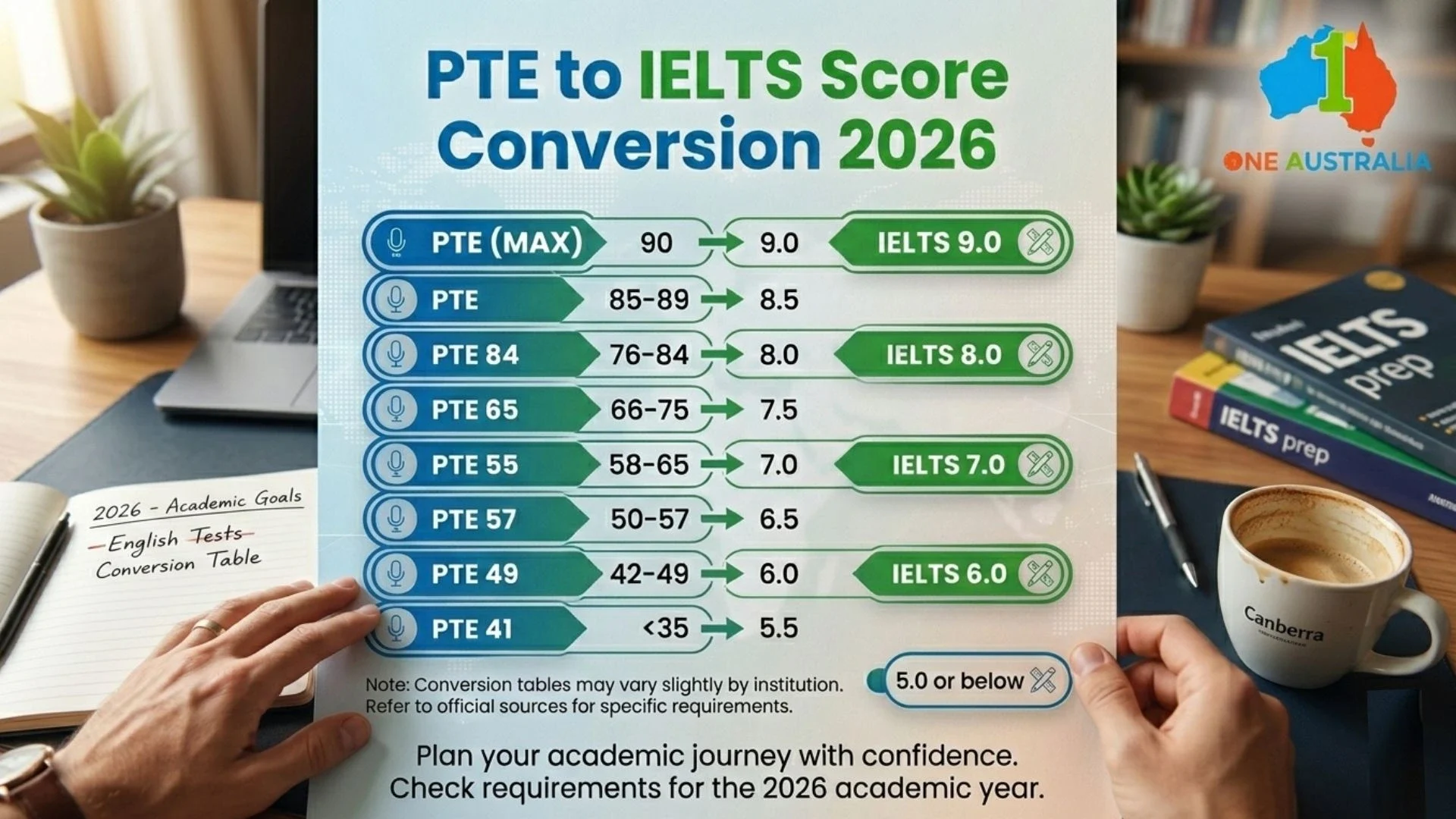
Official PTE to IELTS Score Conversion Table
If you want to accurately convert PTE to IELTS, you must rely on the latest concordance data rather than outdated charts. Because the scoring systems of IELTS Preparation are different, a direct mathematical formula does not apply. Instead, official research aligns score ranges statistically.
Below is the updated overall pte score to ielts comparison used by institutions and migration authorities.
Overall PTE Equivalent to IELTS Band
| PTE Score | IELTS Band Equivalent |
| 50 | 6.0 |
| 55 | 6.5 |
| 61 | 6.5–7.0 |
| 65 | 7.0 |
| 68 | 7.0 |
| 79 | 8.0 |
| 90 | 9.0 |
This table shows the general pte equivalent to ielts at the overall score level. However, it is important to remember:
- Some institutions require minimum scores in each section.
- Skill-wise scores may not map perfectly to the overall band.
- A conversion reflects statistical alignment, not an exact prediction.
For example:
- If you scored PTE 50, your approximate IELTS equivalent is Band 6.0.
- If you scored PTE 65, your IELTS equivalent is around Band 7.0.
- If you achieved PTE 79, your score aligns with IELTS Band 8.0.
- A perfect PTE 90 corresponds to IELTS Band 9.0.
When students search for pte score to ielts, they usually want to confirm eligibility for:
- University admission requirements
- Skilled migration English levels
- Professional registration standards
Using this updated table ensures you can confidently convert PTE to IELTS and understand whether your score meets the required benchmark.
Detailed Score Examples
This section provides practical examples for anyone looking to convert PTE to IELTS or understand their PTE equivalent to IELTS. By reviewing these detailed examples, you can better plan for university admission, skilled migration, or professional registration. It also captures high-intent searches such as pte 55 to ielts, pte 65 to ielts, and pte 79 to ielts.
PTE 50 to IELTS
- pte 50 to ielts ≈ IELTS 6.0
- This is often the minimum requirement for undergraduate programs in Australia, Canada, and the UK.
- Ideal for students applying to courses where the English requirement is Band 6.0, especially in fields that allow conditional offers.
- Understanding this pte score to ielts conversion helps candidates know if they need additional preparation to meet entry requirements.
PTE 55 to IELTS
- pte 55 to ielts ≈ IELTS 6.5
- A popular benchmark for universities and certain skilled migration programs.
- Many undergraduate and postgraduate courses consider IELTS 6.5 as the baseline for academic readiness.
- Candidates searching for convert pte to ielts often use this as a reference to check if their PTE score qualifies them for competitive programs.
PTE 61 to IELTS
- pte 61 to ielts ≈ IELTS 6.5–7.0
- This score is considered competitive for skilled migration, especially for visa pathways that require “Proficient English.”
- Universities offering postgraduate programs often require an IELTS band of 7.0; therefore, knowing the pte equivalent to ielts helps applicants plan their preparation.
- Students with this score are typically ready for academic courses with higher language demands.
PTE 65 to IELTS / 65 PTE to IELTS
- pte 65 to ielts ≈ IELTS 7.0
- Satisfies most postgraduate admission requirements and professional licensing criteria.
- This score level is recognized by migration authorities as meeting “Proficient English” standards.
- Applicants aiming for competitive programs or professional registration should use this pte score to ielts reference to confirm eligibility.
PTE 68 to IELTS
- pte 68 to ielts ≈ IELTS 7.0
- Often meets Proficient English standards for migration and academic purposes.
- Suitable for students applying to programs with higher language expectations and for professionals who require proof of strong English proficiency.
- Knowing this conversion helps in planning additional preparation if aiming for a higher IELTS equivalent, such as Band 7.5 or 8.0.
PTE 79 to IELTS
- pte 79 to ielts ≈ IELTS 8.0
- High-level English performance, accepted by most universities and professional bodies.
- Meets “Superior English” requirements in skilled migration programs for countries like Australia.
- Candidates with this score are highly competitive for admission, scholarships, and professional registration.
- Using this pte score to ielts comparison ensures you understand your position relative to admission or visa thresholds.
IELTS to PTE Score Conversion
Sometimes, test-takers already have an IELTS score and want to know the corresponding PTE score. Understanding the ielts to pte relationship is crucial for planning test strategies, meeting university entry requirements, or satisfying migration English criteria. Below is a detailed ielts to pte score guide based on the latest official concordance.
IELTS 6 to PTE
- ielts 6 to pte ≈ PTE 50
- This score generally meets the minimum English requirement for many undergraduate programs and “Competent English” visa categories.
- Candidates with this score should check if individual section minimums are required for specific universities or migration pathways.
IELTS 6.5 to PTE
- ielts 6.5 to pte ≈ PTE 58–65
- Suitable for postgraduate courses and professional licensing programs that require IELTS 6.5 overall.
- Helps applicants evaluate if they need to retake PTE to achieve a target equivalent to Band 6.5.
IELTS 7 to PTE
- ielts 7 to pte ≈ PTE 65–72
- This is considered a strong academic English level.
- Commonly required for “Proficient English” in skilled migration and higher-level postgraduate programs.
- Using this ielts to pte score reference allows students to determine how much improvement is needed if their PTE result is slightly below target.
IELTS 8 to PTE
- ielts 8 to pte ≈ PTE 79–85
- High-level English performance suitable for “Superior English” migration categories and competitive academic programs.
- Ensures eligibility for professional registration or university scholarships that specify IELTS Band 8.
Skill-Wise PTE to IELTS Comparison
While overall scores provide a quick reference, many universities and immigration authorities require minimum scores in each skill. This makes understanding skill-wise PTE to IELTS conversions crucial for planning your preparation and confirming eligibility. Below is a breakdown of each section and how PTE scores map to IELTS bands.
Listening Score Conversion
- Score mapping differences: PTE Listening is computer-scored using AI algorithms, while IELTS Listening is manually checked and uses a band system. As a result, a single PTE score may correspond to a range of IELTS bands.
- Impact on visa eligibility: Certain visa categories, such as Australian Skilled Migration, require minimum Listening scores. For example, a PTE 61 to IELTS mapping ensures you meet the “Proficient English” level.
- Students should always check pte to ielts score conversion tables for each section, not just the overall band.
Reading Score Conversion
- Why reading bands may differ slightly: PTE Reading measures comprehension through multiple-choice, re-order paragraphs, and fill-in-the-blanks tasks. IELTS Reading uses passages with varied question types, including matching headings and short answer questions.
- Even if your overall score is strong, slight differences in Reading performance may shift your pte equivalent to ielts band for this section.
- Paying attention to Reading scores helps avoid issues in university admission or migration applications that require section minimums.
Speaking Score Conversion
- AI vs human examiner scoring: PTE Speaking is evaluated using automated scoring for pronunciation, fluency, and content. IELTS Speaking is assessed by a trained human examiner, considering communication skills and interaction.
- Small variations in speech clarity or intonation may result in differences when converting your pte to ielts score for Speaking.
- For example, PTE 68 in Speaking may correspond to IELTS 7.0, but minor pronunciation issues could affect the exact IELTS band.
Writing Score Conversion
- Task response vs algorithm scoring: PTE Writing is scored by AI on grammar, vocabulary, and structure, while IELTS Writing is evaluated by an examiner for task response, coherence, and cohesion.
- A PTE candidate who scores well on grammar may still see a slight discrepancy in pte equivalent to ielts for Writing, especially for academic essay evaluation.
- Understanding these differences helps test-takers target specific areas for improvement and ensures they meet skill-wise minimum requirements for universities or migration programs.
PTE vs IELTS – Which Test Is Easier to Score Higher?
For many students and professionals, the choice between PTE Academic and IELTS comes down to which test is easier to score higher. Understanding the differences in scoring, format, and assessment style can help you plan your test strategy and improve your pte to ielts score conversion.
Scoring Method Comparison
| Feature | PTE | IELTS |
| Scoring | AI-based automated scoring | Human examiner + AI (for some tasks) |
| Speaking | Computer-recorded | Face-to-face with examiner |
| Result Time | 1–5 days (fast) | 3–13 days (moderate) |
Key Insights:
- AI-based scoring in PTE provides a highly consistent evaluation, whereas IELTS speaking and writing are influenced by examiner judgment.
- Students aiming for quick results may prefer PTE because it reports scores faster and reduces waiting time.
- When converting pte score to ielts, knowing the test format helps you anticipate possible differences in individual skill scores.
Which Test Suits You Better?
Choosing the right test depends on your strengths and goals:
- For fast results: PTE Academic is ideal because results are usually available within 1–5 days, allowing quicker submission for university or visa applications.
- For strong speaking confidence: IELTS may be advantageous if you communicate naturally in face-to-face settings, as examiners can provide some contextual understanding in the Speaking test.
- For academic writing strength: If you excel in structured essay writing and grammar, PTE’s AI-based scoring may give you an advantage.
Understanding these differences also helps in pte to ielts score conversion, as test-takers can identify areas where their scores might vary between the two exams.
PTE to IELTS for Migration & PR Applications
Many students and skilled migrants take PTE Academic because of its faster results and computer-based format. However, migration authorities and universities often reference English proficiency in IELTS bands. Understanding PTE to IELTS score conversion is crucial for meeting migration and admission requirements.
Australian Migration English Levels
Reference: Australian Government Department of Home Affairs
Australia defines English proficiency for skilled migration using three levels:
- Competent English
- Minimum IELTS: 6.0 in each band
- PTE equivalent: 50–54 in each skill
- Sufficient for basic visa eligibility, but may not maximize points for PR
- Proficient English
- Minimum IELTS: 7.0 in each band
- PTE equivalent: 65–68 in each skill
- Offers maximum points under the migration points system
- Superior English
- Minimum IELTS: 8.0 in each band
- PTE equivalent: 79–85 in each skill
- Required for top-tier points and certain competitive pathways
Knowing your pte equivalent to ielts ensures that you select the right test and target scores for migration eligibility.
University Admission Requirements
Different programs have varying English requirements. Using pte to ielts score conversion, students can verify whether their PTE score meets university standards.
- Undergraduate minimums
- Most universities require IELTS 6.0–6.5 overall
- PTE equivalent: 50–55 overall
- Some programs may have minimum scores in each skill
- Postgraduate benchmarks
- Many postgraduate programs require IELTS 6.5–7.0 overall
- PTE equivalent: 58–65 overall
- Highly competitive programs may require higher scores in Speaking or Writing
Using an accurate pte score to ielts chart can save time and ensure eligibility for both academic and migration purposes. Students and professionals should always check the latest official conversion tables before applying.
Common Mistakes When Converting PTE to IELTS Score
Many candidates make errors when trying to convert PTE to IELTS or interpret their pte to ielts score. Avoiding these mistakes is essential for meeting university, professional, or migration requirements.
Assuming Exact Prediction
- A common misconception is that PTE scores directly equal IELTS bands.
- In reality, concordance tables provide statistical equivalence, not a guarantee.
- For example, a PTE 61 to IELTS mapping suggests an IELTS 6.5–7.0, but minor differences in individual skill scores can affect your exact IELTS equivalent.
- Always treat pte equivalent to ielts as a guide, not a fixed conversion.
Ignoring Section Minimums
- Many institutions or migration authorities require minimum scores in each skill, not just an overall score.
- For example, even if your overall PTE score to IELTS conversion meets Band 7.0, low Speaking or Writing scores may disqualify you.
- Always check section-wise conversion to ensure eligibility for competent, proficient, or superior English requirements.
Using Outdated Conversion Charts
- PTE and IELTS concordance tables are updated periodically. Using old charts can lead to inaccurate expectations.
- The 2026 tables reflect the latest alignment between PTE score to IELTS and provide the most accurate pte equivalent to ielts for migration, university, or professional applications.
- Always reference the official or updated 2026 chart when planning your score targets.
Conclusion
Choosing the right target score is a critical step for students, professionals, and skilled migrants who need to convert PTE to IELTS or plan their English test strategy. Understanding your pte to ielts score ensures you meet both academic and migration requirements without delays or surprises.
Key Takeaways from This Guide
- Accurate Conversion Matters: Use official and updated 2026 concordance tables to determine your pte equivalent to ielts. Avoid outdated charts or assumptions.
- Consider Skill-Wise Requirements: Don’t rely only on overall scores. Check section minimums for Speaking, Writing, Listening, and Reading to ensure eligibility.
- Set Realistic Targets: Align your PTE or IELTS preparation with your academic, professional, or migration goals. For example, if your target is PTE 65 to IELTS, plan focused preparation to achieve Band 7.0 in each section.
Strategic Preparation Tips
- Use a PTE score calculator to estimate your target pte to ielts score and identify areas needing improvement.
- Follow an IELTS preparation guide to understand band descriptors, exam strategies, and skill-building exercises.
- Check official migration English requirements pages to ensure your scores satisfy visa or professional licensing thresholds.
By strategically planning your preparation and understanding the pte score to ielts relationship, you can confidently choose a target score, maximize your chances of success, and meet the English language requirements for your academic or professional goals.
Frequently Asked Questions
1. Can I directly convert PTE to IELTS?
You cannot directly convert PTE to IELTS because they use different scoring systems. PTE is scored 10–90 using AI, while IELTS uses 0–9 bands with human scoring. Use official PTE to IELTS score tables for statistical equivalence, widely accepted by universities and migration authorities.
2.What is 65 PTE to IELTS equivalent?
A PTE score of 65 roughly equals IELTS Band 7.0. This meets most postgraduate admission requirements and qualifies for “Proficient English” in skilled migration programs. Knowing your PTE equivalent to IELTS helps plan preparation and confirm eligibility.
3.What is IELTS 6 to PTE equivalent?
An IELTS Band 6 approximately corresponds to PTE 50. This satisfies many undergraduate programs and “Competent English” visa requirements. Using the IELTS to PTE score conversion helps candidates decide which test to take and set realistic target scores.
4.Is PTE easier than IELTS?
PTE may be easier for those comfortable with computer-based tests because it uses AI scoring, standardizes evaluation, and delivers fast results. IELTS may suit students confident in face-to-face speaking and traditional essay writing. Strengths and preparation style affect which test yields higher scores.
5.Does immigration treat PTE equal to IELTS?
Yes, immigration authorities in Australia, Canada, and the UK officially accept PTE Academic. They rely on official PTE to IELTS score charts to confirm eligibility for skilled migration, visa applications, or professional licensing, ensuring both overall and section minimums are met.