One Australia banner about 2026 IELTS Exam Fees with illustrations of studying students.

IELTS Exam Fee 2026: Everything You Need to Know About IELTS Fee 
TL;DR

  • This blog targets students planning to study abroad, professionals applying for jobs overseas, and individuals seeking PR (Permanent Residency) who need clarity on the IELTS exam fee, IELTS fee structure, and country-wise costs before booking their test. It helps them understand total expenses, avoid hidden charges, and plan their IELTS journey effectively.
  • The blog provides a detailed country-wise comparison of IELTS fees, including India, Australia, UK, and USA. It explains how the IELTS test fee varies globally, while maintaining the same exam format and scoring system, helping users understand pricing differences and international standards.
  • It clearly explains how the IELTS exam fee changes based on test type, including Academic, General Training, UKVI, and IELTS Life Skills. The blog highlights that Academic and General have the same cost, while UKVI is higher and Life Skills is the lowest-cost option.
  • The blog goes beyond basic pricing and explains what the IELTS test fee covers, including the four test modules, result processing, TRF copies, and online score access. It also highlights hidden costs like rescheduling, cancellation, and retake fees that most candidates overlook.
  • It provides actionable strategies to save money on IELTS fee, such as early booking, avoiding rescheduling, using free preparation resources, sending TRFs wisely, and selecting the correct test type from the start. This helps candidates minimize unnecessary expenses while preparing efficiently.

Related Blogs

Introduction 

The IELTS exam fee is the official cost required to register and appear for the International English Language Testing System (IELTS), one of the most widely accepted English proficiency tests worldwide. Whether you are planning to study abroad, apply for permanent residency (PR), or pursue international job opportunities, understanding the overall IELTS fee is an essential part of your preparation journey.

The IELTS test fee varies from country to country and also depends on the test type, but it generally includes all four modules: Listening, Reading, Writing, and Speaking. Each year, millions of candidates take the IELTS exam across major destinations such as India, Australia, the United Kingdom, Canada, and the United States, making it a globally recognized benchmark for English language proficiency.

For test-takers in countries like India and Australia, the IELTS exam plays a key role in higher education admissions and immigration processes. However, many candidates focus only on the basic registration cost and often overlook additional or indirect expenses associated with the test.

This guide will break down everything you need to know about the IELTS exam fee, including country-wise pricing, the IELTS fee in Australia, and a detailed explanation of hidden costs that most students usually miss.

What is IELTS Exam Fee?

The IELTS exam fee is the standard amount that candidates must pay to register and take the IELTS test. It is a fixed charge set by official IELTS test providers and varies slightly depending on the country and test center. This fee is required to book your test slot and is mandatory for all candidates appearing for either Academic or General Training IELTS.

The IELTS test fee covers the complete evaluation of all four language skills assessed in the exam. These include:

  • Listening
  • Reading
  • Writing
  • Speaking

Each section is designed to measure a candidate’s overall English proficiency in real-life academic and professional situations. The fee ensures that candidates receive access to official testing facilities, certified examiners, result processing, and an internationally recognized score report.

In simple terms, the IELTS exam fees are not just for taking a test but for receiving a globally accepted certification that can be used for study abroad, immigration applications, and career opportunities across different countries.

IELTS Fee in Australia (2026)

The IELTS fee in Australia is set by official IELTS test providers and remains relatively consistent across test centers in the country. Candidates must pay the required amount at the time of booking their test, and the fee applies whether you are taking IELTS for study, work, or migration purposes.

IELTS Fee in Australia (2026)

Test TypeIELTS Fee in Australia
AcademicAUD $490
General TrainingAUD $490
UKVIAUD $505+

The IELTS exam fee in Australia is the same for both Academic and General Training modules, making it simpler for candidates to choose their test type without worrying about price differences. However, the UKVI IELTS test is slightly more expensive due to additional security and administrative requirements needed for UK visa applications.

Key Points About IELTS Fee in Australia

  • The IELTS fee in Australia is identical for Academic and General Training tests
  • Only the UKVI version has a higher fee structure
  • The fee covers all four test sections: Listening, Reading, Writing, and Speaking
  • Prices are standardized across most authorized test centers

The IELTS test fees in Australia reflect the global standard pricing model used by IELTS authorities, ensuring uniformity and reliability for all candidates. Whether you are applying for higher education or migration, the IELTS exam fee in Australia remains a mandatory cost for securing your test slot and official score report.

IELTS Exam Fee in India (2026)

The IELTS exam fee in India is fixed by official test providers and remains consistent across most test centers in the country. Candidates are required to pay the fee at the time of registration to book their IELTS test date. The fee applies to both Academic and General Training versions of the exam, with a slightly higher cost for UKVI IELTS due to additional security requirements.

IELTS Fee in India (2026)

Test TypeIELTS Fee (India)
Academic₹19,000
General Training₹19,000
UKVI₹18,250

The IELTS fee is generally inclusive of all four test modules: Listening, Reading, Writing, and Speaking. Candidates receive official score reporting after the test, which is valid for international applications.

Payment Methods

Candidates can pay the IELTS exam fee in India through multiple methods, including:

  • Debit card / Credit card
  • Net banking
  • Online payment gateways
  • Selected test center payment options

GST Inclusion

The IELTS fee is typically inclusive of applicable taxes such as GST, meaning there are no major hidden government charges added separately at the time of payment.

Validity of IELTS Score

The IELTS exam score is valid for 2 years from the date of result declaration. After this period, candidates may need to retake the exam if required by universities, employers, or immigration authorities.

The IELTS exam fee in India remains a crucial investment for students and professionals aiming for global opportunities in education, work, and migration.

IELTS Exam Fee Worldwide Comparison

The IELTS exam fee is not the same across all countries. It varies depending on the location where the test is taken, as each country has its own pricing structure set by official IELTS test providers such as IDP and the British Council. However, the test format and evaluation criteria remain exactly the same worldwide.

IELTS Exam Fee by Country

CountryIELTS Exam Fee
India₹19,000
AustraliaAUD $490
UK£260
USA$300

The variation in the IELTS fee across countries is mainly due to operational costs, local currency value, and administrative charges. Despite these differences, the IELTS test fee is standardized within each country, meaning all candidates pay the same amount regardless of the test center.

IELTS Fee by Test Type

The IELTS test fee is not significantly different for most standard test formats, but it does vary depending on the purpose of the exam. IELTS offers different test types to match academic, immigration, and basic English communication needs.

Academic vs General Training

Both the Academic and General Training versions of IELTS are priced the same in most countries. The IELTS exam fee for these two test types is identical because both assess the same core English skills Listening, Reading, Writing, and Speaking. The only difference is the content focus, where Academic is designed for higher education and General Training is intended for work or migration purposes.

UKVI IELTS

The UKVI IELTS test comes with a higher fee compared to the standard versions. This is because it includes additional security measures and is specifically required for UK visa and immigration applications. The IELTS test fee for UKVI is higher due to these extra verification and compliance requirements.

IELTS Life Skills

The IELTS Life Skills test is the most affordable option. It is designed for individuals who only need to prove basic speaking and listening skills for specific UK visa categories. As a result, the IELTS exam fee for Life Skills is lower than other IELTS test formats.

Overall, the IELTS fee structure depends on the test purpose, but Academic and General remain the standard-priced options, while UKVI is higher and Life Skills is the lowest-cost alternative.

What Does IELTS Fee Include?

The IELTS exam fee is not just a payment for appearing in the test, but it covers several essential services that are part of the complete IELTS assessment process. Once you pay the IELTS test fee, you gain access to the full examination system and official result reporting.

The IELTS fee generally includes the following:

Full test (4 sections)
The fee covers all four modules of the IELTS exam: Listening, Reading, Writing, and Speaking. Each section is designed to evaluate your overall English language proficiency in academic and real-life contexts.

Result processing
After completing the test, your answers are evaluated by certified examiners, and your scores are processed and verified according to global IELTS standards.

5 free TRF copies (Test Report Forms)
Candidates can send their IELTS scores to up to five institutions free of charge. These official TRF copies are directly sent to universities, employers, or immigration authorities.

Online score access
The IELTS exam fee also includes access to your results online, allowing you to view your band scores once they are released.

In simple terms, the IELTS test fee covers not only the exam itself but also scoring, certification, and official reporting services that are accepted worldwide for study, work, and migration purposes.

How to Save Money on IELTS Fee

The IELTS exam fee is a necessary investment for studying abroad, migration, or job opportunities, but many candidates end up spending more than required due to poor planning. By making smart decisions during registration and preparation, you can reduce your overall IELTS test fee burden and avoid unnecessary expenses.

Book Early

Booking your IELTS test in advance helps you secure preferred dates and avoid last-minute rescheduling, which often comes with additional charges. Early booking also gives you more time to prepare effectively.

Avoid Rescheduling

Rescheduling your test can significantly increase your total cost. Since the IELTS fee is already fixed and relatively high, it is better to stick to your chosen test date unless absolutely necessary.

Use Free Preparation Tools

Instead of relying only on paid coaching, use free IELTS practice materials, sample tests, and official resources. This helps reduce coaching expenses while still improving your score.

Send TRFs Wisely

You are allowed to send a limited number of Test Report Forms (TRFs) for free. Make sure you only send them to shortlisted universities or institutions to avoid extra charges.

Choose the Correct Test Type

Selecting the right IELTS module (Academic, General Training, or UKVI) from the beginning prevents switching later, which may lead to paying the IELTS exam fee again.

By following these strategies, candidates can manage their IELTS test fee more efficiently while focusing on achieving a higher band score without unnecessary financial stress.

Conclusion

The IELTS exam fee is an important part of your journey toward studying abroad, working internationally, or applying for permanent residency. While the IELTS fee may vary across countries such as India, Australia, the UK, and the USA, the test structure and evaluation system remain the same globally. Understanding the complete IELTS test fee breakdown helps candidates plan their budget more effectively and avoid unexpected expenses.

From registration charges to test type variations and additional costs, it is clear that the IELTS exam fees are not just about appearing for a test but about accessing a globally recognized certification. Countries like Australia and India have different pricing structures, but the value of the IELTS score remains consistent worldwide.

By planning early, choosing the right test type, and avoiding unnecessary expenses, candidates can manage their IELTS costs more efficiently. Overall, understanding the full structure of the IELTS fee ensures better financial planning and a smoother preparation journey toward achieving international goals.

FAQs 

1. Is IELTS fee refundable?

The IELTS exam fee is generally non-refundable once you have booked your test. However, in some cases such as medical emergencies or valid personal reasons, partial refunds or test rescheduling may be allowed if supported by proper documentation and within the test center’s cancellation policy.

2. Why is IELTS so expensive?

The IELTS fee is considered high because it includes global-standard test administration, certified examiners, secure testing systems, result verification, and international recognition. The cost also covers infrastructure, evaluation processes, and official reporting services used by universities, employers, and immigration authorities worldwide.

3. Is IELTS cheaper than PTE?

In most countries, IELTS and PTE have similar pricing, but PTE is often slightly cheaper in some regions. However, the IELTS test fee offers wider global acceptance, especially for immigration and university admissions, which makes it a preferred choice despite the cost difference.

4. Can I retake IELTS for free?

No, you cannot retake IELTS for free. Every attempt requires paying the full IELTS exam fee again. Each test attempt is treated as a separate booking, and there is no free retake policy offered by IELTS authorities.

5. What is IELTS fee in Australia?

The IELTS fee in Australia is approximately AUD $490 for Academic and General Training tests. The UKVI IELTS test costs slightly more, usually AUD $505 or higher. The IELTS exam fee in Australia is standardized across most official test centers.
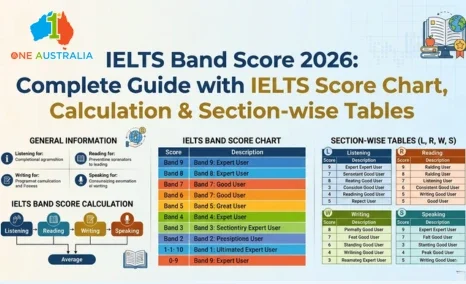
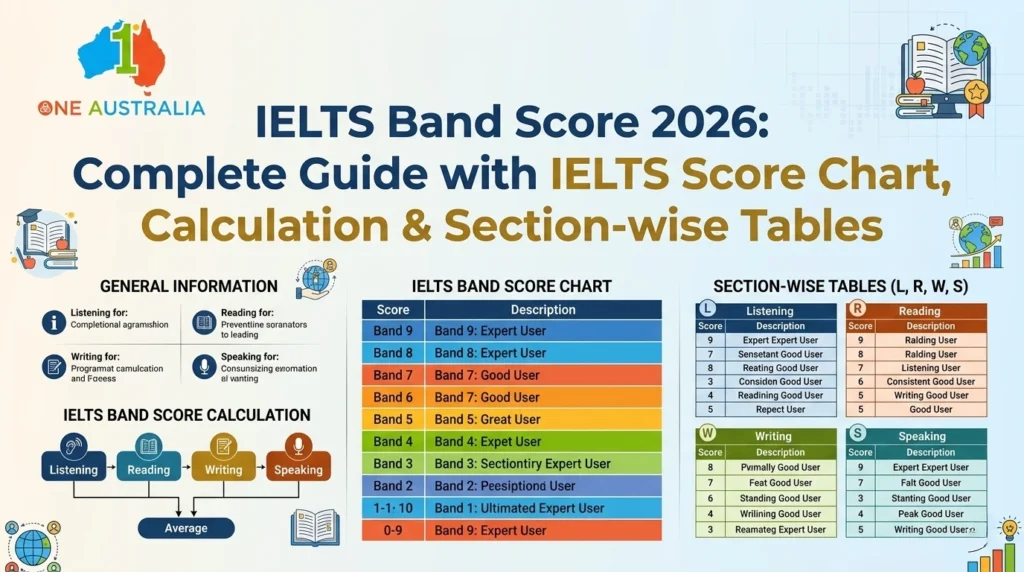
IELTS Band Score 2026 guide infographic showing score chart, calculation method, and section-wise tables

IELTS Band Score 2026: Complete Guide with IELTS Score Chart, Calculation & Section-wise Tables

TL;DR

  • This blog is designed for students planning to study abroad, professionals applying for jobs, and individuals pursuing PR. It provides a complete understanding of the IELTS band score, helping readers identify required scores and plan their preparation effectively.
  • It clearly explains the IELTS band score system, including the 0–9 scale, detailed band descriptors, and what each IELTS score band means in real-world academic and professional contexts.
  • The blog includes a detailed IELTS score chart and IELTS band score chart, along with step-by-step calculation methods, formula, and rounding rules to help readers accurately estimate their final score.
  • It provides a complete section-wise analysis of Listening, Reading, Writing, and Speaking, including raw score conversion tables, marking criteria, and differences between Academic and IELTS general score chart formats.
  • The blog offers goal-based score requirements for study abroad, PR, and jobs, along with actionable strategies and proven techniques to improve IELTS band score and achieve higher results efficiently.

Related Blogs

What is IELTS Band Score?

The IELTS band score is a standardized measurement used to evaluate a candidate’s English language proficiency across four core skills: Listening, Reading, Writing, and Speaking. Each section is scored individually on a scale from 0 to 9, and these scores are then averaged to produce an overall IELTS band score. This system provides a clear and consistent way for universities, employers, and immigration authorities to assess a candidate’s ability to use English in real-life situations.

IELTS Score Band Explained (0–9 Scale)

The IELTS scoring system uses a 9-band scale, where each band reflects a specific level of English proficiency. This IELTS score band system is designed to indicate how effectively a person can communicate in English, from basic understanding to expert-level fluency.

  • Band 9 (Expert User): Full command of the language with complete accuracy and fluency
  • Band 8 (Very Good User): Strong command with only occasional errors
  • Band 7 (Good User): Effective communication with some inaccuracies
  • Band 6 (Competent User): Generally effective despite some mistakes
  • Band 5 (Modest User): Partial command with limited accuracy
  • Band 4 (Limited User): Basic competence in familiar situations
  • Band 3 (Extremely Limited User): Very limited communication ability
  • Band 2 (Intermittent User): Minimal understanding of English
  • Band 1 (Non-user): Essentially no ability to use the language
  • Band 0: Did not attempt the test

This structured IELTS band score explained approach helps institutions quickly interpret a candidate’s language level and determine their suitability for academic, professional, or migration purposes.

No Pass or Fail in IELTS

One of the most important aspects of the IELTS exam is that there is no pass or fail result. Instead of a binary outcome, candidates receive an IELTS band score that reflects their current level of English proficiency. Different institutions and countries set their own required IELTS score band depending on their standards. For example, universities may require a band score of 6.5 or 7.0, while immigration programs might have different criteria.

This flexible scoring system makes the IELTS band score more practical and globally recognized, as it focuses on measuring real ability rather than simply determining whether a candidate has passed or failed.

IELTS Band Score Chart (0–9 Explained)

The IELTS band score chart provides a clear overview of how English proficiency is measured in the IELTS exam. Each candidate receives a score between 0 and 9, known as the IELTS score band, which reflects their ability to understand and use English in academic and real-world contexts.

This IELTS score chart is used globally by universities, employers, and immigration authorities to assess whether a candidate meets their required level of English. Understanding the IELTS band score chart helps you interpret your results accurately and set realistic target scores.

IELTS Score Band Levels Explained

Below is the complete IELTS band score chart with detailed meaning of each band:

  • Band 9 – Expert User
    Has fully operational command of the language. Uses English accurately, fluently, and appropriately in all situations.
  • Band 8 – Very Good User
    Has a strong command of English with only occasional unsystematic inaccuracies. Handles complex language well.
  • Band 7 – Good User
    Has operational command of the language, though with occasional errors and misunderstandings. Can handle complex language in most situations.
  • Band 6 – Competent User
    Has an effective command of English despite some inaccuracies and misunderstandings. Can use and understand fairly complex language.
  • Band 5 – Modest User
    Has partial command of the language and can cope with overall meaning in most situations, though likely to make frequent mistakes.
  • Band 4 – Limited User
    Basic competence is limited to familiar situations. Frequent problems in understanding and expression.
  • Band 3 – Extremely Limited User
    Conveys and understands only general meaning in very familiar situations. Frequent breakdowns in communication.
  • Band 2 – Intermittent User
    Has great difficulty understanding spoken and written English.
  • Band 1 – Non-User
    Has no ability to use the language except for a few isolated words.
  • Band 0 – Did Not Attempt
    No assessable information is provided.

This structured IELTS score chart allows you to quickly identify your proficiency level and understand what each IELTS band score represents. It also helps you determine what band you need to achieve based on your academic, professional, or immigration goals.

How IELTS Band Score is Calculated

The IELTS band score is calculated by evaluating your performance across four key sections of the test: Listening, Reading, Writing, and Speaking. Each of these sections is scored individually on a scale from 0 to 9. These individual scores are then combined to produce your overall IELTS band score.

Understanding how the IELTS score band is calculated is essential if you want to accurately estimate your results and set a target score for study, work, or migration.

Four Sections of IELTS Scoring

  • Listening: Measures your ability to understand spoken English in various contexts such as conversations and lectures.
  • Reading: Assesses your ability to read and interpret academic or general texts, depending on the test type.
  • Writing: Evaluates how clearly and effectively you can present ideas in written English across two tasks.
  • Speaking: Tests your spoken English through a face-to-face interview, focusing on fluency, pronunciation, and coherence.

Each section contributes equally to your final IELTS band score, which ensures a balanced evaluation of your overall English proficiency.

IELTS Score Calculation Formula

Overall Band Score=L+R+W+S4\text{Overall Band Score} = \frac{L + R + W + S}{4}Overall Band Score=4L+R+W+S​

In this formula:

  • L = Listening score
  • R = Reading score
  • W = Writing score
  • S = Speaking score

The result is your average score, which becomes your overall IELTS band score after rounding.

Rounding Rules for IELTS Band Score

The IELTS scoring system follows specific rounding rules to determine the final band score:

  • If the average ends in .25, it is rounded up to the next half band
    Example: 6.25 → 6.5
  • If the average ends in .75, it is rounded up to the next whole band
    Example: 6.75 → 7
  • If the average is close to a whole number (e.g., 6.1), it is rounded down to the nearest whole band

These rounding rules are a crucial part of how the IELTS band score is finalized. By understanding this calculation method, you can better predict your results and focus on improving specific sections to achieve your desired IELTS score band.

IELTS Score Chart

The IELTS score chart becomes more meaningful when you break it down section by section. Instead of only looking at your overall result, understanding how each module contributes to your final score helps you identify strengths and weaknesses. This section-wise approach to the IELTS band score chart is especially useful for targeted preparation and improving specific skills.

Each of the four sections, Listening, Reading, Writing, and Speaking, is scored on the same 0–9 scale. However, the way scores are calculated differs slightly depending on the module. Below is a clear breakdown of how the IELTS score chart works for each section.

Listening Score Chart

The Listening section is based on the number of correct answers out of 40 questions. Your raw score is converted into a band score using the IELTS band score chart. Generally, a higher number of correct answers directly increases your band score.

Reading Score Chart

The Reading score also depends on correct answers out of 40, but the conversion differs between Academic and General Training tests. This makes the IELTS score chart slightly different for each version, which is important to understand when preparing.

Writing Score Chart

The Writing section does not use raw scores. Instead, it is assessed based on four criteria: Task Achievement, Coherence and Cohesion, Lexical Resource, and Grammatical Range and Accuracy. Each criterion contributes equally to your final writing band score.

Speaking Score Chart

The Speaking test is evaluated through a live interview and scored based on Fluency and Coherence, Lexical Resource, Grammatical Range and Accuracy, and Pronunciation. Like Writing, this section relies on examiner assessment rather than a raw score conversion.

This section-wise IELTS band score chart gives you a clearer understanding of how each part of the test is evaluated. By focusing on individual sections, you can develop a more effective preparation strategy and work toward achieving your target IELTS band score.

IELTS Listening Score Chart (Raw Score to Band)

The Listening section of the IELTS exam is scored based on the number of correct answers out of 40 questions. Your raw score is then converted into a band score using the official IELTS score chart. This conversion helps determine your final IELTS band score for the Listening module.

Understanding this IELTS score chart is important because even a small difference in correct answers can impact your overall band score.

IELTS Listening Score Chart

Correct Answers (Out of 40)Band Score
39–409.0
37–388.5
35–368.0
32–347.5
30–317.0
26–296.5
23–256.0
18–225.5
16–175.0
13–154.5
11–124.0
8–103.5
6–73.0
4–52.5
2–32.0
11.0
00

How to Use This IELTS Score Chart?

This IELTS score chart shows how your raw Listening score translates into a band score. For example:

  • If you get 30 correct answers, your band score will be 7.0
  • If you score 35 correct answers, your band score will be 8.0

Because the Listening section is purely based on correct answers, it is one of the most predictable parts of the IELTS band score chart. This makes it easier to set clear targets, for instance, aiming for at least 30 correct answers if your goal is Band 7.

By regularly practicing with this IELTS score chart, you can track your progress and focus on improving accuracy to achieve a higher IELTS band score.

IELTS Reading Score Chart (Academic vs General)

The Reading section of IELTS is scored based on the number of correct answers out of 40 questions. However, the IELTS band score chart for Reading differs between the Academic and General Training tests. This is because the General Training test is considered slightly easier, so it requires more correct answers to achieve the same band score.

Understanding both versions of the IELTS general score chart and Academic chart is essential for accurate preparation and target setting.

IELTS Academic Reading Score Chart

In the Academic test, fewer correct answers are needed to achieve higher bands compared to General Training. Below is the approximate IELTS band score chart for Academic Reading:

Correct Answers (Out of 40)Band Score
39–409.0
37–388.5
35–368.0
33–347.5
30–327.0
27–296.5
23–266.0
19–225.5
15–185.0
13–144.5
10–124.0
8–93.5
6–73.0
4–52.5

IELTS General Score Chart

The IELTS general score chart requires a higher number of correct answers to reach the same band score. This reflects the comparatively easier nature of the General Training reading passages.

Correct Answers (Out of 40)Band Score
409.0
398.5
37–388.0
367.5
34–357.0
32–336.5
30–316.0
27–295.5
23–265.0
19–224.5
15–184.0
12–143.5
9–113.0
6–82.5

Key Difference Between Academic and General Reading Scores

The main difference between the two versions of the IELTS band score chart lies in the number of correct answers required. For example:

  • In Academic Reading, 30 correct answers typically equal Band 7
  • In General Reading, you need around 34–35 correct answers to reach Band 7

This difference makes it crucial to use the correct IELTS general score chart or Academic chart depending on the test you are taking. By understanding these variations, you can set realistic goals and improve your performance more effectively.

IELTS Writing Band Score Criteria

The Writing section of IELTS is assessed using four equally weighted criteria that determine your final IELTS score band. Unlike Listening and Reading, which are based on correct answers, Writing is evaluated by certified examiners based on the quality, clarity, and effectiveness of your written response.

To achieve a high IELTS band score, you must perform well across all four criteria, as each contributes 25% to your final writing score.

Task Achievement (Task Response)

This criterion measures how well you address the question and fulfill the task requirements.

  • For Task 1, it evaluates how accurately you describe data, trends, or processes
  • For Task 2, it assesses how clearly you present and support your ideas

A higher IELTS score band requires fully developed answers with relevant examples and clear conclusions. Missing key parts of the question can significantly reduce your score.

Coherence and Cohesion

This refers to how logically your ideas are organized and how well they flow from one to another.

  • Clear paragraph structure
  • Logical sequencing of ideas
  • Proper use of linking words (however, therefore, in addition)

To achieve a strong IELTS band score, your writing should be easy to follow, with smooth transitions and well-structured paragraphs.

Lexical Resource (Vocabulary)

This criterion evaluates the range and accuracy of your vocabulary.

  • Use of varied and precise words
  • Ability to paraphrase effectively
  • Correct word choice and spelling

A higher IELTS score band requires not just advanced vocabulary, but also the ability to use it naturally and accurately without overcomplicating sentences.

Grammatical Range and Accuracy

This measures your ability to use a variety of grammatical structures correctly.

  • Use of simple and complex sentences
  • Accuracy in tense, punctuation, and sentence structure
  • Minimal grammatical errors

To reach a higher IELTS band score, you should demonstrate control over grammar while maintaining clarity and readability.

How These Criteria Affect Your IELTS Score Band?

Each of these four criteria is equally important in determining your final Writing IELTS score band. For example, if your grammar is strong but your ideas are poorly organized, your overall score will still be limited.

Focusing on balanced improvement across Task Achievement, Coherence, Vocabulary, and Grammar is the most effective way to increase your IELTS band score in the Writing section.

IELTS Speaking Band Score Criteria

The Speaking section of IELTS is assessed through a face-to-face interview and evaluated across four key criteria. Each of these contributes equally to your final IELTS score band, making it important to develop balanced speaking skills rather than focusing on just one area.

Understanding these criteria clearly can help you improve your performance and achieve a higher IELTS band score.

Fluency and Coherence

Fluency refers to your ability to speak smoothly without unnecessary pauses, while coherence relates to how logically your ideas are connected.

  • Speak at a natural pace without frequent hesitation
  • Organize ideas clearly and stay on topic
  • Use linking words to connect thoughts

Example:

  • Lower band: “I… um… I like travel… because… it is good…”
  • Higher band: “I really enjoy traveling because it allows me to explore new cultures and gain different perspectives on life.”

A higher IELTS score band requires consistent flow and well-structured responses.

Pronunciation

This criterion evaluates how clearly and accurately you pronounce words and how easily the examiner can understand you.

  • Clear pronunciation of words
  • Proper stress and intonation
  • Ability to be understood without effort

Example:

  • Lower band: Mispronounced words that make understanding difficult
  • Higher band: Clear speech with natural rhythm and correct emphasis on key words

Good pronunciation does not mean having a native accent; clarity is what matters for a strong IELTS band score.

Lexical Resource (Vocabulary)

This measures the range and appropriateness of the vocabulary you use while speaking.

  • Use a variety of words and expressions
  • Avoid repetition
  • Use topic-specific vocabulary when possible

Example:

  • Lower band: “I like this place. It is very nice. Very good.”
  • Higher band: “I find this place quite आकर्षive because of its peaceful environment and vibrant atmosphere.”

To achieve a higher IELTS score band, you should demonstrate flexibility in vocabulary and the ability to express ideas precisely.

Grammatical Range and Accuracy

This criterion assesses how accurately and effectively you use grammar in your speech.

  • Use a mix of simple and complex sentences
  • Maintain correct tense and sentence structure
  • Minimize grammatical errors

Example:

  • Lower band: “Yesterday I go market and buy things.”
  • Higher band: “Yesterday, I went to the market and bought a few essential items.”

A higher IELTS score band requires consistent grammatical accuracy along with the ability to use more advanced sentence structures.

How These Criteria Impact Your IELTS Score Band? 

Each of these four criteria, Fluency, Pronunciation, Vocabulary, and Grammar, plays an equal role in determining your final Speaking IELTS score band. Even if you are strong in one area, weaknesses in another can limit your overall score.

To improve your IELTS band score in Speaking, focus on speaking regularly, recording your responses, and practicing with real test questions to develop confidence and accuracy across all four criteria.

What is a Good IELTS Band Score?

A “good” IELTS band score depends on your goal, whether you are planning to study abroad, apply for permanent residency (PR), or pursue job opportunities. Since IELTS does not have a pass or fail system, institutions and authorities set their own minimum score requirements based on their standards.

In general, a higher IELTS band score increases your chances of acceptance and opens more opportunities globally.

IELTS Band Score for Study Abroad

For universities and colleges, the required IELTS band score varies depending on the course and institution:

  • Undergraduate programs: Typically require 6.0–6.5
  • Postgraduate programs: Usually require 6.5–7.0
  • Top universities: Often require 7.0–8.0 or higher

In addition to the overall IELTS band score, many universities also require a minimum score in each section (e.g., no band below 6.0).

IELTS Band Score for PR (Permanent Residency)

Countries like Canada, Australia, and the UK use IELTS scores as part of their immigration systems. The required IELTS band score depends on the visa category and program:

  • Canada PR: Generally requires 6.0–7.5 (depending on CRS points and category)
  • Australia PR: Typically requires 6.0 minimum, but 7.0+ improves chances significantly
  • UK immigration: Usually requires 4.0–7.0 depending on visa type

A higher IELTS band score can increase your eligibility and ranking in immigration systems.

IELTS Band Score for Jobs

For professional and employment purposes, the required IELTS band score varies by industry and role:

  • General jobs: 5.5–6.5
  • Professional roles (e.g., healthcare, engineering): 6.5–7.5
  • Highly competitive roles: 7.0+

Employers typically look for a strong IELTS band score to ensure effective communication in the workplace.

What IELTS Band Score Should You Aim For?

  • Band 6.0: Competent level (basic requirement for many institutions)
  • Band 7.0: Good level (widely accepted for study and PR)
  • Band 8.0+: Very strong level (ideal for top universities and competitive profiles)

Ultimately, a “good” IELTS band score is one that meets or exceeds the requirements of your specific goal. Setting a clear target based on your plans will help you focus your preparation and achieve the desired result.

IELTS Band Score for Different Countries

The required IELTS band score varies by country and depends on whether you are applying for study, work, or immigration. Understanding these country-specific requirements helps you set a realistic target and choose the right preparation strategy.

Below is a general overview of IELTS band score requirements for popular destinations.

IELTS Band Score for Canada

Canada uses IELTS scores for both study permits and permanent residency (PR), especially under programs like Express Entry.

  • Student visa: Typically requires an overall IELTS band score of 6.0–6.5
  • Undergraduate programs: 6.0–6.5
  • Postgraduate programs: 6.5–7.0
  • PR (Express Entry): Usually 6.0–7.5+, depending on your Comprehensive Ranking System (CRS) score

A higher IELTS band score significantly improves your chances of receiving an invitation for PR.

IELTS Band Score for the UK

The UK accepts IELTS for university admissions and visa applications, with requirements varying by course level and visa type.

  • Student visa: Generally requires 5.5–6.5
  • Foundation courses: Around 5.0–5.5
  • Undergraduate programs: 6.0–6.5
  • Postgraduate programs: 6.5–7.5

Some UK universities may also require minimum section scores (for example, no band below 5.5 or 6.0).

IELTS Band Score for Australia

Australia uses IELTS for both academic admissions and skilled migration programs.

  • Student visa: Typically requires 6.0 overall
  • Undergraduate programs: 6.0–6.5
  • Postgraduate programs: 6.5–7.0
  • Skilled migration:
    • Competent English: 6.0
    • Proficient English: 7.0
    • Superior English: 8.0

Achieving a higher IELTS band score can increase your points in Australia’s migration system, improving your chances of selection.

How to Improve Your IELTS Band Score?

Improving your IELTS band score requires a focused strategy for each section of the test. Since all four modules contribute equally to your final result, balanced preparation is the most effective way to improve IELTS band score quickly and consistently. Below are practical, proven techniques you can apply to each section.

Listening Strategies

The Listening section is one of the easiest areas to improve with the right practice.

  • Practice with real test recordings regularly to get familiar with different accents
  • Read questions before the audio starts to predict answers
  • Focus on keywords instead of trying to understand every word
  • Avoid losing concentration after missing one answer, move on quickly

To improve IELTS band score in Listening, aim to increase your accuracy by practicing timed tests and reviewing mistakes carefully.

Reading Techniques

Reading requires both speed and accuracy, especially under time pressure.

  • Use skimming to understand the main idea of passages
  • Scan for keywords to locate answers quickly
  • Do not spend too much time on one question, move forward and return later
  • Practice different question types (True/False/Not Given, Matching, etc.)

Improving your reading strategy can significantly boost your IELTS band score, especially if you learn to manage time effectively.

Writing Improvement

Writing is often the most challenging section, but structured practice can lead to major improvements.

  • Understand the format of Task 1 and Task 2 clearly
  • Plan your answer before writing to organize ideas logically
  • Use clear paragraph structure (introduction, body, conclusion)
  • Focus on grammar accuracy and vocabulary range

To improve IELTS band score in Writing, get feedback on your essays and work on correcting repeated mistakes.

Speaking Fluency

Speaking improvement comes from consistent practice and confidence building.

  • Practice speaking daily on common IELTS topics
  • Record your answers to identify errors in fluency and pronunciation
  • Avoid memorized responses, focus on natural communication
  • Expand answers with examples instead of giving short responses

To improve IELTS band score in Speaking, focus on speaking clearly and confidently rather than trying to use overly complex language.

Conclusion

The IELTS band score is more than just a number, it is a complete reflection of your English language ability across Listening, Reading, Writing, and Speaking. Understanding how the scoring system works, using the IELTS score chart, and analyzing section-wise performance can give you a clear advantage in your preparation.

By learning how scores are calculated, reviewing the IELTS band score chart, and practicing with real examples, you can accurately estimate your current level and set realistic goals. Whether you are aiming for study abroad, PR, or job opportunities, your target IELTS band score should align with your specific requirements.

Most importantly, improving your IELTS score band is a gradual process. With consistent practice, the right strategies, and a focus on all four sections, you can steadily increase your performance and achieve your desired result.

A well-planned approach, combined with regular practice and performance analysis, will help you move closer to your target IELTS band score and open doors to global opportunities.

FAQs on IELTS Band Score

1. What is IELTS band score?

The IELTS band score is a measure of your English language proficiency, ranging from 0 to 9. It evaluates your performance in Listening, Reading, Writing, and Speaking, with each section contributing equally to your final score.

2. What is a good IELTS band score?

A good IELTS band score typically ranges between 6.0 and 7.5, depending on your goal. Most universities require at least 6.5, while competitive programs and immigration pathways may require 7.0 or higher.

3. Is IELTS hard?

The difficulty of IELTS depends on your current level of English. With proper preparation and practice, achieving a high IELTS band score is manageable if you understand the test format and scoring criteria.

4. Is there pass or fail in IELTS band score?

No, there is no pass or fail in the IELTS band score system. You receive a score between 0 and 9, and institutions set their own required band scores.

5. How is IELTS band score calculated?

The IELTS band score is calculated by averaging the scores of Listening, Reading, Writing, and Speaking, and then rounding the result to the nearest whole or half band.