
Category: IELTS Coaching

ielts-ezgif.com-optiwebp

5 IELTS MYTHS THAT CAN MISGUIDE YOU

5 IELTS MYTHS THAT CAN MISGUIDE YOU

If you have been getting ready to give your IELTS exam in the near future, you might want to take a quick look at this article to help you differentiate between what is really going to be helpful to you. 

And what are just useless and untrue statements that will lead you astray. 

It is quite common for lot of people to fall for these tricks, so it’s important to remember that a lot of what you find online is often just a myth.

In this article, we will debunk 5 major IELTS myths that can confuse and mislead you in your genuine practise towards getting a high band score in your exam.

Myth 1: British/American accents help you score more

IELTS is an English language test, hence there is an assumption that speaking with a British or American accent will give the candidate an advantage when it comes to their speaking scores. 

However, a fake foreign accent is not the way to success.

In fact, it will most likely cause you to be less accurate in your speech and make you lose points because using your energy focusing on your accent will lead to your fluency and coherence decreasing. 

You should try to be as clear as possible, no matter where you are from or what accent you have. There are no evaluation criteria for accents, but there is for fluency, precision of topic, grammatical sense and pronunciation. 

Rather than focusing on your accent, focus on how to pronounce each word as accurately as possible. This means you need to pay attention to sounds, intonation and sentence structures.  

In order to improve your pronunciation, try to practise saying words and sentences out loud. Repeating what you hear from native speakers and imitating their exact tone can help improve your own pronunciation as well.

Myth 2: Grammar is the only thing that matters

In the speaking test, there are four evaluation criteria; Fluency and coherence, Lexical resource, Grammatical range and accuracy, and Pronunciation. 

All four of these have the same weightage and are just as important as the others. Just being good at any one will not give you a great advantage. 

This holds true for grammar as well. Many people think that if they have the basic English grammatical sense, that it will be easy for them to score in this section. 

However, good grammar will only give you a fourth of the marks you need to do well. If your goal is a 7+ band in speaking, then you will need to practise a great deal on the other criteria as well. 

This is especially true for your vocabulary. Knowing more words and using them correctly can show that you have good fluency. 

Using connectors in your speech (e.g., Firstly, secondly, lastly, moreover, in addition, therefore, so as to etc.) can help with its overall structure and can help you speak in an organised manner. 

Myth 3: Speak faster without hesitation to get a high score

Vocabulary and grammar can assist with your fluency but you also need to make sure that you are speaking coherently. What that means is that in addition to speaking in English, you also need to speak in a logical manner. 

You have to be understood by the examiner in order to receive a good score. 

If you speak fast to show that you know a lot about the topic, but find yourself not making much sense, then you need to change the way you are attempting your speech. The examiner’s impression of you will not be a good one. 

When you practise speaking, try to avoid hesitation. However, do not do that by increasing the pace at which you speak. A certain level of hesitation is normal, you can take a breath and talk as you normally would. 

Myth 4: Computer based exam is harder than the paper based alternative

Some people tend to believe that for the IELTS exam, it is always better to do the paper-based test rather than the computer-based one, due to the increased difficulty in attempting the computer-based one. 

This is a complete myth; the difficulty of each test only depends on the skills of the person attempting it. There are no reasons within the test itself that can be blamed for low scores. 

The type of questions in every exam will remain the same. 

However, if you know that you prefer typing over writing and are comfortable with technology, then the computer-based exam would be better for you. 

In contrast, if you are more confident writing as compared to typing, then the paper-based test will be easier for you. 

You can play by your strengths and take advantage of your skills, rather than thinking that one exam is just purely more difficult than the other.

Myth 5: Writing more will lead to high scores

A common and misleading assumption about the IELTS is that the more you write, the higher your scores will be. IELTS is a test that will assess your language skills. 

This is judged not by the number of words you write, but rather the quality of what you are writing. There is no easy trick such as “write 10% more than required” to get you a good score. 

When the question offers a word limit for the answer, you should try your best to follow that limit. 

This doesn’t mean you need to be exact and absolutely cannot write fewer or more words, but the general idea is to match your content to the needs of the question. 

However, do not write below the word limit either, that can lead to a loss in marks. 

CONCLUSION

The IELTS is not a difficult test. With enough practise and dedication, anyone can score a high band. 

Avoid the above myths and misconceptions as much as you can, and rather spend your time focused on how you can actually improve your score. 

It is always advisable that you get good training from experts in the field, so that you can not only practise extensively but so that you can also receive adequate feedback in your speaking and writing abilities. 

At A One Australia, we consider our team to be our strongest asset. Our tutors have helped more than 20,000 students with the best PTE Coaching to get the scores they desired, and continue to do so every day. 

Not only are they completely competent in what they teach, they are passionate about providing all the support that our client’s need. 

Our feedback is always on a one-to-one basis, and we prioritise your need in order to make sure you get the scores you want. 

We are here to give you the best chance possible to secure a score you can be proud of. Use the tips and techniques above to help practise for your test, and if you still need more help, we are here to provide that for you. 

We provide a detailed and in-depth IELTS coaching course if you are looking for assistance before your IELTS exam. 

People find it easier to get coaching as it makes the process easier and you can ensure getting a good grade in the first attempt. Check out our IELTS course here: https://oneaustraliagroup.com/ielts-coaching/
How to get your ielts trf number online

How To Get Your IELTS TRF Number Online: What Does TRF Represent In The IELTS?

How to get your ielts trf number online

TL;DR:

  • This blog is written for IELTS aspirants, international students, skilled migrants, and working professionals who need to understand, access, verify, and manage their IELTS TRF (Test Report Form) for university admissions, job applications, and immigration purposes.
  • The IELTS TRF (Test Report Form) is an official score document showing your Listening, Reading, Writing, and Speaking scores, valid for two years and accepted worldwide by institutions, employers, and visa authorities.
  • Every TRF has a unique 15–18 digit TRF number, located on the bottom-right corner of the score sheet (or top of e-TRF), which is essential for online score verification, institution submissions, and application tracking.
  • Test-takers receive one original TRF, and can request up to five free Additional TRFs within one month, with further copies available for a small fee  deliverable via email, post, courier, or internationally.
  • Paper-based candidates receive TRFs after 13 days, while computer-based test takers receive them within 3–5 days. TRFs can be viewed online, verified through the official IELTS portal, and retrieved using the candidate portal if misplaced.

Know more about IELTS TRF, verification, and managing your scores:

How To Get Your IELTS TRF Number Online: What Does TRF Represent In The IELTS?

Overview

The International English Language Screening System (IELTS) is a standard English language efficiency examination for non-native speakers.

Schools as well as employers approve it internationally to assess the English language skills of pupils and staff members. IELTS examination takers obtain a TRF after taking part in the examination.

TRF stands for Test Report Form (TRF). It is a copy of a candidate’s IELTS score and works like a mark sheet.

A TRF brings the IELTS bands scored in the reading, writing, speaking, and listening areas of the examination.

It stands for two years and is shown to educational institutions as well as employers in English-speaking countries to inspect the English skills of prospects.

The IELTS examination is conducted both online and offline. On the thirteenth day following the exam, candidates who took the IELTS test  on paper receive their IELTS TRF.

However, candidates for computer-based tests get their TRFs three to five days after the test. Students can collect the TRF from IDP’s IELTS offices after presenting the identification proof used for registration.

Test takers typically get one copy of the TRF, and they can get two copies for either the United Kingdom Border Agency or Citizenship and Immigration Canada (CIC) (UKBA).

They can additionally verify their TRF by utilizing the IELTS verification service online. They will need an IELTS TRF number, which is a 15–18 digit identifier displayed at the bottom right corner of the TRF.

How to Get Your IELTS TRF Number Online & Verify It (2025)

What is an IELTS TRF?

The IELTS TRF (Test Report Form) is an official document issued to candidates after completing the IELTS exam. It provides a detailed record of your scores in Listening, Reading, Writing, and Speaking.

TRF serves as proof of your English proficiency and is recognized globally by universities, employers, and immigration authorities. It remains valid for two years and plays a critical role in applications for study, work, or migration.

TRF Full Form in IELTS

TRF stands for Test Report Form in IELTS.
It is the official scorecard issued by IELTS authorities after you complete the exam. The TRF contains your band scores for each module  Listening, Reading, Writing, and Speaking  along with your overall band score.

Key Details in the IELTS TRF:

  • Candidate’s full name and date of birth
  • Candidate photograph and ID proof details
  • Test date and center details
  • Individual band scores (Listening, Reading, Writing, Speaking)
  • Overall band score
  • Type of exam (Academic or General Training)

TRF Availability

  • Paper-based IELTS: Available after 13 days
  • Computer-based IELTS: Available within 3 to 5 days

Number of TRFs Provided

  • One physical TRF is issued to the candidate
  • Up to five additional TRFs can be sent directly to universities or immigration authorities (usually free)

Digital TRF

IELTS also provides an electronic TRF (eTRF) which can be shared online with institutions.

IELTS TRF Number

The IELTS TRF number is a unique 15–18 digit identifier printed on your TRF, usually located at the bottom right corner.

This number is essential for:

  • Verifying your  IELTS TRF  online
  • Submitting scores to universities or employers
  • Tracking your TRF


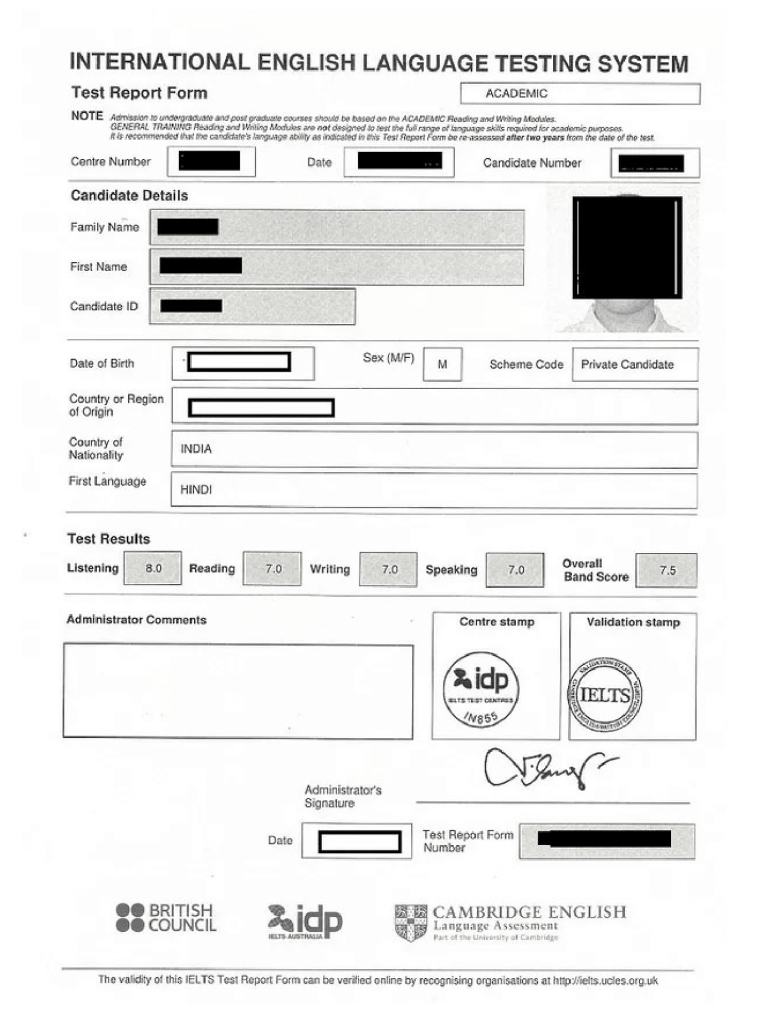
Example of IELTS TRF

Given that IELTS TRF is a very important document, it is essential to keep it safely. By using the  IELTS TRF verification service, institutions can examine candidates’ IELTS report forms.

The candidates’ IELTS TRF numbers, which are available in the bottom right corner of the form, will be needed.

Additionally, pupils should be aware that IELTS recommendation numbers andTRF Numbers are not the same.

A sample of IELTS TRF is shown in the image below. It encapsulates the following information:

  • Prospect Information: name, date of birth, and gender
  • IELTS Test Centre Numbers
  • Examination Outcomes: Listening, Reading, Speaking, and Writing, as well as the 
  • overall IELTS score
  • IELTS TRF Number

IELTS Test Record Form (TRF) Verification

As part of the assessment, all IELTS TRFs are validated using the online IELTS TRF verification website.

Access to this website allows organizations and institutes to ensure they receive authentic IELTS results.

Additionally, access to the  IELTS TRF verification service is only available to IELTS Recognizing Organizations (ROs).

TRF vs TRF Number vs Reference Number

Term

Meaning

Where to Find

Purpose

TRF (Test Report Form)

Official IELTS score sheet

Given by IELTS test centre / e-TRF online

Shows your IELTS band scores

TRF Number

15–18 digit unique ID on TRF

Bottom-right corner of TRF

Score verification and submission to universities/immigration

IELTS Reference Number

Number given during registration

Test confirmation email / IELTS portal

Used to log in, check results, and manage test details

Where to Find Your IELTS TRF Number

Your IELTS TRF Number is clearly printed on your official Test Report Form (TRF).
You can locate it in the following places:

  • Physical TRF: Bottom-right corner of the score sheet
  • Digital / e-TRF: Displayed at the top of the digital score report

The TRF number is a 15–18 character alphanumeric code used for official score verification, university applications, visa processes, and online result authentication.

If you are unable to locate your TRF number or have lost your TRF, contact your IELTS test centre or log into your IELTS candidate portal for support or re-issuance options.

ATRF, or Additional Test Report Form

The first five digital Additional Test Report Forms (ATRF) are processed for free and can be requested within one month from the test date.

Candidates will be charged a nominal fee of Rs 250 for any additional TRF reporting per college or university after the initial five.

The TRFs can be sent to the institutions listed in the application via email, regular post, courier services, or international shipping. Additional surcharges may apply for courier services and overseas delivery.

How to Send Your TRF to Institutions

Within one month following the test day, test takers may request five TRF submissions to colleges and institutions. Distribution of the TRFs to recognized organizations is managed by the coordinators of the IELTS assessment.

The TRFs are sent to the academic institutions listed in the application via email, regular mail, courier, or international postage. Candidates can request digital score reporting to a maximum of five institutions per month. An additional fee of Rs 250 per institute applies for any TRF submissions beyond the first five.

Initial copies of TRFs are not required for international schools or employers that already have online access to IELTS TRF records.

Candidates can also access their TRF online by logging into their registration account. The IELTS TRF number, a 15–18 digit identifier located at the bottom right corner of the TRF, is required for verification and submission purposes.

Lost Your TRF Number? Here’s What to Do

If you have lost your IELTS TRF or forgotten your TRF number, follow these steps to recover it:

  1. Log in to your IELTS Candidate Portal
    Your digital Test Report Form (e-TRF) and TRF number are usually available in your online IELTS account. Check under the “Results” or “Downloads” section.
  2. Contact Your IELTS Test Centre (IDP or British Council)
    Reach out to the test centre where you took the exam. They can verify your identity and help you retrieve details or issue a replacement TRF if needed.
  3. Provide Identity Documents for Verification
    Be prepared to share:
    • Passport / ID used during registration
    • IELTS registration number or confirmation email
    • Test date and centre details

This verification step ensures privacy and prevents misuse of your personal information.

Important: IELTS centres do not disclose TRF numbers over email or phone without proper ID verification, as a security measure to protect your results.

If your physical TRF is lost, you may also request additional TRF copies to be sent directly to institutions such as universities, immigration departments, or professional bodies.

Tracking IELTS TRF

On the thirteenth day after the exam, applicants who registered for the paper-based IELTS test receive the TRF along with their IELTS score.

On the other hand, candidates for the computer-based test obtain their IELTS TRF 3 to 5 days after the examination.

After the results are announced, they can verify their IELTS TRF online, by text, by mail, or in person at a centre. To obtain TRFs from the testing centre, they must present the identifying documentation that was used upon enrolling.

Now get your PTE, IELTS & NAATI Online Coaching in just 4 easy installments through AfterPay. You can check out our Unlimited Combo Pricing Packages.

You can check out the free PTE practice material: https://oneaustraliagroup.com/practice-material/

Contact us today to get a 25 AUD coupon free.

FAQs About IELTS TRF

Q1. What does TRF stand for in IELTS?

TRF stands for Test Report Form in IELTS (TRF Full Form in IELTS), the official document showing your IELTS scores.

Q2. Where can I find my IELTS TRF Number?

Your TRF Number is a unique 15–18 digit code located at the bottom right corner of your TRF. It is required for online verification and submission to institutions.

Q3. How long is the IELTS TRF valid?

A TRF is valid for 2 years from the test date and can be used for admissions, employment, or visa purposes.

Q4. Can I request extra copies of my TRF? 

Yes, the first five additional TRFs are free within one month of the test date. Any extra copies requested beyond that will incur a fee per institution.

Q5. How can institutions verify my IELTS TRF online?

Institutions can verify your TRF using the official IELTS TRF verification portal. They will need your TRF Number to confirm the authenticity of your IELTS results.

Q6.Do Academic and General Training IELTS tests have different TRF numbers?

Yes. Both Academic and General Training test-takers receive a TRF with a unique TRF number. While the TRF numbers look similar in format, the internal coding within the number may vary to reflect your test type, test centre, and test session details. However, the overall purpose of the TRF number remains the same  to verify your IELTS results.

Q7.Is the TRF number the same as the IELTS reference number?

No. The TRF number is printed on your official IELTS score sheet and used to verify your results.
The IELTS reference number is issued during registration and is used to log in and access your exam details.

Q8.How many digits does the TRF number have?

The TRF number typically contains 15–18 characters, depending on the test centre and whether you took a paper-based or computer-based IELTS test.

Q9.Can I request a new TRF if I lose mine?

You cannot receive a second personal copy, but you can request additional TRF copies to be sent directly to universities or immigration bodies. Contact your test centre for this service.

Q10.What information does the IELTS TRF number help verify?

The TRF number allows universities, immigration authorities, and employers to securely verify your IELTS scores and confirm that the results belong to you.

Table of Contents