
Summarize Written Text-PTE Writing

TL;DR:
- This blog targets PTE Academic aspirants who want to excel in the Summarize Written Text task by understanding templates, examples, scoring criteria, and common mistakes for effective preparation.
- In the PTE Summarize Written Text task, candidates are given a passage and must write a concise, one-sentence summary within 10 minutes, capturing the main idea and key supporting details.
- Using PTE Summarize Written Text templates and practicing with high-scoring examples help candidates structure their summaries correctly, use complex/compound sentences, and maintain accuracy in grammar, spelling, and vocabulary.
- Summaries are evaluated based on content accuracy, correct word count (5–75 words), grammar, sentence structure, and relevant vocabulary. Misrepresentation of the passage or exceeding word limits results in losing points.
- Avoid writing over 75 words or under 5 words, missing key points, using simple sentences, and ignoring grammar, spelling, and plural rules. Regular practice with mock tests and examples improves performance.
Introduction
The PTE Summarize Written Text task is an important component of the PTE Academic Writing section. In this task, you are given a passage of text and are required to write a concise, one-sentence summary that captures the passage’s main idea along with its key supporting details. You have 10 minutes to complete the task.
Mastering this task is crucial for achieving a high PTE score, and familiarizing yourself with summarize written text examples, templates, and the word limit for summarize written text in PTE can make your preparation more effective and focused.
Know more about PTE Summarize Written Text
Summarize Written Text – PTE Writing
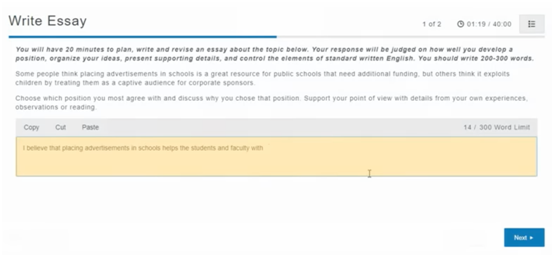
You will be shown a passage of text, and you have to read that passage and write a short summary of it. This summary must be one sentence, following the PTE Summarize Written Text template. You will be given 10 minutes to write your summary in the PTE Summarize Written Text task.
The word counter at the bottom of the screen keeps track of how many words you’ve typed. You can also use the cut, copy, and paste options to help you create your summary. Practicing with summarize written text examples and templates can help you perform better in this task.
Tips for Summarize Written Text
- It is important that you give your response exactly in the required structure. Your summary must be just one sentence. Keep an eye on the word count, as your response should not exceed 75 words.
- It is best to use a summarize written text template when practicing so you know exactly what is required for the PTE Summarize Written Text task.
- Pay attention to spelling, grammar, and plurals, as accuracy is crucial for scoring well. Practice using summarize written text templates and structures available online to improve your writing skills. Also, review summarize written text examples that have previously scored well in the PTE, and try to write in a similar style.
- Practice using summarize written text templates and structures available online to improve your writing skills. Also, review summarize written text examples that have previously scored well in the PTE, and try to write in a similar style.
Use complex and compound sentence structures to summarize the passage’s main meaning while including any highlighted supporting details. For example, well-written summaries often use conjunctions and clauses to connect ideas effectively.
How to Write Summarize Written Text (Step-by-Step)
Follow the steps below to write an accurate and high-scoring PTE Summarize Written Text response.
1. Skim the passage (10–15 seconds)
Begin by skimming the passage quickly to understand the general topic and context. Do not try to read every word at this stage. The goal is to grasp the subject and tone of the text.
2. Identify the main idea
Locate the main idea, which is usually presented in the first one or two sentences. This is the central message or argument that the author is trying to convey.
3. Identify 2–3 key supporting points
Scan the passage to find two to three important supporting ideas that explain or reinforce the main idea. Avoid focusing on minor examples or unnecessary details.
4. Select 6–7 important keywords
Pick essential keywords and phrases from the passage. These should reflect key concepts, academic terms, or subject-specific vocabulary. Using relevant keywords improves content recognition and relevance scoring.
5. Combine the main idea and key points into one sentence
Create one clear, meaningful sentence that integrates the main idea and supporting points. Ensure your sentence follows logical structure and maintains the original meaning of the passage.
6. Use appropriate conjunctions
Connect the ideas smoothly using conjunctions such as:
and, while, as, because, although, moreover, however, therefore
These help create a complex or compound sentence, which improves grammar and structure scores.
7. Maintain the one-sentence rule
Your response must be written as a single sentence with only one full stop. Additional periods will break the sentence and lead to score deductions.
8. Stay within the word limit
Ensure your summary is within the required word count:
- PTE Academic: 5 to 75 words
- PTE Core: 25 to 50 words
Exceeding or falling short of the word limit will result in reduced marks.
9. Proofread your response
Quickly review your sentence to check for grammar mistakes, spelling errors, punctuation issues, and sentence clarity. The sentence should read smoothly and accurately reflect the passage.
Summarize Written Text Word Limit
In the PTE Academic exam, the summarize written text word limit requires candidates to write their response in one single sentence between 5 and 75 words. Your summary must clearly capture the main idea of the passage without adding personal opinions or extra details.
Staying within the summarize written text word limit is very important, as writing fewer than 5 words or more than 75 words will affect your score. Proper grammar, punctuation, and sentence structure also play a key role in achieving a high score in this task.
Summarize Written Text Templates for PTE
Using a summarize written text template helps you structure your sentence correctly and ensures that all key points from the passage are included. Practicing with templates can make your PTE Summarize Written Text task easier and improve your accuracy.
Template 1: “The passage discusses [main idea] and highlights [supporting detail], emphasizing [conclusion/impact].”
Template 2: “According to the passage, [main idea], while [supporting detail] illustrates [impact].”
Tip: Combine these templates with summarize written text examples to practice writing high-scoring responses for the PTE.
PTE Academic vs PTE Core – Summary Rules
The Summarize Written Text task exists in both PTE Academic and PTE Core, but the expectations and word limits differ slightly. The table below highlights the key differences:
| Feature | PTE Academic | PTE Core |
| Task | Summarize Written Text | Summarize Written Text |
| Word Limit | 5–75 words | 25–50 words |
| Sentence Count | One sentence only | One sentence only |
| Punctuation | Only one full stop allowed | Only one full stop allowed |
| Skill Focus | Grammar, cohesion, and clarity | Grammar, conciseness, and relevance |
| Recommended Approach | Use linking words to connect ideas smoothly | Avoid unnecessary words and keep the sentence concise |
Examples of Summarize Written Text Responses
Good Example:
“The passage explains the importance of renewable energy and provides examples of solar and wind power as sustainable alternatives.”
Poor Example:
“Renewable energy is good for environment.”
Tip: Study high-scoring summarize written text examples to understand how to structure sentences effectively. Practice writing your own summaries using summarize written text templates to improve your performance in the PTE Summarize Written Text task.
Scoring – PTE Summarize Written Text
Content
Responses in the PTE Summarize Written Text task will be graded by analysing whether all of the passage’s essential points have been addressed without changing the passage’s aim or topic. If what you provide as a response represents the topic incorrectly, you will lose all points for the summary. The best summary will be able to highlight the most important part of the passage and also include any supporting details of the text, while staying within the required summarize written text word limit.
Form
You will receive no points if your response in the summarize written text task is under the minimum of 5 words or beyond the maximum of 75 words. Following the official summarize written text word limit is mandatory for scoring.
Grammar
Grammar is graded by analysing if the sentence’s basic structure is correct. A major clause as well as a subordinate clause are generally seen in the best responses in PTE Summarize Written Text, provided they remain within the specified summarize written text word limit.
Vocabulary
Vocabulary is scored if it is considered to be relevant and appropriate to the passage available in the summarize written text task, and it must be used effectively within the given summarize written text word limit.
Common Mistakes to Avoid in PTE Summarize Written Text
- Writing a response that exceeds 75 words or is below 5 words.
- Missing key points or misrepresenting the passage’s main idea.
- Using simple sentences instead of complex or compound sentence structures.
Ignoring spelling, grammar, and plural rules in your summary.
Notes for PTE Summarize Written Text
- The summary you provide will be evaluated as correct or incorrect based on how accurately it responds to the passage.
- Speaking and listening skills are not scored in this task.
- To improve your performance, practice using PTE Summarize Written Text mock tests, practice questions, and online practice tests. You can access these resources here.
FAQs – PTE Summarize Written Text
1.What is the PTE Summarize Written Text task?
The Summarize Written Text task requires you to read a passage and write a single sentence that captures the main idea and key supporting points. The summary must stay within the required word limit and accurately reflect the author’s message without adding personal opinions.
2.How many words should a PTE summarize written text response have?
For PTE Academic, the summary must be between 5 and 75 words, while PTE Core requires 25 to 50 words. Staying within the word limit is essential for scoring.
3.Are there any templates for PTE Summarize Written Text?
Yes, using a summarize written text template or PTE summarize written text template helps you structure your summary correctly and ensures all key points are included.
4.Can I use examples to practice PTE Summarize Written Text?
Yes, reviewing high-scoring summarize written text examples helps you understand effective sentence structures, complex/compound sentences, and relevant vocabulary usage.
5.What are the common mistakes in the Summarize Written Text task?
Common mistakes include exceeding the summarize written text PTE word limit, missing key points, using simple sentences instead of complex or compound structures, and making grammatical errors.
6.Can I write more than one sentence in Summarize Written Text?
No. You must write only one sentence. Using more than one full stop or creating multiple sentences will result in losing points for form.
7.How do I choose the main idea for the PTE summary?
Identify the central theme by reading the first one or two sentences, then confirm it by noticing repeated concepts or key phrases throughout the passage. Focus on the author’s overall argument or conclusion.
8. Should I use examples in the PTE summary?
No. You should not include examples or detailed supporting information. Instead, highlight the core idea and two to three important supporting points without unnecessary details.
9.How can I improve my score in Summarize Written Text?
Practice identifying the main idea quickly, develop the ability to form complex sentences with conjunctions, and review high-scoring examples. Also ensure correct spelling, grammar, and punctuation.
10.How much time do I get for Summarize Written Text?
You are given 10 minutes per question in the Summarize Written Text task. Use this time to read, plan, write, and quickly proofread your response.